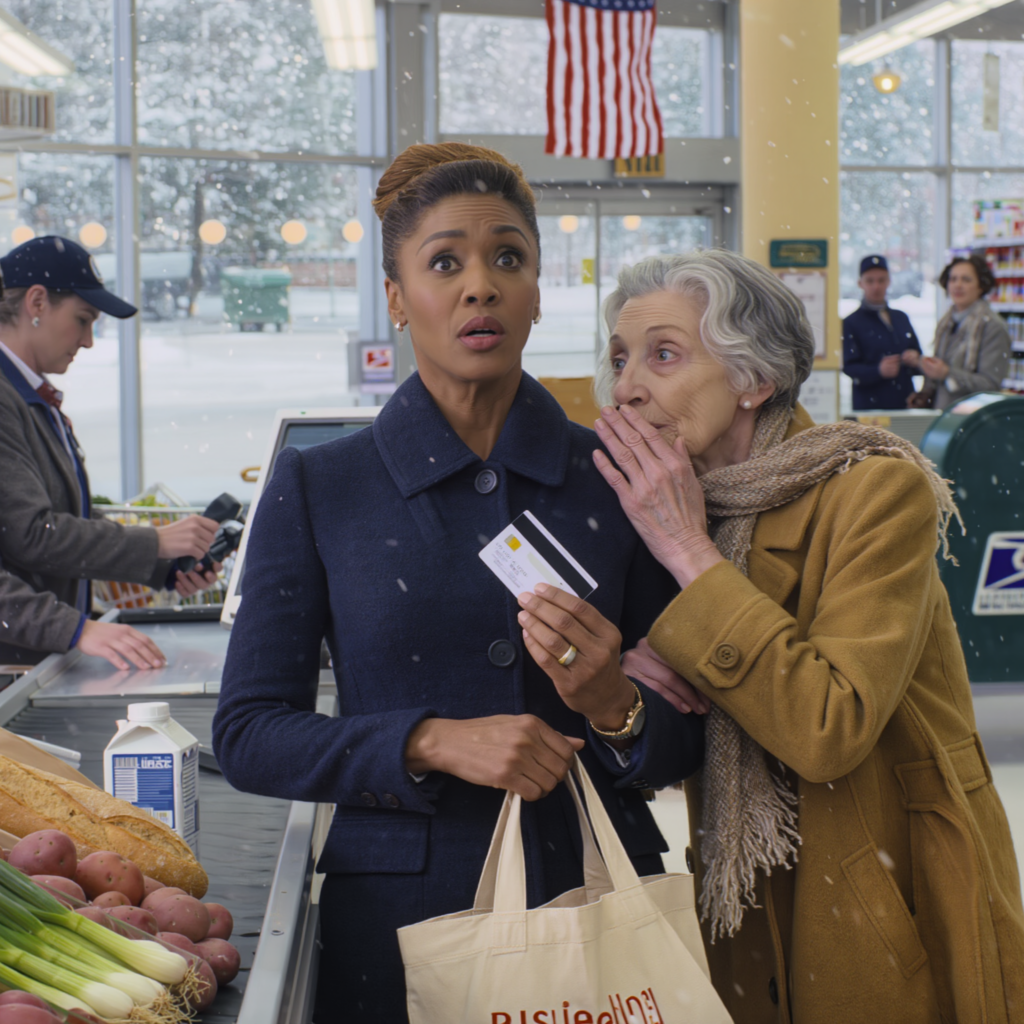
After paying for the elderly woman’s groceries at the store, she whispered quietly to me, “When your husband leaves, do not touch the snow in the yard.” I laughed it off, but decided to listen and didn’t shovel the driveway. And when I stepped out onto the porch the next morning, I was stunned by what I saw.
I was standing in line at the checkout of our local grocery store, clutching my worn-out tote bag to my chest. Outside the windows, a blizzard was sweeping through the streets—December had turned out to be especially snowy this year.
Fifty-eight is the age when you stop sprinting through supermarkets hunting for sales and start going to the familiar place near your house, where the clerks know you by name.
Ahead of me, right at the register, a hunched-over elderly woman in a faded shawl was fumbling around. She poured loose change onto the counter from a tattered wallet, counting the coins with trembling fingers.
On the belt lay the most modest of purchases: a loaf of bread, a carton of milk, three potatoes, and a small onion.
“Ma’am, you’re short,” the cashier—a young woman named Candace with tired eyes—said wearily. “You’re short about a dollar.”
“How can that be, baby?” the old woman muttered in confusion, sorting through the coins again. “I counted at home. I counted everything.”
Behind me, someone sighed in annoyance. The line was growing, and people were in a hurry to get home out of the bad weather.
I looked at the shrunken figure of the old woman, at her hands red from the cold, at her cheap groceries, and something tugged inside me. How many times had I walked past someone else’s grief, pretending not to notice? How many times had I turned away so I wouldn’t have to see someone else’s need?
But today, something made me step forward.
“Candace, ring it up with mine,” I said, handing a twenty-dollar bill over the old woman’s shoulder. “I’ll pay for it.”
“Oh, honey—really—you don’t have to,” the old woman said, flustered, turning around. “I’ll just put something back.”
“Don’t worry about it, ma’am.” I smiled warmly. “It’s nothing, not even worth mentioning.”
The old woman raised her eyes to me, and I involuntarily shuddered at her strange, piercing gaze. Her eyes were not old at all. They were clear, deep, as if they saw right through me—straight into my soul.
She was small and fragile, her face furrowed with deep wrinkles, but in those eyes shone some unusual power, an ancient wisdom.
“Thank you, daughter.” The old woman scooped her purchases into a worn plaid bag, and her voice trembled with gratitude. “Your kindness will not be forgotten. It will come back to you.”
I shrugged, paying for my own groceries: chicken for a stew, vegetables, bread, a couple of cans of goods. Vernon was leaving this evening for another long-haul run—for a week, maybe ten days.
I had to cook for him for the road and also stock up on everything necessary for myself while he was away. Thirty-two years married, and all that time I had seen him off on trips, waited for his return, cooked, washed, cleaned.
Life flowed in a well-worn groove—monotonous, predictable.
I had already picked up my bags, intending to leave, when I felt an unexpectedly strong grip on the sleeve of my old coat. The old woman stood beside me, clutching the fabric with her wiry fingers with such force that I couldn’t immediately pull away.
“Listen to me carefully, daughter,” she whispered, leaning in so close I could feel her breath.
The old woman smelled of mothballs, dried herbs, and something else—elusive and ancient.
“When your husband leaves for the night, do not touch the snow in the yard. Do you hear me? No matter what he tells you, don’t shovel until morning. Let the white lie lie untouched.”
“What?” I blinked in confusion, trying to understand the meaning of these strange words. “What snow?”
“Don’t touch the snow until morning,” the old woman repeated slowly, distinctly, as if hammering every word into my consciousness.
Her fingers gripped my sleeve even tighter, almost to the point of pain.
“Promise me. This is very important. Your life depends on it. Believe an old woman.”
“Yes.”
“Okay. Okay,” I agreed mechanically, freeing my arm and involuntarily stepping back.
My heart beat anxiously. I felt uneasy from that intense, almost hypnotic gaze.
“I won’t shovel. I promise.”
The old woman finally let me go, nodded slowly—as if satisfied with the promise—and then, quickly, surprisingly agile for her age, walked out of the store, dissolving into the snowy whirl beyond the glass doors.
I watched her go, then shook my head, chasing away the strange sensation. The poor old woman must not be all there.
I felt sorry for old folks—lonely, poor, living in their own world of fantasies and superstitions. Maybe from need and loneliness, the mind gets confused, and so she spits out nonsense about snow and husbands.
Outside, I was immediately blasted by a snowy vortex. Icy flakes plastered my face. I shivered, wrapped myself deeper into my old scarf, and walked quickly to the bus stop, where a small group of chilled people had already gathered.
Vernon and I lived on the outskirts of the city in a quiet suburb where the houses stood on large lots. The house had belonged to my parents, a sturdy old place with thick walls, built back in the seventies.
I had been the mistress of it for many years. I had revived the once-neglected garden, planted apple trees that now gave a harvest every summer, and cultivated flower beds—roses near the porch, peonies along the walkway.
Thirty-two years married, and for the greater part of them—almost thirty years—we had lived in this very house, which was home to me.
The bus was stuffy, crowded, and smelled of wet wool. I squeezed to the window, leaned my forehead against the cold glass, and remembered the words of the strange old woman again.
Don’t touch the snow.
What sort of eccentricity was that?
Honestly, just this morning, while hurriedly eating breakfast before heading out, Vernon had grumbled that the driveway absolutely needed to be cleared—that the drifts were piling up high and the walkways were completely covered.
He ordered me to take care of it by evening so the paths would be clear. Otherwise, he said, he couldn’t turn the car around.
And here’s some strange, senile lady whispering weird things about snow.
A stupid coincidence. Nothing more.
The house met me with dark, empty windows, and cold. Vernon had gone to the depot in the morning to prep the truck for the haul and hadn’t turned up the heat.
I went in, shook the snow off my boots onto the mat, took off my wet coat, walked across the cold floor to the kitchen, turned up the thermostat, put the kettle on the stove, unpacked the groceries, and neatly put everything in its place.
Vegetables in the pantry, chicken in the fridge, bread in the box—every movement habitual, practiced over years.
The house gradually warmed up. The baseboards creaked cozily as the heat rose, and the kettle began to whistle.
Vernon was supposed to return by six in the evening to pick up his things and food for the road.
I began to cook with the same method as always. I cleaned and cut the chicken, put it on to boil for a rich broth, chopped vegetables for the salad Vernon liked to take with him, and took out the meatloaf from the freezer, which I’d prepared a week ago—especially for his trip.
He preferred home-cooked food to roadside diners. He said there was nothing but chemicals and dirt there.
At exactly six, the front door slammed, and the cold burst into the house along with Vernon. He walked in with a heavy tread, shaking snow from his jacket right onto the floor, paying no attention to the puddles.
Tall, broad-shouldered, with a weathered, hard face and cold gray eyes—fifty-nine years old, but still solid and strong despite a quarter of a century behind the wheel of an eighteen-wheeler.
Twenty-five years of roads. Thousands and thousands of miles across the country.
“Well, is everything ready?” he asked instead of a greeting, not even looking at his wife as he walked straight into the kitchen.
“Yes, Vern. I’m packing it now.”
I had already taken out the prepared containers and began neatly arranging the cooled soup, meatloaf, salad, and cornbread.
Vernon sat at the table, poured himself tea from the old ceramic pot, added three spoons of sugar, and stayed silent—staring at his phone screen, typing something quickly, never once looking at me.
I stole a glance at him, at the profile I knew down to the smallest detail.
When had this begun—this alienation, this wall of ice between us? A year ago? Two? Maybe five, or ten, before.
In the early years, he would return from trips tired but happy, hug me at the threshold, tell me about the road and the people he met, joke and laugh.
And now—only silence, only irritation in every movement, in every glance, as if I were not a wife but a tiresome servant.
“Clean the snow this evening once it gets dark,” Vernon threw out, not looking up from his phone. “The driveway is completely buried. It might drift even more tomorrow.”
“Vernon, it’s already almost dark. The blizzard is bad,” I started, but cut myself off when I saw him raise a cold gaze to me.
“I said this evening,” he cut in sharply. “You’re not a child. You can handle it in half an hour. I don’t have time. The haul starts early tomorrow morning. The cargo is important.”
I pressed my lips together, continuing to silently pack the containers into the large travel bag.
The old woman’s words came to mind.
When your husband leaves for the night, do not touch the snow.
A coincidence—strange to the point of impossibility.
Although what sort of coincidence, really? It’s winter, after all. You have to shovel snow every week, or even more often in weather like this.
“When exactly are you leaving?” I asked quietly.
“In about an hour. The load is already packed and sealed. The paperwork is all ready and signed.”
Vernon finished his cooled tea in one big gulp and stood up heavily.
“I’m going to take a shower, grab my things, and head out.”
He went upstairs to the bedroom.
I remained in the kitchen alone, slowly eating the cooled soup I’d made that morning. Outside the window, the wind howled, and snow fell ceaselessly in large flakes.
I walked to the window, pulled back the curtain, and looked out into the yard. The single streetlamp by the gate barely pierced the thick snowy veil, illuminating the swirling snowflakes.
The path to the gate was indeed almost completely buried. The white drift reached almost to the knee.
About forty minutes later, Vernon came down already dressed in his road clothes, with his heavy duffel bag on his shoulder.
I handed him the bag of food wrapped in several layers.
“Will you call when you get there?” I asked, knowing he usually did not call, but asking out of habit anyway.
“Yeah,” he threw back shortly, taking the bag.
He didn’t even look me in the eye. He didn’t kiss me goodbye like he always used to—just gave a short nod.
“Look, make sure you shovel the snow, you hear? Or it’ll drift up again overnight, and you won’t be able to get out in the morning.”
The door slammed with a dull thud.
I heard his old pickup truck start up and roll down the snowy street. The sound of the engine gradually faded into the distance.
I sat at the kitchen table, wrapping my hands around a cup of cold tea.
It became quiet—empty—and somehow anxious in my soul, though I didn’t know why.
The old woman’s words surfaced in my memory again, clear and persistent.
Don’t touch the snow.
I shook my head, trying to chase these thoughts away.
Foolishness. Old folk superstition.
But something held me back from dressing warmly and going out to shovel the yard as Vernon had ordered.
Fatigue crashed down all at once like a sack of sand on my shoulders. The day had been long and exhausting.
My legs buzzed, my back ached from housework, and the blizzard was raging so hard that everything would just be covered again by morning anyway.
What was the point of suffering now?
Decided.
I would not go out into this bitter freeze to drag a shovel around. I would deal with it in the morning if it was really necessary.
Vernon was already far away. He wouldn’t see, wouldn’t know, and if anything I would blame the blizzard—say it was pointless to clean in such weather.
I went upstairs to the bedroom, changed into an old warm nightgown and a soft robe, and lay down on the bed with a tattered book I’d started reading a week ago.
But I couldn’t read.
The letters swam before my eyes, my thoughts tangled—returning again and again to the strange meeting in the store.
Who was that mysterious old woman? Why did she say exactly that—about the snow, about the yard? And why did she look so persistently, so seriously, so piercingly into my eyes, as if warning of something terrible and inevitable?
Outside the window, the wind continued to howl. The house creaked under strong gusts.
I got up, walked to the bedroom window, and looked out.
The yard was drowning in pitch darkness. Only the weak yellowish light of the single lamp by the gate snatched thick swirling snowflakes from the gloom.
The path had completely disappeared under a thick white blanket. The gate, the porch, the rose bushes—everything was buried beyond recognition.
A strange, anxious feeling seized me, tightening my chest, as if something absolutely had to happen this night.
Something important. Fateful. Something that could not be brushed aside.
I returned to the bed and lay down, pulling the warm blanket up to my chin.
I didn’t want to sleep at all, despite the fatigue. I lay there listening to the howling winter wind outside the window and simply could not get rid of the growing anxiety squeezing my heart.
The old clock on the nightstand ticked monotonously, showing eleven at night.
Vernon was probably already far away from here, speeding along the snowy night highway, listening to the radio, drinking strong coffee from a thermos, thinking about his own things.
What did he even think about lately?
We had barely spoken in recent months—years.
He would come home silently, sleep off the road, eat something without looking, pack up again, and leave.
We lived like complete strangers under one roof, connected only by a marriage license.
When exactly had this happened?
I sorted through the memories of the last years of our life together. Maybe it all started after we realized we could not have children.
But that was so long ago—at the very beginning of our marriage, more than thirty years back.
Back then, Vernon seemed to comfort me. He said the right words: that we would live well, just the two of us; that happiness wasn’t only in children.
Or maybe it was my serious illness three years ago—the surgery, the long, painful recovery.
Vernon had become especially distant then, cold, as if I had become a burden to him, or he was simply tired of me—of our monotonous life, of this old house, of my aging face, of everything.
I closed my eyes, trying to chase away the heavy, pressing thoughts.
Tomorrow would be a new day.
Maybe all of this just seemed this way because of exhaustion and loneliness—winter blues.
That’s all.
I needed to pull myself together, do something useful.
When Vernon returned in a week, I would cook something special—something delicious. We would sit down and talk normally, heart to heart.
We hadn’t really talked in a long time.
Sleep came in snatches—restless and anxious. I would fall into a fitful doze, then wake sharply from especially strong gusts of wind, from the creaking of window frames.
I dreamed of that old woman from the store—her piercing, all-seeing eyes, her dry gripping fingers on my sleeve.
“Don’t touch the snow,” she repeated in the dream again and again, like a spell.
I woke up early, still completely dark. I looked with sleepy eyes at the clock: the beginning of six in the morning.
Outside the window, it was just starting to lighten a tiny bit.
The blizzard had finally stopped completely.
The silence was somehow special—dense, ringing.
I got up, threw a warm knitted robe over my shoulders, went down to the kitchen, mechanically put the kettle on the stove, lit the burner, walked to the window… and froze, not believing my eyes.
The yard was entirely covered in untouched, smooth snow—absolutely white.
But from the gate to the house, to the windows of the first floor, led clear, very deep footprints.
Men’s footprints from heavy, large boots.
Definitely not Vernon’s.
I knew his shoes—his size, his walk—perfectly.
These were completely strange tracks.
Someone had come to our house at night—walked around the yard, come close to the windows—while I remained completely alone.
I stood by the window, clutching the windowsill with whitened fingers.
My heart pounded so hard and fast it felt like it was about to jump out of my chest.
I couldn’t tear my gaze away from the tracks, trying to understand, to comprehend what was happening.
Deep, clear prints of heavy boots led from the gate straight to the house, methodically circling it on two sides, stopping at every window of the ground floor as if someone were carefully studying the house.
Someone had walked around my house at night while I slept—alone, defenseless.
My hands trembled slightly. I stepped back from the window, pressing my palm to my mouth to hold back a frightened sob, fighting to breathe.
Breathing became difficult.
I needed to calm down, pull myself together, think clearly.
Maybe it was neighbors for some reason.
No. Impossible.
The neighbors on the left—the elderly Petersons—were both over seventy. Such deep, heavy tracks were definitely not theirs.
The lot on the right had been empty for a year. The owners had moved to the city long ago. The house was closed up.
Across the street lived only Mrs. Higgins.
But why would an elderly woman walk around a stranger’s yard in a blizzard at night?
I forced myself to walk closer to the glass, peering at the tracks more carefully.
They didn’t go chaotically—not disorderly—but very purposefully, thoughtfully: from the gate straight to the living room windows, then neatly along the wall to the kitchen windows, further to the back of the house where the pantry and the basement entrance were.
As if someone were methodically walking the perimeter, carefully looking into every window—studying something, watching, checking.
A cold chill ran down my spine.
Goosebumps covered my skin.
Burglars—preparing, looking for what to steal.
But they took nothing. They didn’t even try to break in.
The gate was closed on a simple latch. The lock was intact and unharmed.
The tracks led only from the gate into the yard and back.
That meant the person somehow opened it, walked through calmly, circled the house, then just as calmly closed the gate and left—without rushing.
The kettle on the stove whistled piercingly, and I shuddered from head to toe at the sudden sharp sound.
I turned off the gas with a trembling hand, but didn’t even think about brewing tea.
I had to do something urgently—make a decision, call the police.
But what exactly would I say?
That at night, someone strange walked around the yard… but stole absolutely nothing, broke nothing, smashed nothing.
I remembered our community officer, Gareth Pernell. I had known him for many years—ever since he came to work in this precinct as a very young man.
Now he was over fifty, but he still worked diligently.
He was known as a conscientious, responsive man you could turn to.
I could definitely call him.
I quickly went up to the bedroom, dressed hurriedly—pulling on whatever came to hand: warm sweatpants, a thick wool sweater—swapped my slippers for warm winter boots.
I took out my cell phone and found the officer’s number in my old contacts.
My fingers were still trembling nastily as I dialed.
“Officer Pernell, this is Vance from Chestnut Street, House 17. Please excuse me for calling so early, but I have a very strange situation here.”
“Good morning, Mrs. Vance.” The officer’s familiar, calm, slightly raspy voice came through. “What happened?”
“Last night, someone came to my house. They walked around the yard, left tracks in the snow. I was home alone. My husband left for a long haul and I’m very—”
“I see. Did anything go missing? Did they break the door? Are the windows intact?”
“No. Everything seems whole and in place, but the tracks… they lead right up to the windows from all sides, as if someone was purposely peeking inside or looking for something specific.”
Gareth Pernell was silent for a few seconds on the other end of the line, thinking.
“All right. I’ll come over right now. Twenty, thirty minutes max. Don’t go out of the house for now. Don’t trample the tracks under any circumstances, and check all windows and doors thoroughly. Make sure everything is securely locked.”
“Thank you so much,” I exhaled with relief. “I’ll wait for you.”
I put the phone on the table and immediately began checking the house.
I looked around with new, wary attention. The house now seemed foreign—hostile, unsafe.
Every familiar creak of the floorboards, every rustle outside the window, made me flinch nervously and look around.
I methodically walked through all the rooms on the first floor, carefully checking the windows. All were tightly closed with latches.
Nowhere were there even the slightest signs of an attempted break-in.
The front door was locked with two turns of the key and the chain—exactly as I had left it the night before bed.
It seemed everything was in perfect order, but for some reason this did not calm me down at all.
On the contrary, it worried me even more.
I walked again—drawn by some magnet—to the kitchen window, peering at the tracks again.
Now, in the brighter morning light, they were visible even more clearly, even more frighteningly: very large, very deep.
The distance between steps was quite wide.
Definitely a man.
Tall, heavy, large build.
He walked leisurely—completely confidently, calmly.
He knew exactly what he was doing and why he came.
Twenty minutes dragged on excruciatingly, unbearably long—like hours.
I sat in the kitchen clutching a cup of completely cold tea in my trembling hands and literally could not take my tense gaze off the window.
What if this unknown person returned right now?
What if he was watching somewhere nearby, waiting for the right moment when I stepped out or got distracted?
Finally, bright headlights hit the window.
I jumped up from the chair and looked out at the recognizable cruiser of the officer.
Gareth Pernell got out of the car—a tall, heavyset African-American man a little over fifty, in a uniform winter jacket and a warm hat.
I practically ran to the door, threw it open before he could ring the bell.
“Officer Pernell, thank you so much for coming so quickly.”
“Oh, think nothing of it, Mrs. Vance. It’s my job.”
He deliberately shook the stuck snow off his heavy boots, walking after me into the kitchen.
His experienced gaze immediately caught the window—the view of the yard.
“Show me exactly where the tracks are.”
We went out together onto the cold porch. The frosty, prickly air painfully burned my flushed face and lungs.
Officer Pernell slowly, thoroughly descended the creaking wooden steps, carefully examining the snowy yard.
He walked right up to the tracks, carefully squatted down, examining each print for a long time.
“Boots. Size twelve, maybe even thirteen,” he muttered thoughtfully to himself, clearly estimating. “Deep tread sole looks like work boots or combat boots. Coming from the gate.”
He slowly traced the entire chain of tracks with an attentive gaze from beginning to end—straight to the living room windows, then methodically along the entire wall of the house to the back, then back the same way to the gate.
“Very strange.”
“Who could it even be?” I hugged myself tightly, wrapping up in the old jacket I’d hastily thrown over my shoulders, shivering—not only from the cold.
“That,” he said, rising heavily from his squat and brushing snow off his knees, “is indeed a very good and important question.”
He looked at me.
“Tell me, Mrs. Vance, do you have any serious conflicts with neighbors? Maybe someone took offense at something—holds a grudge.”
“No. What do you mean? We speak absolutely normally with all the neighbors. We live quietly, peacefully. We don’t bother anyone. We don’t quarrel with anyone.”
“And your husband—when exactly did he leave for his trip?”
“Yesterday evening around seven. He left for a long haul—at least for a week, maybe even longer.”
The officer slowly nodded, recording something intently in a small battered notebook.
“That means this person knew for sure that you remained in the house completely alone. Very interesting—and concerning.”
He studied the track path again.
“Opened the gate carefully, walked through calmly, then just as carefully closed the gate and left. Didn’t hurry at all. Behaved confidently.”
“Officer… what do you think he was doing here at all? Why come at night—walk around the house?”
“That’s exactly what we have to find out.”
He looked at me with a very serious, heavy gaze.
“There are several possible options. Maybe he was scoping out what exactly is valuable in the house—preparing for a robbery. Maybe he was checking thoroughly to see if anyone lives in the house—if it’s empty.”
Or maybe he significantly did not finish.
But I understood perfectly well without words.
Maybe this person was preparing for something much worse than a simple robbery—for an attack, for violence.
“Do any of your neighbors have security cameras installed?” Pernell asked in a businesslike manner, looking around at the neighboring houses.
I thought tensely.
“Mrs. Higgins across the street seems to have a camera. She installed a system last year after the Petersons’ garage got broken into.”
“Excellent. That can help a lot. Let’s go to her right now—ask to see the footage. Possibly the camera captured who exactly came, what car they arrived in.”
We quickly walked out the gate and crossed the empty, snowy road.
Mrs. Higgins’s house stood directly opposite—neat, well-kept, painted a pleasant light blue with nice wooden shutters.
I rang the doorbell at the gate.
About a minute and a half later, the front door swung open.
The hostess herself appeared on the porch—a plump, good-natured woman of about seventy in a bright floral housecoat, with gray hair neatly gathered in a small bun at the back of her head.
“Ara, honey, what happened? Is something wrong?” Mrs. Higgins squinted anxiously, looking with curiosity at the officer standing nearby.
“Mrs. Higgins, hello.” I swallowed. “Someone strange walked in my yard last night. There are clear tracks left in the snow. Officer Pernell came to sort it out. Can we look at the recording from your security camera? Maybe something important is visible on it.”
“Oh, Lord have mercy.” The neighbor threw up her hand sincerely. “Someone strange walked around at night and you were alone? Vernon is on a long haul? My God, how scary. Yes—come in quickly. Of course. Come in. We’ll definitely look.”
We walked inside the cozy house into a small but very clean and tidy living room, densely packed with old, sturdy furniture made of dark wood.
A modern flat-screen TV hung on the wall, and beneath it stood a black box for the video recorder, blinking green and red lights.
Mrs. Higgins fussed, a little confused, turned on the TV, fiddling for a long time with several remotes.
“Here. It seems to be working and showing. Officer Pernell, you figure out this technology yourself because I don’t understand it very well. My grandson set it up.”
The officer silently nodded, confidently took the remote control, and began quickly rewinding the recording.
I froze nearby, not tearing myself away from the screen—afraid to miss even a single thing.
On the black-and-white grainy recording, the street in front of Mrs. Higgins’s house was clearly visible. My own house opposite. The gate of my yard. Part of the yard itself.
“You say your husband left the house around seven in the evening?” Gareth clarified, not taking his eyes off the screen.
“Yes, around seven, maybe a little later.”
He rewound the recording to eight, set playback to normal speed.
The picture was not the best quality—grainy, black-and-white, blurred in places due to the falling snow.
But on the whole, it was quite possible to distinguish what was happening.
The street was completely empty, deserted. Snow fell in a thick veil—visibility very poor.
Time on the recording crawled slowly forward.
Nine p.m. Ten. Eleven.
“Here,” Pernell said suddenly. “Look closely—right here.”
He poked a thick finger intensely at the screen.
A few minutes to midnight.
On the deserted street, an unfamiliar car unexpectedly appeared—a regular dark sedan.
It slowly, leisurely drove up and neatly stopped right opposite my house.
A tall man in a dark bulky jacket and a knit cap pulled low over his forehead got out of the car leisurely.
It was absolutely impossible to make out a face on the recording.
He calmly looked around as if checking for witnesses, then confidently opened my gate and disappeared behind it, dissolving into the darkness.
“Lord have mercy,” I whispered, feeling my insides turn traitorously cold, my legs going weak.
About ten minutes later—maybe twelve—the man appeared in the frame again.
He walked out of my yard completely calmly, just as calmly closed the gate behind him on the latch, got into his car, and slowly, without rushing, drove away—disappearing around the bend.
“Pause,” Officer Pernell commanded, hitting the button.
He rewound a little and froze the image at the moment when the car was visible best.
“Here’s the license plate. Hard to see because of the snow and darkness, but I think we can try to make out a few numbers.”
He leaned closer.
“And here—on the side door of the car—that’s a logo. Some company writing.”
I squinted, staring intensely at the blurred fuzzy image on the screen.
On the side of the car, there was indeed something light painted—some large inscription, an emblem.
“Looks very much like a company car,” the officer muttered thoughtfully. “Definitely not a private owner. Some organization, a serious firm… or maybe it’s appraisers from a real estate agency.”
Mrs. Higgins suddenly piped up. She had been standing nearby this whole time, watching intently, pressing both hands to her ample chest.
“But from a realtor agency?”
I turned sharply to her, not understanding.
“What appraisers, Maria? Why appraisers at all?”
“Well, I don’t know exactly.” The neighbor hesitated, embarrassed. “Maybe someone is planning to sell the house. Doing an appraisal.”
She suddenly cut herself off mid-sentence when she saw my completely whitened, frozen face.
“Oh, Ara, forgive me. I’m an old fool. Probably said something stupid.”
But Officer Pernell was already alert like an experienced hound.
“Mrs. Higgins, why did you think of a real estate agency immediately?”
“Well… just an association,” she said softly. “Just last month, an appraiser from an agency came to me when I was looking at buying my daughter’s apartment in the city. So, he also arrived late in the evening—had no time during the day—in exactly the same kind of company car, with a big bright agency logo on the door. It just seemed very similar to me.”
The officer magnified the image of the car even more, as much as the recording quality allowed.
The writing on the side door was hard to read due to distance and darkness—blurred—but the first word could still be distinguished.
It seemed to be Hearth.
“Hearth… something else,” he said under his breath.
He quickly wrote it down in his notebook.
“We definitely need to check all the real estate agencies in our city and county—urgently. Find out who exactly has company cars with similar markings.”
I was silent, finding no words.
One insane, simply incredible thought was spinning in my head, making me feel sick.
An appraiser from a real estate agency came to inspect my house at night.
But who could have called this appraiser?
The house was titled strictly to me—entirely in my name.
I had never given anyone any permissions, any power of attorney.
I wasn’t planning to sell anything at all.
This was my only home.
“Mrs. Vance.” Gareth Pernell gently but firmly placed a heavy hand on my shoulder. “Did you, by chance, give anyone an official notarized power of attorney for your house—for a sale, for signing any documents, deals?”
“No. Of course not.” I shook my head resolutely. “I didn’t even think about any sale. This is my home. I’ve lived here my whole life.”
“And your husband—Vernon—could he?”
I felt the ground go out from under my feet.
I froze.
“Vernon… but he can’t do anything at all without my knowledge and consent. The house is fully titled strictly to me—in my name.”
“Theoretically, he really can’t—and shouldn’t,” the officer agreed slowly. “But in practice, unfortunately, all sorts of unpleasant situations happen. Fraud. Forgery of signatures and documents.”
He looked at me.
“Let’s definitely check the real estate agencies in all districts. If it really was an appraiser from some agency, we will find out thoroughly who exactly ordered this night assessment of your house.”
By lunchtime, we were sitting in the office of Hearthstone Realty in the city center.
Gareth Pernell had found three agencies with similar logos in the vehicle database and called them.
And in the third one, they confirmed:
Yes.
Their appraiser went out to Chestnut Street the previous evening.
The agency director, Isaac Graves—a man of about forty in an expensive suit—met us with a faint politeness that poorly concealed his nervousness.
“Please, have a seat.” He pointed to the leather chairs in front of the desk. “How can I help?”
“Yesterday, your employee went to the address 17 Chestnut Street,” Pernell began, taking out his badge. “Appraised a house. We would like to know the details.”
“Chestnut 17.” Graves frowned, opened a folder on the desk, leafed through. “Yes, correct. Order for an appraisal of a private house with a lot. What is the problem?”
“The problem is…” I leaned forward, trying to speak calmly, though my hands were shaking. “That this house is mine. And I didn’t call anyone for an appraisal.”
The director raised his eyebrows.
“How is that? The order is filed in the owner’s name. Look here.”
He turned the folder around and showed a document.
Vance Vernon Michael, client.
Owner: Vance Ara.
“There is a power of attorney from the owner.”
“What power of attorney?” My voice broke. “I gave no power of attorney.”
Graves blinked in confusion, dug into the folder again, took out another sheet.
“Here, please. Power of attorney from Vance Ara, authorized spouse to represent interests in real estate transactions. Notarized.”
He held out the document.
I grabbed the sheet, drilling into it with my eyes.
My name. Passport data. Address.
Everything was correct.
At the bottom—a signature.
My signature.
But I had not signed this.
Never.
“It’s a forgery,” I whispered, feeling the room swim before my eyes. “I didn’t sign this.”
Officer Pernell took the document from me, studied it carefully.
“Mr. Graves, when was this power of attorney brought to you?”
“A week ago.” Graves cleared his throat. “Vernon Vance came in person, said he wanted to sell the house, asked to conduct an appraisal. We processed everything, agreed on a site visit. He said his wife was aware—she just had no time to deal with it, trusted him.”
“And you didn’t check the authenticity of the power of attorney?” the officer asked, his gaze heavy.
“It has a notary seal. Everything as required.” Graves squirmed in his chair. “We’re not required to verify every power of attorney through the notary board. That’s not our job.”
“Show me all correspondence with the client,” Pernell cut him off. “Everything you have—documents, contracts, emails.”
The director nodded and went to the computer.
I sat staring at one spot.
My head buzzed.
Vernon—my husband—had forged my signature and wanted to sell the house. Our house. Without saying a word to me.
“Look here.” Graves turned the monitor. “First contact was two weeks ago. He emailed—asked about appraisal and sale of a house. We set up a meeting. He came, brought documents. We drew up a contract for appraisal. The appraiser went out, inspected the house…”
“At night,” I said dully.
“At eleven at night,” I added, my voice strange in my own ears. “While I was sleeping. He walked around the house—peered into the windows.”
“Well, the client requested evening time specifically,” Graves said, spreading his hands. “He said someone is there during the day, and he needed it to be unnoticed. We don’t refuse clients if the request doesn’t break the law.”
“And the fact that you’re working with forged documents—that doesn’t break the law?” Officer Pernell slammed his palm on the table.
“I didn’t know the documents were forged,” Graves said, going pale. “I swear—everything looked legal.”
“What happened next?” the officer asked, nodding at the monitor. “After the appraisal.”
“After the appraisal, we compiled a report. The house was valued at $420,000. Vance agreed to this amount, asked to find a buyer. We posted a listing.”
“When?” I interrupted.
“This morning. And a buyer has already responded—a serious man ready to pay cash immediately. We set up a meeting for the day after tomorrow to sign the preliminary contract.”
I covered my face with my hands.
The day after tomorrow.
Two more days and the house would have been sold—her home where she had lived for thirty-plus years.
“Where is this buyer now?” Officer Pernell asked.
“I don’t know. He called, left a number, said the money is ready. Interested in a quick deal.”
“I see.”
The officer wrote down the phone number.
“Mr. Graves, the deal will have to be canceled. A criminal case is being opened regarding fraud and forgery of documents.”
“But—but we have nothing to do with it!” Graves jumped up. “We worked in good faith. We were deceived. We will sort it out.”
“For now, give me all documents—copies of correspondence—and your appraiser’s contact info.”
Half an hour later, we walked out of the agency.
I moved like I was in a dream, not feeling my feet.
Gareth supported me by the elbow.
“Mrs. Vance, you need to sit down. There’s a diner over there. Let’s go in.”
We sat at a table by the window.
The officer ordered me tea with sugar. Coffee for himself.
I wrapped my hands around the hot cup, but couldn’t get warm.
The cold was inside—icy, piercing.
“Why?” I whispered. “Why would he do that?”
Pernell sighed, sipped his coffee.
“Money, Mrs. Vance. Four hundred thousand is no small sum. Apparently, he needed it urgently or decided to start a new life. It happens.”
“But this… this is betrayal. We’ve been together so many years. Thirty-two years.”
“I’ve seen all kinds of things over the years,” the officer said quietly. “People change—or just show their true face.”
I took a sip of tea. The hot sweet liquid revived me a little, cleared my thoughts.
“What do I do now?”
“Now we’ll go to the station. You’ll write a statement. I already called—they’ll open a file. We’ll summon your husband for questioning. We’ll order handwriting analysis on the signature. Check the notary. If we prove forgery—and we will prove it—he faces prison time. Fraud on a large scale.”
“Prison?” I repeated.
It was strange to hear.
My husband—the man I had lived half my life with—could go to prison.
“And the house,” I asked, voice thin, “will it stay mine?”
“Of course. The deal is invalid. The documents are fake. The house is yours, and no one will take it away.”
I nodded.
We spent several hours at the police station.
I wrote a statement, explained, answered questions.
Officer Pernell described the footprints in detail—the camera recording.
The detective, a young woman with a tired face, wrote everything down, nodded.
“We’ll summon your husband with a subpoena,” she said at the end. “When does he return from his trip?”
“He should be back in a week, but I can call him—tell him to come back sooner.”
“No.” The detective shook her head. “Don’t warn him. Let him think everything is going according to plan. It’ll be simpler to detain him that way.”
I agreed.
When I walked out onto the street, it was already getting dark.
Winter. December.
Short days.
Gareth walked me to the bus.
“You hold on,” he said in parting. “I know it’s hard right now, but you did the right thing. You can’t let things like this slide.”
“Thank you,” I said, shaking his hand. “If not for you—”
“Come on. It’s my job.” He waved a hand. “You should say thank you to that old lady who warned you about the snow. Miracles, honestly.”
I sat on the bus, leaned my forehead against the cold glass.
The old lady.
How did she know?
I remembered her eyes—piercing, seeing right through—and her dry fingers on my sleeve.
Her words:
When your husband leaves.
Do not touch the snow.
If I had shoveled the snow in the evening, as Vernon ordered, the tracks wouldn’t have been visible.
I would never have known someone came.
In the morning, new snow would have fallen and everything would have been covered.
I would have lived on, not suspecting that the house was being sold out from under me.
And in two days, Vernon would have called and said the house was sold.
Or maybe he would have said nothing at all and simply disappeared with the money.
And what could I have done?
Proving something would have been almost impossible if the deal had already gone through.
At home, I took off my coat, went into the kitchen, sat by the window, and looked at the yard—at the tracks, now slightly dusted by new snow.
I should have eaten something, but I didn’t want to.
I felt sick from the thoughts—from the betrayal—from how easily Vernon had decided to deceive me.
Thirty-two years.
I cooked for him, washed, waited for him from trips.
When he was sick, I was there.
And he—coldly, distantly.
I thought that was just his character, that work had worn him out.
But he was simply waiting for the moment to get rid of me—sell the house, take the money, start a new life.
Maybe he’d had someone for a long time.
Another woman—young, beautiful—and he dreamed of running away to her, and his wife was in the way.
Tears rolled down my cheeks.
I didn’t hold them back.
I sat and cried, staring into the darkness outside the window.
I cried not for my husband—for myself, for the lost years.
For the fact that life had passed with a man who turned out to be a stranger in the end, that at fifty-eight I was left alone with a broken heart and betrayal in my memory.
The phone rang.
Vernon lit up on the screen.
I looked at the call for a long time, then declined it.
A minute later, a text came.
“How are things? Got here fine. Talk tomorrow.”
Dry. Short. As always.
I didn’t answer.
The night passed without sleep.
I lay in bed, staring at the ceiling, sorting through everything that had been between us, searching for the moment when everything broke.
Or had it been broken from the start?
Maybe he never loved me.
Married for convenience—needed a house, needed a mistress of the house—and now decided that was enough.
Time to take what he could and leave.
In the morning, I got up shattered, eyes swollen.
Looked in the mirror—a stranger’s face.
Gray strands in my hair. Wrinkles. Fatigue.
Old. Ugly.
Maybe that’s why he decided to get rid of me.
No.
Enough.
I straightened up, looking at my reflection.
Enough pitying myself and making excuses for him.
He is a criminal.
He wanted to rob me, leave me on the street, and I will not let him do that.
I got dressed, went down to the kitchen, made breakfast, forced myself to eat, then took out the phone and called the lawyer Vernon had once hired for paperwork.
I explained the situation and asked for help with a divorce.
“Come in tomorrow. We’ll draw everything up,” the lawyer said. “And you are doing the right thing—doing it immediately. Things like this cannot be forgiven.”
I hung up.
Divorce.
A strange word.
I never thought I would say it.
It always seemed that Vernon and I would be together to the end—like his parents, like my parents—for life.
But it turned out: simply until the moment he got bored.
Two days later, Gareth Pernell called.
“Mrs. Vance, your husband returned. We detained him this morning when he arrived at the depot. Interrogation is underway. Do you want to be present?”
“No,” I answered firmly. “I don’t want to see him.”
“Understood. Then I’ll tell you the main thing. He confessed to everything. Says he got into debt—slot machines. Lost a large sum. Creditors were threatening. Decided to sell the house. Thought you wouldn’t find out until it was too late.”
“And what now?”
“The case is going to court. Taking into account the confession and the fact that the deal didn’t go through, he’ll likely get probation or a short real term—plus compensation to you for moral damages.”
“Okay. Thank you.”
I hung up.
Slot machines.
Debts.
So it wasn’t about another woman—not about me getting old and ugly.
Just money.
Just gambling.
Just stupidity.
For some reason, that didn’t make it easier.
Maybe another woman would have even been better.
At least some human explanation.
But this way, he just sold our life for debts.
Spring came unexpectedly early.
At the end of March, the snow melted in a few days, exposing the blackened earth and the first green shoots of grass.
I stood by the kitchen window with a cup of coffee in my hands and looked at the yard where, once, on a cold December night, a stranger’s footprints had remained.
Footprints that changed my whole life.
The trial went quickly.
Vernon got two years’ probation, plus an obligation to pay me compensation in the amount of $5,000.
The lawyer explained that it was difficult to get more.
There were no actual damages.
The deal did not go through.
The house stayed with me.
Vernon paid the money immediately.
In court, he looked at the floor, never raising his eyes.
He offered no apology.
The divorce was finalized a month later.
Vernon moved in with his brother.
He took his things while I wasn’t home.
I specifically went to a friend’s to avoid seeing him.
When I returned, the house was empty.
Half the closet gaped with bare shelves.
On the wall, a light spot where his photograph had hung.
I took down the other photos, put them in a box, and put it away in the attic.
I didn’t throw them out.
A third of a life together, after all.
But I didn’t want to look at them anymore.
The first weeks after the divorce were strange.
The silence in the house was deafening.
No one slammed the door.
No one demanded dinner.
No one grumbled.
I walked through the rooms and didn’t know whether to rejoice or cry.
The neighbors were supportive.
Mrs. Higgins came by every day with pies and news.
The Petersons invited me for tea.
Officer Pernell stopped by a couple of times and asked, “Is everything all right?”
“You are strong, Mrs. Vance,” he said once over tea. “Not every woman at your age would decide to start life over, but you are managing.”
“What choice do I have?” I chuckled. “Sit and pity myself? Many do just that.”
“But you hold on. That is worth a lot.”
I started thinking about work.
Pension was still a ways off, and what was I to live on?
The compensation and my savings wouldn’t last long.
I didn’t want to sell the house.
It was all that remained.
I looked through ads.
At my age, options were few: sales clerk, cleaner, night watchman.
The requirements were scary: under forty-five, work experience, computer skills.
Where would a housewife with thirty years of tenure go?
In early April, I got lucky.
The local library was looking for an assistant librarian.
Part-time. Small salary.
But close to home.
I went for an interview with the director, Nenah, a pleasant woman of about sixty.
“Experience with books?”
“No,” I admitted, “but I read a lot. All my life. I love books.”
I spoke sincerely.
Reading had been my escape all those years.
“That is enough.” Nenah smiled. “I need a person who loves books, not just punches the clock. Come in Monday.”
The library turned out to be a quiet, cozy place.
An old building with high ceilings, creaky parquet floors, rows of shelves—smelling of paper and comfort.
I quickly got the hang of it: helped readers, shelved books, taped up covers.
The work wasn’t hard, but it was pleasant.
Gradually, I met the regulars—grandmothers looking for romance novels, school kids with classics, young moms with fairy tales, an elderly retired military man with history books.
One of the regular readers, Vivian—about seventy—lingered at the counter one day.
“Ara, honey, aren’t you the one Maria Higgins was telling about?”
“Mrs. Higgins—yes. We’re neighbors.”
“She told your story,” Vivian said gently, “about the husband who wanted to sell the house. How awful.”
I pursed my lips.
“That was in winter. It has passed now.”
“But good for you,” Vivian said, putting a hand on my shoulder, “for not putting up with it.”
“I put up with mine for thirty years,” she continued. “Drank, ran around, raised a hand to me. I stayed—raised the kids. He died of cirrhosis ten years ago. And only after his death did I understand how one can live freely, without fear.”
“You still have plenty of life left,” Vivian added. “Fifty-eight is young. My friend got married at sixty-two—happy as a schoolgirl. Don’t give up.”
Vivian started coming by more often.
She introduced me to other ladies—Lucille, Tammy, Zora—about the same age, widows or divorced.
They gathered together, went to the theater, to exhibitions.
“Join us,” Lucille offered one day. “On Saturday, there’s a retro music concert at the community center—Relive Our Youth.”
I agreed.
I hadn’t been anywhere in a long time.
With Vernon, cultural life ended ten years ago.
He considered it a waste of time.
The concert turned out to be pleasant.
Songs of my youth—seventies, eighties.
I listened to familiar melodies and felt something thawing inside.
Nearby, my friends sang along, laughed, shared memories.
After the concert, we went to a café and talked heart to heart.
Everyone had their own difficult story.
Lucille’s husband left for a younger woman.
Tammy’s husband died at forty-five.
Zora never married—dedicated her life to work.
“You know what I realized?” Tammy said, stirring her tea. “Happiness isn’t in men. It’s in us. If you have a hobby, friends, a goal—you’re happy. And if all happiness is in a husband, he leaves and that’s it. Life is over.”
“Right?” Zora nodded. “I’ve been alone all my life. I live, work, go to theaters—a full life.”
I listened and thought that they were right.
All my life, I built around Vernon—his schedule, his desires, his moods.
I forgot about myself.
Now I needed to remember who I was—what I loved, what I wanted.
At home, I took out an old album.
There I was at twenty—a student at Teachers College.
I’d dreamed of becoming a teacher.
Then I got married.
Children didn’t happen.
I didn’t go to work.
I stayed home for thirty years.
But there had been dreams.
I wanted to draw, travel, learn French.
I put it all off for later.
Now nothing was stopping me.
I took a notebook and wrote:
“What do I want?
One—learn to draw.
Two—go to the city museum.
Three—learn French.
Four—fix up the garden.
Five—find a hobby.”
The list was short, but it was a start.
I smiled—for the first time in months.
Sincerely.
The next day, I signed up for drawing classes at the community center.
Classes on Tuesdays and Thursdays, on my days off.
The instructor, Alice, greeted me warmly.
“Never too late to start,” she said. “The main thing is desire.”
The first lessons were hard.
My hand wouldn’t obey.
Lines were crooked.
But I didn’t give up.
I came home and practiced.
By the end of April, I drew my first still life—apples in a vase.
I hung it in the kitchen and felt pride every time I looked at it.
In May, I decided on a trip.
I took the weekend, bought a bus ticket to the state capital, walked through museums, took photos, felt free and happy.
Returning home, I felt a surge of strength.
Life goes on.
It started anew—without deception, without coldness.
One evening in early June, I was sitting on the porch with tea.
It smelled of blooming lilacs.
I’d planted three bushes in the spring.
Mrs. Higgins walked up to the gate.
“Ara, can I come in?”
“Of course. Come in.”
The neighbor sat nearby.
“Wanted to ask… remember that old lady who spoke about the snow?”
I shuddered.
How could I forget?
“I remember. Why?”
“I tried to find her.” Mrs. Higgins lowered her voice. “Did she help you? I asked at the store. Nobody knows her. Candace says she was there one time. Never saw her again.”
Strange, I thought.
I thought about her, too.
Maybe it was a guardian angel.
Mrs. Higgins sighed.
“How did she know about the snow?”
I chuckled.
“I don’t know. Maybe intuition. Or life experience. Or maybe fate.”
The neighbor nodded slowly.
“You paid for her groceries—did a good deed—so she paid you back. Fair.”
I was silent, looking at the sunset.
Maybe so.
Good begets good.
I helped the old woman.
She helped me.
“You know, Maria,” I said quietly, “I’m grateful to her. If not for her, I would have lived on not knowing the truth. It hurt. It was insulting. But I broke free—from the lies, from the cold. And now I live for real. The first time in many years.”
Mrs. Higgins hugged me.
“You did good, Ara. You didn’t break. Many would have gone into depression, but you got up and kept going. Proud of you.”
We sat until it got dark.
Then the neighbor left, and I remained.
I looked at the stars, listened to the silence, and thought about how life is unpredictable.
You never know what will be tomorrow.
But that isn’t scary.
I remembered the old woman’s words—“Don’t touch the snow.”
Such a simple phrase… and how it changed everything.
I mentally thanked that unknown woman.
Thank you for the truth.
Thank you for the salvation.
Thank you for the chance to start over.
And in the morning, I woke up with new plans.
Sign up for French.
Plant a flower bed.
Live on.
Life continued—new, my own, real—and I was ready for it.
If you liked my story and want to hear more, go ahead and subscribe to my channel. If you’d like to support me, you can do it through Super Thanks—it would mean a lot.
In the comments, tell me which city you’re watching from and what time it is so I can see how far my story reaches.
I’ve added two more life stories on the screen just for you. Click one now, and let’s keep spending time together.
Much love.
See you soon.
News
My son looked me dead in the eye and said he’d sell the Connecticut house my late husband and I built, just to buy his wife a shiny new Mercedes—then gave me 24 hours to pack—because “she matters more.” I smiled, nodded, and started folding sweaters, while the truth sat in a folder he’d never thought to ask about.
My son said, “I decided to sell your house to buy a new car for my wife. She’s more important…
In a Chicago courtroom filled with reporters and family friends, my parents tried to bankrupt me in public—just to make sure the whole city believed I was broke. They wanted humiliation, headlines, and the end of my name. But when the judge asked one single question, their lawyer went pale—and my father’s empire began to crumble before everyone’s eyes…
I sat in a bankruptcy courtroom packed with strangers—not because I was out of money, but because my parents…
After my husband’s death, I decided to open his old safe. Inside was $500,000 in cash and some documents. But when I saw the third item, a cold wave of terror swept over me… and for the first time in fifty years of marriage, I realized how little I’d truly known the man I’d shared my life with.
After my husband’s death, I decided to open his old safe. Inside was $500,000 in cash and a stack…

On the morning I boarded a packed CTA bus for my divorce hearing at the Cook County courthouse, I thought I was just a discarded wife trying to arrive with my head high—until a frail old man stumbled at the door, I caught him, and the quiet “thank you” he gave me became the first domino in a chain that would make my powerful attorney-husband lose his breath.
What if the path to a divorce hearing turned into the moment that would change your destiny forever? Today, I…
For seven months, every single night at exactly 2:47 a.m., my husband would rise from our creaking bed, cross the dark room, and stand on my side just watching me breathe—until the night I pretended to sleep and finally heard what he was whispering, and the truth behind that 2:47 ritual shattered everything I thought I knew about my life.
For seven months, every single night at 2:47 in the morning, my husband would stand right next to my…
My son and his wife left me for a seven-day cruise with my “mute” 8-year-old grandson, but the second the lock clicked, he looked up and whispered, “Grandma, don’t drink the tea Mama made for you”—and that was the moment I realized this week wasn’t babysitting… it was a test I might not survive.
My son and his wife flew off on a cruise, leaving me alone for a week with my 8-year-old grandson,…
End of content
No more pages to load