After my husband’s death, I decided to open his old safe. Inside was $500,000 in cash and a stack of documents. But when I saw the third item, a cold wave of terror swept over me.
I’m glad you’re here with me. Please listen to my story till the end and let me know which city you’re listening from. That way, I can see how far my story has traveled.
I stood in front of Harold’s old safe for twenty minutes before I finally entered the combination. My hands shook as I turned the dial—right to 17, left to 43, right again to 9. His birthday, our anniversary, the day we bought this house.
Even in death, Harold was predictable. The safe door swung open with a soft click that seemed too quiet for what I was about to discover.
Harold had been gone for three months. Three months of casseroles from neighbors, condolence cards I couldn’t bring myself to answer, and nights when I woke up reaching for someone who would never be there again.
Seventy-two years old, and I was alone for the first time since I was twenty.
The funeral was lovely. Everyone said so. Our son, David, came from Seattle with his wife, Jennifer, and they stayed for a week, helping me sort through Harold’s things.
But neither of us could bring ourselves to touch the safe. It sat in his study behind his desk, hidden by a painting of a lighthouse that had hung there for forty years.
David had said before he left,
“Mom, you should open it. There might be insurance papers, bonds—who knows what.”
“Dad was always so secretive about that thing.”
Secretive. That was one word for it.
I had finally worked up the courage that morning. The house was too quiet, and I needed something to do besides stare at the walls and remember.
I made myself a cup of coffee, put on Harold’s old cardigan that still smelled faintly of his cologne, and went into his study.
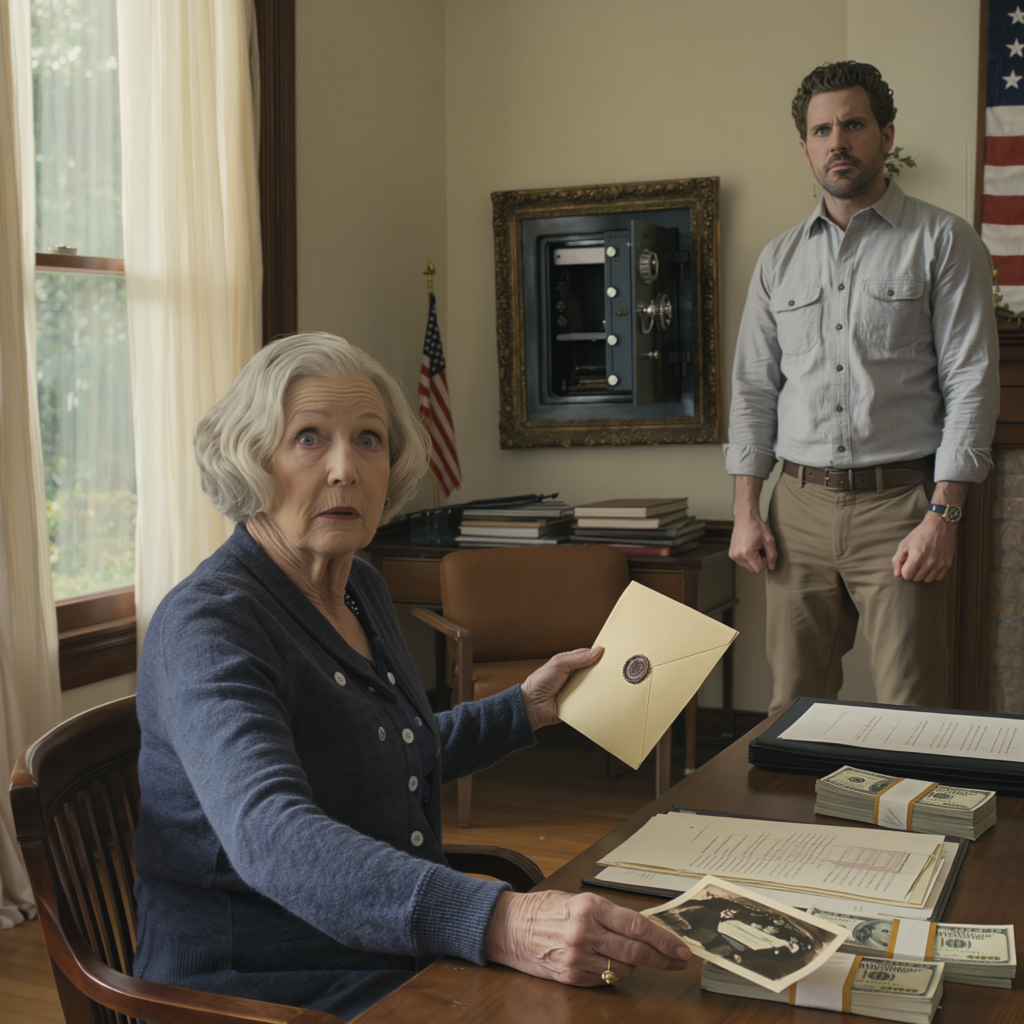
The first thing I saw when the door opened was money. Stacks of it—$100 bills bound with rubber bands—arranged in neat rows like soldiers at attention.
I pulled out one stack, then another, my heart beginning to pound. How much was here?
I started counting, but my hands were shaking too badly. Fifty thousand in the first stack. I counted five more stacks, then five more.
The safe wasn’t large, but it was packed efficiently.
When I finally finished, I had to sit down in Harold’s leather chair, feeling dizzy. Five hundred thousand dollars.
$500,000 in cash hidden in a safe in our suburban Connecticut home.
Where did Harold get this kind of money? We weren’t poor, but we weren’t rich either. He’d been an accountant. We drove a ten-year-old Buick. We clipped coupons.
This was more money than I’d ever seen in my life.
Beneath the money, I found documents. I pulled them out with trembling fingers, spreading them across Harold’s desk.
Property deeds for places I’d never heard of. Bank statements from accounts I didn’t know existed. Names I didn’t recognize.
My mind raced trying to make sense of it all. Robert Kellerman. Victor Pines. Sarah Chen.
Who were these people? Why did Harold have their information locked away?
Then I saw the envelope—thick manila paper, sealed, with my name written on the front in Harold’s careful handwriting.
Margaret—only if something happens to me.
Well, something had happened. A heart attack while mowing the lawn. The doctor said he died instantly.
I remembered thinking at the time that it was just like Harold to go quietly without making a fuss. Now I wondered what else I hadn’t known about my husband of fifty years.
I opened the envelope.
Inside was a single photograph, old and faded, the corners soft with age. I lifted it to the light streaming through the study window.
The cold started at my fingertips and spread up my arms into my chest, squeezing the air from my lungs.
It was me—forty years younger, but unmistakably me. I was standing next to a car I hadn’t thought about in decades: Harold’s old blue Chevrolet.
But it wasn’t the car that made my blood turn to ice.
It was what was visible through the car’s open trunk.
The body.
I dropped the photograph as if it had burned me, but I couldn’t look away from where it had fallen on the desk.
Memories I had buried for four decades came rushing back with such force I had to grip the edge of the desk to steady myself.
July 1985. The cabin upstate. The accident that wasn’t an accident.
We’d agreed never to speak of it again. We’d agreed that no evidence existed.
Harold had promised me that night, holding me while I sobbed, that he’d taken care of everything, that we were safe, that no one would ever know.
But here was proof. Here was evidence that someone had been there.
Someone had taken this photograph. Someone knew.
And Harold had kept it locked away all these years without telling me.
Why? Was it insurance? Blackmail?
Had someone been threatening him?
My mind spun with possibilities, each one worse than the last. The study suddenly felt too small, the walls pressing in.
I looked at the money again, understanding washing over me with horrible clarity.
This wasn’t savings.
This was payment. A payoff.
Harold had been paying someone to keep quiet, and now Harold was dead—which meant whoever had taken this photograph, whoever had been bleeding us for God knows how long, would be coming for me next.
I sat there in my dead husband’s chair, surrounded by blood, money, and secrets, holding a photograph that could destroy what was left of my life.
And I wondered what else I didn’t know about the man I’d married.
More importantly, what was I going to do now?
I don’t know how long I sat there staring at that photograph. The coffee I’d made had gone cold. The morning sun had shifted across the study floor.
My legs had gone numb.
Forty years.
For forty years, I had managed not to think about that night. I’d built a wall in my mind, brick by brick, and locked that memory behind it.
I’d been a good wife, a good mother, a good neighbor. I’d volunteered at the library. I’d baked cookies for school fundraisers.
I’d lived a normal life.
But normal lives don’t include bodies and trunks.
The memory came back in fragments, like pieces of a broken mirror.
July 1985. David was twelve, away at summer camp.
Harold and I had driven upstate to the cabin we’d rented for years, a little place on Lake Champlain where we’d spent every summer since we were newlyweds.
Except that year, we weren’t alone.
Harold had been acting strange for months—distracted, nervous. He’d been working late, taking phone calls he wouldn’t explain.
I’d suspected an affair, though I’d never confronted him. I was too afraid of what the truth might be.
That night at the cabin, a man had shown up. I could still see his face if I closed my eyes—mid-40s, graying hair, an expensive suit that looked out of place in the woods.
Robert.
Robert Kellerman.
The name from the documents in the safe.
I’d been in the kitchen when I heard the shouting. Harold’s voice higher than I’d ever heard it.
“You can’t do this. I kept my end of the deal.”
The other man’s voice had been cold.
“You’ve been skimming, Harold. Did you think we wouldn’t notice?”
I walked to the living room doorway, a tea towel still in my hands.
The stranger pulled out a gun. Just like that. No warning. One moment we were three people in a cabin.
The next there was a weapon pointed at my husband’s chest.
“Please,” Harold said, voice breaking. “My wife is here.”
The man turned to look at me.
I remember his eyes—flat, calculating.
“Then you both have a problem.”
What happened next came back in snapshots.
Harold lunging forward. The gun going off—but not at Harold.
The man stumbling backward, surprised, and the gun discharging into his own chest.
He fell against the fireplace, blood spreading across his expensive shirt.
We stood there frozen as he died.
It took less than five minutes. Five minutes that shaped the next four decades of our lives.
Harold moved first.
“We can’t call the police, Margaret. They’ll never believe it was an accident. And if they investigate, they’ll find out about the money.”
“What money?” I whispered.
“I’ll explain everything later. Right now, we have to deal with this.”
We dealt with it.
Harold wrapped the body in a tarp from the shed. We drove three hours north to a construction site Harold somehow knew about.
We buried Robert Kellerman under concrete that would be poured the next morning for a shopping mall foundation.
Then we went home and never spoke of it again.
But someone had taken a photograph.
Someone had been there watching.
All these years.
A car door slammed outside, jerking me back to the present.
I shoved the photograph into the envelope, my heart hammering. The documents went back into the safe, but there were too many stacks of money.
I couldn’t fit them all in quickly.
I grabbed Harold’s cardigan from the back of the chair and threw it over the piles of cash on the desk.
The front door opened.
“Mom?”
David.
What was he doing here? He was supposed to be in Seattle.
“In the study,” I called, my voice surprisingly steady.
He appeared in the doorway, still wearing his jacket, a travel bag over his shoulder. He looked tired.
At forty-seven, David had started to resemble Harold more than I liked—the same narrow shoulders, the same worry lines between his eyes.
“I thought I’d surprise you,” he said. “Jennifer’s at a conference in Boston, so I figured I’d come check on you. I’ve been worried.”
He stepped into the study, and his eyes went immediately to the open safe, then to the desk.
The cardigan had slipped. The corner of a money stack was visible.
“Mom…” His voice changed. “What’s all this?”
“Your father’s papers,” I said quickly. “I finally opened the safe. It’s just old documents—nothing important.”
But David was already moving toward the desk. He lifted the edge of the cardigan, and his eyes widened.
“Is that cash? How much is there?”
“David, please.”
I stood, positioning myself between him and the money.
“This is complicated. I’m still trying to understand it myself.”
“Understand what?” He pulled the cardigan completely off, staring at the stacks of $100 bills. “Mom, there must be hundreds of thousands of dollars here. Where did Dad get this?”
“I don’t know yet.”
“What do you mean you don’t know?” His voice rose. “You’ve been married to him for fifty years, and you don’t know where he got half a million dollars in cash?”
So he’d already estimated the amount. David had always been quick with numbers, just like his father.
“Your father kept some things private,” I said carefully. “His business dealings.”
“Business dealings?” David laughed, but there was no humor in it. “Dad was an accountant, a regular, boring accountant who worked for the same firm for thirty years. Where did this money come from?”
I couldn’t tell him. How could I explain that his father had been involved with criminals?
That we’d buried a man and lived with that secret for forty years?
That this money was almost certainly connected to something illegal?
“I need time to figure this out,” I said. “Please, David—just give me a few days.”
But he was already pulling out his phone.
“We should call someone. A lawyer, maybe. Or the police.”
“No police.”
The words came out sharper than I’d intended.
“Absolutely not.”
David looked at me—really looked at me for the first time since he’d entered the room.
“Mom, you’re scaring me. What’s going on? What aren’t you telling me?”
Everything, I thought. I’m not telling you everything.
“I just need time,” I repeated. “Can you do that for me? Can you trust me to handle this?”
He was quiet for a long moment, his eyes moving between me and the money.
I could see him calculating, weighing options.
Finally he said,
“I’m staying here. I’m not leaving you alone with this.”
It wasn’t what I wanted, but I couldn’t argue without making him more suspicious.
“Fine,” I said. “Stay. But promise me you won’t tell anyone about this—not Jennifer, not the police, no one.”
“Mom…”
“Promise me, David.”
He ran a hand through his hair, a gesture so like Harold it made my chest ache.
“Okay,” he said. “I promise. For now.”
For now.
That was the best I was going to get.
I started putting the money back into the safe and David helped me, both of us working in silence.
But I could feel his questions hanging in the air between us.
As I closed the safe door and spun the dial to lock it, I thought about the photograph still hidden in the envelope, tucked now in the pocket of Harold’s cardigan.
Someone out there had taken that picture.
Someone knew what we’d done.
They had been bleeding Harold for years.
Now Harold was gone.
David was asking questions.
And I was running out of time.
What had Harold gotten us into?
And more importantly, how was I going to get us out?
That night, I barely slept.
David had taken his old room upstairs, and I could hear him moving around until well past midnight.
I stayed in the master bedroom with Harold’s cardigan folded on the chair beside me, the photograph still in its pocket.
Every time I closed my eyes, I saw Robert Kellerman’s face—the surprise in his eyes when the gun went off, the way he’d slumped against the fireplace.
Harold had told me later that Kellerman was an enforcer for people Harold had been laundering money for.
Harold had been caught skimming.
“Just to give us a better life,” he’d said. “Just so David could have the things he deserved.”
But someone had taken that photograph.
Someone knew.
At six in the morning, I gave up on sleep and went downstairs.
David came into the kitchen an hour later, already dressed. The circles under his eyes told me he hadn’t slept either.
“I’ve been thinking about the money,” he said over coffee. “Maybe Dad made some good investments. Maybe he was just being cautious, keeping cash on hand.”
He was giving me an out, a way to pretend everything was normal.
“Maybe,” I said softly.
After breakfast, David said he needed to run to the store.
I waited until his car pulled out of the driveway, then hurried to check the mail.
The morning was cold for September. I walked quickly down the driveway in my slippers.
Our neighbor, Mrs. Chen, waved from her garden, and I waved back.
Just a grieving widow checking her mail.
I pulled out the stack of envelopes—bills, a catalog, a sympathy card—and a plain white envelope with no return address.
My name was handwritten in block letters.
Margaret Flynn.
My hands started shaking before I even opened it.
Inside was a single piece of paper. The message was composed of letters cut from magazines.
Harold kept you safe. Now he’s gone. $100,000 by Friday or everyone learns what you did. Instructions to follow.
The paper fluttered from my fingers.
This was real.
Someone was really coming for me.
Friday.
Today was Tuesday.
Three days.
I looked up and down the street. Was someone watching? Had they seen me find the note?
I shoved it into my pocket and hurried back to the house, my heart pounding.
Inside, I locked the door and leaned against it.
A hundred thousand dollars.
A fifth of what was in the safe.
But if I paid, would it stop there?
The sound of a car in the driveway made me jump.
David was back already.
I tried to compose my face.
He came through the door with a shopping bag.
“Got the charger,” he said. “And I picked up some cookies.”
He stopped.
“Mom… you look pale.”
“I’m fine. Just tired.”
But he noticed the mail in my hand.
“Anything important?”
“Just bills.”
I set the stack on the hall table, making sure the plain white envelope stayed hidden in my pocket.
David picked up the pile, flipping through it.
He paused at a credit card statement.
“This is Dad’s card,” he said. “There are charges here from last month—after Dad died.”
My blood went cold.
“What?”
“Look. August 15th—gas station in New Haven. Dad died August 1st.”
Someone had Harold’s credit card.
Or were these charges set up before he died?
“It must be fraud,” I said. “Someone probably stole his card number. I should call the credit card company.”
“No,” David said. “Let me look through Harold’s papers first. Mom, if someone’s using Dad’s card, I’ll handle it. Please.”
That look again.
The one that said he knew I was hiding something.
The rest of the day, David stayed close.
Too close.
He helped me sort through papers. He made lunch. He asked careful questions about Dad’s work, his habits in the months before he died.
“Did he seem worried about anything?” David asked that evening.
“Why are you asking?”
“Just trying to understand where that money came from.”
He wasn’t going to let this go.
That night, after David went to bed, I sat in the kitchen with the blackmail note spread on the table.
Friday—two days away now.
How would I get the money without David noticing?
I heard footsteps on the stairs and quickly shoved the note back in my pocket.
But David was just getting water.
Through the kitchen doorway, I watched him pause at the hall table, looking at the stack of mail again.
He picked up something and stood there reading it in the dim light.
Then he looked toward the kitchen.
Looked right at me.
“Mom,” he said slowly. “Where did this envelope come from?”
My heart stopped.
The plain white envelope.
I’d put it on the table with the other mail without thinking.
“What envelope?” I managed.
He walked into the kitchen, holding it up.
“This one with your name on it. There’s no stamp, no postmark. Someone hand-delivered this.”
I couldn’t speak.
“What was in it?” David asked. His voice was quiet, but there was steel underneath. “And don’t lie to me.”
The kitchen clock ticked in the silence.
David stood there holding the envelope, waiting for my answer.
I could see Harold in his face—his old expression when he was working through a problem, determined to find the solution.
“It’s nothing,” I finally said. “Just a note from someone at the bank about Harold’s accounts.”
“Banks use letterhead,” David said. “They mail things with postage.”
He turned the envelope over in his hands.
“This was hand-delivered. Someone came to our house and put this in the mailbox. Who was it?”
“I don’t know.”
“What did the note say?”
“David, please. It’s late. Can we discuss this tomorrow?”
“No.”
He pulled out a chair and sat down across from me.
“Mom, I’m not leaving this kitchen until you tell me what’s going on. The money in the safe. The credit card charges after Dad died. Now this.”
He leaned forward.
“What was Dad involved in?”
I looked at my son’s face and saw that I was losing him.
Every lie, every evasion, pushed him further away.
But the truth would destroy him completely.
“Your father had some business dealings,” I said carefully. “Some debts. I’m handling it.”
“What kind of debts require half a million dollars in cash hidden in a safe?”
“I can’t explain everything right now.”
“Can’t or won’t?” David’s voice rose. “I have a right to know. He was my father, too. And whatever this is, it affects me.”
He swallowed.
“What if these people come after me? After Jennifer?”
That possibility hadn’t occurred to me.
And the thought made me feel sick.
Would they go after David? Use him to get to me.
“No one’s coming after you,” I said, hoping it was true.
“How do you know?”
He leaned forward.
“Mom, you’re clearly terrified. I can see it. You haven’t slept. You jump every time a car drives by.”
His voice dropped.
“What was in that note?”
I closed my eyes.
Maybe I could give him part of the truth—just enough to satisfy him without revealing everything.
“Someone your father owed money to,” I said quietly. “They want payment.”
“How much?”
“$100,000.”
David’s eyes widened.
“Jesus. By when?”
“Friday.”
“That’s two days away.”
He ran a hand through his hair.
“Okay. Okay. We use the money from the safe. We pay them. Then it’s over, right?”
“I don’t know if it’ll be over.”
“What do you mean?”
“These aren’t the kind of people who take one payment and disappear, David. They’ll keep coming back. They’ll bleed us dry.”
He stared at me.
“What kind of people? Who was Dad involved with?”
“I can’t tell you that.”
“Can’t or won’t?”
He stood up, pacing.
“I’m forty-seven years old. I’m not a child you need to protect. Whatever Dad did, whatever trouble he was in, I can handle it.”
But he couldn’t.
How could he handle knowing his father was a money launderer?
That his parents had killed someone?
“Just give me the money,” I said. “Let me deal with this my way.”
“No.”
The word hung in the air between us.
“What do you mean, no?”
“I mean I’m not letting you hand over $100,000 to some criminals without knowing the full story.” David’s jaw was set. “And I’m certainly not letting you handle this alone. We’re going to figure this out together.”
“David—”
“Or I’m calling the police right now.”
My heart stopped.
“You can’t.”
“Why not? If Dad was involved in something illegal, if someone’s threatening you, the police should know.”
“No police,” I said firmly. “Absolutely not.”
“Why?”
He turned to me, eyes hard.
“What are you so afraid they’ll find?”
Everything.
I was afraid they’d find everything.
“These people won’t stop at one payment,” I said instead. “And if we involve the police, they might come after us differently—more violently.”
That gave him pause.
“Are we in danger?”
“I don’t know. That’s why I need to handle this carefully.”
David pulled out his phone.
“I’m calling Jennifer. She has a friend who’s a lawyer. Maybe he can—”
I reached across the table and grabbed his wrist.
“No lawyers. No police. No one else can know about this.”
He looked down at my hand on his wrist, then back at my face.
“Then I’m staying, and I’m helping, and you’re going to tell me everything. Or at least enough that I understand what we’re dealing with.”
He pulled his wrist free.
“David, those are my terms, Mom. Either you let me help, or I make some calls.”
It was an ultimatum.
My own son was threatening me.
But what choice did I have?
If I refused, he’d go to the police, or he’d start digging on his own and find things that would lead him to the truth anyway.
“Fine,” I said quietly. “But not tonight. I need time to think about how to explain this. Tomorrow morning. First thing.”
He released the envelope onto the table.
“And Mom—no more lies.”
He left the kitchen, his footsteps heavy on the stairs.
I heard his bedroom door close.
I picked up the envelope, turning it over in my hands just as David had.
Someone had stood at the end of my driveway and placed this here.
Someone who knew where I lived.
Someone who knew Harold was dead.
Someone who knew exactly what leverage to use.
Tomorrow I’d have to tell David something.
But what?
How much truth could I give him without destroying everything?
And how was I going to get that money to whoever was blackmailing me without my son finding out?
The next morning, I found the second note.
It was wedged under the windshield wiper of my car.
The same block letters.
The same magazine cutouts.
Noon today, Riverside Park. North bench by the fountain. Bring the money. Come alone.
My hands shook as I pulled it from the windshield.
I looked around the driveway, the street.
It was barely seven in the morning.
Had someone come during the night or just before dawn?
They’d been watching the house.
Watching me.
David was still asleep upstairs.
I had five hours to get the money and figure out how to leave without him following me—because he would follow me.
After last night, I knew he wouldn’t let me out of his sight.
I went back inside and straight to Harold’s study.
The safe combination felt familiar now under my fingers.
The money was still there, stacks of hundreds bound with rubber bands.
I took five stacks—$100,000—and put them in a canvas shopping bag from the hall closet.
“Going somewhere?”
I spun around.
David stood in the doorway in his pajamas, arms crossed.
“Just organizing some things,” I said.
“With a shopping bag full of cash.”
He walked into the study.
“You got another note, didn’t you? When? Where?”
There was no point lying.
“On my car this morning,” I said. “They want the money at noon.”
“Where?”
“Riverside Park.”
“I’m coming with you.”
“The note said, ‘Come alone.’”
“I don’t care what the note said.” David’s voice was firm. “You’re not meeting some criminal alone with $100,000. What if they hurt you? What if they take the money and—”
“And what?” I tried to sound calmer than I felt. “Kill me in broad daylight in a public park?”
“They want money, David. That’s all.”
“You don’t know that.”
He was right.
I didn’t know.
But I knew that if David came with me, if he saw who was blackmailing me, he’d have more questions.
Questions I couldn’t answer.
“Please,” I said. “Let me handle this. If you’re there, they might not show up—or they might get angry. Dangerous.”
David wavered.
I could see him calculating risks, trying to decide what was safer.
“I’ll park nearby,” he finally said. “Close enough to see the bench. If anything looks wrong, I’m coming in.”
It wasn’t ideal, but it was better than having him right beside me.
“Okay.”
At 11:30, we drove to Riverside Park in tense silence.
David parked his car near the south entrance where he had a partial view of the fountain area.
I took the canvas bag and started walking.
The park was busy for a Wednesday—mothers with strollers, joggers, a few teenagers skipping school.
Normal people living normal lives.
I wondered if any of them had ever buried a body.
If any of them were being blackmailed by ghosts from their past.
The north bench was empty.
I sat down, the bag between my feet, and waited.
At exactly noon, a man sat down beside me.
He was in his sixties, gray hair, expensive coat.
Something about him was familiar, but I couldn’t place it.
He didn’t look at me.
He stared straight ahead at the fountain.
“Margaret Flynn,” he said.
His voice was smooth, educated.
“It’s been a long time.”
“Who are you?”
“You don’t remember me. I’m hurt.”
He turned to look at me.
And suddenly I did remember.
Younger, darker hair, but the same cold eyes.
Victor Pines.
The name from Harold’s documents.
“I worked with your husband,” he said. “Well, worked is a gentle word for it.”
“I don’t know what you’re talking about,” I said.
“Please.” Victor nodded at the bag. “We’re past that.”
He settled back on the bench like he had all the time in the world.
“Harold paid me for forty years to keep quiet about what happened at the lake. Five thousand a month like clockwork.”
He smiled.
“Then he went and died on me. Inconsiderate, really.”
Forty years.
Five thousand a month.
I did the math quickly.
Two point four million.
Harold had paid this man nearly $2.5 million over the course of our marriage.
“The money in the safe,” I whispered.
“Some of it, probably.” Victor’s smile widened. “Harold was resourceful. He skimmed from his clients, made side deals. He was quite the entrepreneur.”
He turned his head slightly, as if he were commenting on the weather.
“Of course, his clients didn’t know about me. Or about Robert Kellerman buried under that shopping mall in Vermont.”
My blood turned to ice.
“How did you—”
“How did I know?” Victor finished for me. “I was there, Margaret. I took the photograph.”
He leaned back, casual.
“Robert was my partner. We were supposed to collect what Harold owed together, but Harold surprised us. And you know what?”
He shrugged.
“I decided Robert’s death might be more profitable than his life.”
“You let us bury him,” I whispered. “You watched us.”
“I documented everything,” Victor said. “Photos, location, dates. Then I gave Harold a choice—pay me monthly, or I go to the police.”
He spread his hands.
“He chose wisely.”
“You’re a monster.”
“I’m a businessman.”
His gaze sharpened.
“And now that Harold’s gone, you’re my client.”
He glanced at the bag.
“That’s just the first payment. I’ll need the same amount every month.”
“I don’t have that kind of money.”
“You have $400,000 left in the safe,” Victor said calmly. “That’s eight months. Plenty of time to figure something out.”
He stood up.
“Leave the bag on the bench. Walk away. I’ll be in touch about next month’s payment.”
“And if I refuse?”
Victor’s smile disappeared.
“Then your son finds out his father was a criminal and his mother is a murderer.”
He leaned down close to me, his breath warm on my skin.
“Then the police dig up that shopping mall. Then you spend whatever’s left of your life in prison.”
His eyes held mine.
“I’ve waited forty years for this, Margaret. I can wait a little longer.”
His voice dropped.
“But can you?”
He walked away, disappearing into the park crowd.
I sat there unable to move.
Four hundred thousand left.
Eight months.
What would happen after that?
My phone buzzed.
A text from David.
Are you okay? Who was that man?
I looked toward where David was parked.
He’d seen everything.
I walked back to the car on shaking legs.
David was out of his vehicle before I reached him, his face tight with anger.
“Who was that?” he demanded. “I saw you give him the bag. Who is he?”
“Someone your father owed money to.”
“I got that part, Mom.” David’s voice was sharp. “I want a name.”
I climbed into the passenger seat.
David got behind the wheel without asking and started the engine.
“His name is Victor Pines,” I said quietly.
“Victor Pines,” David repeated slowly. “That name was in Dad’s papers in the safe. What was Dad’s connection to him?”
“They did business together years ago.”
“What kind of business?”
“I don’t know all the details.”
It was partially true.
I didn’t know everything Harold had done for Victor and his associates.
I’d never wanted to know.
David drove us home in silence, but I could see his jaw working.
He was thinking.
Planning.
When we pulled into the driveway, he turned off the engine but didn’t get out.
“That man looked familiar,” he said. “Have I met him before?”
“No.”
“Are you sure?”
“There’s something about him.” David shook his head. “How much did Dad owe him? Just the hundred thousand? More? How much more?”
“David, please.”
“How much?”
“He wants a hundred thousand every month.”
David’s head snapped toward me.
“Every month? For how long?”
“I don’t know.”
“Jesus Christ.”
He got out of the car, and I followed him into the house.
He went straight to the living room, pulling out his phone.
“What are you doing?”
“Looking him up.”
His fingers moved rapidly across the screen.
“Victor Pines… maybe there’s something online. If we know who he is, what he does, maybe we can find a way to stop him.”
“David, don’t—”
He held up the phone.
“Victor Pines. Sixty-three years old. Lives in Stamford. Used to work for…” he scrolled, “some kind of financial consulting firm that went under in the ’90s. Suspected connections to organized crime, but never charged.”
He looked up at me.
“Dad was involved with the mob.”
“It wasn’t like that.”
“Then what was it like?”
David’s voice rose.
“Tell me, Mom. Because from where I’m standing, it looks like Dad was laundering money for criminals, and now one of them is bleeding us dry.”
I sat down on the couch, suddenly exhausted.
“Your father made mistakes,” I said. “He got involved with the wrong people. He was trying to protect us by hiding half a million dollars and paying blackmail for forty years.”
David paced the room.
“What does this guy have on Dad? What’s he threatening to reveal?”
“I can’t tell you that.”
“Can’t or won’t?”
He stopped pacing.
“That’s your favorite phrase lately.”
We stared at each other across the living room.
My son.
My baby.
He looked at me now like I was a stranger.
“I’m going to Dad’s study,” David said finally. “I’m going through everything—every paper, every document—and I’m going to figure out what the hell was going on.”
“David—”
But he was already gone, his footsteps heavy on the stairs.
I heard him opening drawers, moving furniture.
I should’ve stopped him.
Should’ve locked the study.
But what was the point?
He’d already seen too much.
An hour later, David came back downstairs with a shoebox.
His face was pale.
“I found this hidden in the back of Dad’s closet,” he said, setting the box on the coffee table. “Behind his old boots. Inside were papers, photographs, a small notebook.”
David picked up the notebook and opened it.
“It’s a ledger. Dates, amounts, initials—going back decades.”
He flipped through pages.
“Look at this. VP—$5,000 every month, like clockwork. For forty years.”
He looked at me.
“Victor Pines.”
His eyes widened as he calculated.
“That’s almost $2.5 million.”
I said nothing.
David picked up one of the photographs.
It showed Harold with Victor and another man I didn’t recognize—three of them younger, standing outside a warehouse.
“Who’s the third man?”
“I don’t know.”
Another lie.
He picked up another photo.
This one made him go very still.
It was an old picture of Harold and me at the lake cabin.
Summer 1985.
The year everything changed.
“This is from the summer I was at camp,” David said slowly. “You and Dad went upstate without me.”
He looked at more papers in the box.
“And here’s a receipt from that week. Gas station in Vermont.”
He pulled out a folded map.
A map with a location circled near Lake Champlain.
His eyes met mine.
“What happened that summer, Mom?”
“Nothing,” I said. “We just took a vacation.”
“Then why did Dad keep all this? Why did he hide it?”
David’s hands were shaking now.
“What happened at that cabin?”
“David, stop. Please. No.”
He stood up, the shoebox in his hands.
“I’m done with half-truths and evasions. Something happened in 1985—something bad enough that Victor Pines has been blackmailing Dad ever since.”
His voice broke.
“And you know what it was.”
He moved toward the door.
“Where are you going?”
“To make some calls. Dad’s old colleagues. Maybe the police in Vermont. Someone knows something.”
“David, no.”
“You won’t tell me the truth,” he said, “so I’ll find it myself.”
He grabbed his jacket.
“And Mom—whatever you and Dad did, whatever you’re hiding, I’m going to find out. And then we’re going to deal with it together.”
“Or not.”
The door slammed behind him.
I sat alone in the living room, surrounded by the evidence of Harold’s secret life scattered across the coffee table.
My son was going to dig until he found the truth.
And when he did, he’d never forgive me.
I spent the next three hours in agony, imagining what David was doing—calling police departments, tracking down Harold’s old business associates.
Every scenario ended the same way.
David learning the truth.
David hating me forever.
At four o’clock, I heard a car in the driveway.
Then another.
I looked out the window and my heart stopped.
David’s car.
And behind it—a black Mercedes.
David got out, his face grim.
The Mercedes door opened, and Victor Pines emerged, straightening his expensive coat.
They were coming to the house.
Together.
I opened the front door before they could knock.
“What’s going on?”
“We need to talk,” David said.
His voice was flat, controlled.
“All of us.”
Victor smiled that cold smile.
“Your son is very persistent, Margaret. He tracked me down at my office. Made quite a scene, actually.”
“You went to see him?”
I stared at David.
“Why would you?”
“Because I wanted answers.”
David pushed past me into the house.
Victor followed, uninvited.
“And I got some,” David said. “Not all, but enough to know that whatever Dad was involved in—you were part of it too.”
They stood in my living room.
My son.
My blackmailer.
Two threats to everything I had left.
“Sit,” Victor said, gesturing to the couch as if this were his house. “Let’s have a civilized conversation.”
“Get out,” I said to him. “You have no right to be here.”
“Actually, I have every right,” Victor said. “Your son invited me. And besides, he’s been asking questions that could cause problems for all of us. Better to clear the air.”
David sat down heavily in Harold’s old chair.
“Tell me about Robert Kellerman.”
The name hung in the air like poison.
I looked at Victor, who was watching me with amusement.
“Go ahead, Margaret,” Victor said. “Tell your son about Robert.”
“I don’t know what you’re talking about,” I whispered.
“Mom,” David’s voice cracked. “I found him online. Missing person case from 1985. Robert Kellerman. Last seen in Vermont. Investigation went nowhere. No body ever found.”
His eyes pleaded.
“Tell me Dad wasn’t involved. Tell me this is all some sick mistake.”
I couldn’t speak.
I couldn’t move.
Victor sat down on the couch, making himself comfortable.
“Since Margaret seems to have lost her voice,” he said pleasantly, “I’ll explain.”
David’s hands clenched.
“Robert Kellerman was my business partner. In July 1985, he came to collect money your father owed us. There was an altercation at a cabin near Lake Champlain. Robert ended up dead.”
“No,” David whispered. “No. Dad wouldn’t—”
“It was an accident,” I said.
The words finally broke free.
“The gun went off. We didn’t mean for anyone to die.”
David’s face went white.
“We…”
He stared at me.
“You were there?”
“I was making tea in the kitchen,” I said. “I heard shouting. When I came out, Robert had a gun pointed at your father. Harold tried to take it from him. There was a struggle. The gun fired.”
The memories flooded back—vivid and terrible.
“He fell against the fireplace,” I whispered. “There was so much blood.”
David’s voice was barely audible.
“Then what?”
“Then we panicked,” I said. “We didn’t think anyone would believe it was an accident. Harold said the people Robert worked for would kill us if they knew.”
My throat tightened.
“So we… we buried him.”
“Jesus Christ.”
David stood up, pacing.
“You killed someone. Both of you. And you’ve been lying about it for forty years.”
“I took photographs,” Victor said pleasantly. “Insurance policy. Been very profitable.”
David whirled on him.
“You watched them bury a man and did nothing. Your own partner.”
“Robert was a liability,” Victor said, “and his death became an opportunity.”
Victor shrugged.
“Your father understood business. He paid well for my silence.”
“You’re a parasite,” David spat.
“I’m a realist.”
Victor’s gaze moved between us.
“And now we have a new reality. Harold’s gone. The payments need to continue.”
He held up a finger.
“But here’s the interesting part. Your son came to me today threatening to go to the police unless I left you alone.”
I looked at David in horror.
“You didn’t.”
“I thought I could protect you,” David said. “I thought if I told him we’d go to the authorities, he’d back off.”
“Adorable,” Victor said, “but misguided.”
He leaned forward.
“Because if you go to the police, Margaret goes to prison for manslaughter. Maybe murder at seventy-two. How long do you think she’d survive?”
“But you’d be guilty too,” David argued. “Accessory after the fact. Blackmail.”
“Prove it,” Victor said. “The photographs are hidden. The records are clean. I’ve been very careful for forty years.”
Victor leaned closer, voice calm.
“But there’s another option. One that benefits everyone.”
“What option?” I asked.
David’s eyes narrowed.
“David pays,” Victor said, as if it were obvious. “He’s a successful man. Tech consultant, right? Makes good money. He takes over the monthly payments. And nobody goes to prison.”
“Absolutely not,” I said.
“I’m not paying you a dime,” David said at the same time.
Victor sighed.
“Then we have a problem, because in three weeks I need another $100,000. If I don’t get it, I make a phone call.”
He tilted his head.
“Actually, I make several calls. Police. Media. Your neighbors. Everyone learns what the respectable Flynn family really is.”
“You’re bluffing,” David said. “If we go down, you lose your income.”
“I’m sixty-three years old,” Victor said. “I have enough money to retire comfortably. Your mother’s the one with something to lose.”
He stood and walked to the door, then turned back.
“Oh—and David. If you’re thinking about doing something stupid, like hiring someone to scare me or make me disappear… I have a dead man’s switch. Letters with everything ready to mail if anything happens to me.”
Victor’s smile was thin.
“You kill me, you destroy your mother.”
The door closed behind him.
David and I sat in silence.
Finally, he spoke.
“I can’t believe you did this. I can’t believe Dad did this.”
His voice cracked.
“We were protecting you,” I whispered. “Protecting our family.”
“By killing someone?”
“It was an accident.”
He looked at me like I was a stranger.
“I don’t know who you are.”
“I’m your mother.”
“My mother wouldn’t…”
His voice broke.
“I need to leave. I can’t be here right now.”
“David, please. I need time to think.”
He grabbed his keys.
“About what I’m going to do about all of this.”
David left.
I heard his car pull out of the driveway, the engine sound fading into the distance.
The house felt hollow without him, every room echoing with the weight of what I’d confessed.
I sat on the couch until dark, not bothering to turn on lights.
Forty years of secrets—destroyed in one afternoon.
My son knew the truth now.
He knew what kind of people his parents really were.
The worst part was that I dragged him into it.
Victor had been right.
David was now part of this.
He couldn’t unknow what he’d learned.
He couldn’t go back to his innocent life in Seattle.
I’d ruined him the way Harold and I had ruined ourselves that night in 1985.
Around ten, I heard a key in the front door.
David still had his house key from when he’d arrived.
He came in quietly, finding me in the dark living room.
“Mom,” he said, and flipped on a lamp. “Why are you sitting in the dark?”
I must have looked terrible, because his expression softened—just slightly.
“Have you eaten?” he asked.
I shook my head.
He went to the kitchen.
I heard cabinets opening, the microwave beeping.
He returned with two mugs of soup and sat down across from me, handing me one.
“I drove around for hours,” he said, “thinking. Trying to make sense of this.”
He took a sip.
“I called Jennifer. Didn’t tell her details. Just said we had a family crisis. She wants me to come home.”
“You should go,” I said. “Get away from this mess.”
“I can’t,” he said.
His voice was tired.
“You’re my mother. And despite everything—despite what you did—I can’t just abandon you.”
Tears burned my eyes.
“You should.”
“Well, I won’t.”
He set down his mug.
“But we need to figure this out. We need a plan, because I’m not paying Victor Pines $100,000 a month for the rest of his life.”
“There’s no other choice,” I whispered.
“There’s always a choice.”
David pulled out his phone.
“I’ve been researching. Victor Pines has a history. That financial consulting firm he worked for—it was shut down for fraud. He was investigated, but charges were dropped. Suspicion of witness intimidation.”
He looked up.
“So he’s connected. Dangerous. That’s why we have to pay him… or we find leverage.”
David scrolled again.
“Everyone has secrets, Mom. Even blackmailers. We find out what Victor’s hiding, and we turn this around.”
“How?”
“I don’t know yet,” David admitted. “But I have three weeks to figure it out.”
He looked at me.
“I need to know everything. Not just about Robert Kellerman. Everything. What exactly was Dad doing for these people? What was the money laundering operation? Who else was involved?”
So I told him all of it.
How Harold had been recruited in the early ’80s by people who needed someone to make dirty money look clean. How he’d moved funds through fake accounts, shell companies.
How he’d gotten greedy and started skimming.
That was why Robert came to the cabin.
To punish Harold.
To send a message.
And Victor had seen an opportunity.
“He’s been milking us ever since,” I finished.
David was quiet for a moment.
“What about the other names in Dad’s documents?” he asked. “Sarah Chen. There were others.”
“I don’t know who they were,” I said. “Maybe they’re like Victor. Maybe they were all partners.”
“Maybe.”
His eyes lit up.
“Maybe one of them has a grudge against Victor.”
“That’s a dangerous game.”
“We’re already playing a dangerous game.”
David stood, energized.
“Tomorrow I’m going through all of Dad’s papers again. Every document. Every name. There has to be something we can use.”
He hesitated.
“And if there isn’t…”
“What?”
“I don’t know yet. But Mom—I need you to promise me something. No more secrets. No more lies. If we’re going to get through this, we do it together. Honestly.”
I nodded.
“I promise.”
“And we don’t hurt anyone,” David said. “Whatever we do, we don’t become like them. Like Victor.”
I nodded again, though I wasn’t sure that was a promise I could keep.
How far would I go to protect my son?
To protect what was left of our family?
The next morning, David was in Harold’s study before I woke up.
I found him surrounded by papers, his laptop open, taking notes.
“I found something,” he said without looking up. “Sarah Chen—she’s not just a name. She’s Victor’s ex-wife. They divorced in 1998. Nasty split, according to public records. She sued him for half his assets.”
“How does that help us?”
“Because if she sued him, she knows about his money. And if she knows about his money, she might know where it came from.”
David looked at me.
“She might know about the blackmail. She might even have proof.”
“Why would she help us?”
“Because she hates him.”
David clicked to an article.
“And because she’s been trying to prove he committed fraud for years.”
“Victor said he has safeguards,” I whispered. “Dead man’s switches.”
“He could be bluffing,” David said, “or Sarah might know where they are.”
He closed the laptop.
“It’s a long shot, but it’s something.”
“How do we even find her?”
“Already did.”
He checked the time.
“She lives in Boston. Two hours away. We could be there by noon.”
I thought about Victor’s threat.
Three weeks until the next payment.
Three weeks to find a way out.
Or watch my son drain his savings to pay off a blackmailer.
“What if she won’t help?” I asked.
“Then we find another way.” David’s voice was steady. “But Mom, we have to try, because the alternative is letting Victor win.”
He looked at me.
“And I’m not ready to do that.”
I looked at my son—determined, angry, but still here.
Still fighting for me, despite knowing the truth.
“Okay,” I said. “Let’s go to Boston.”
Sarah Chen lived in a modest brownstone in Cambridge.
We parked across the street and sat in the car for a moment, gathering courage.
“Let me do the talking,” David said. “If she knows Victor, she’ll be suspicious.”
A woman answered the door on the second knock.
Mid-sixties.
Elegant in a simple way.
Sharp eyes that assessed us immediately.
“Sarah Chen?” David asked.
“Who’s asking?”
“My name is David Flynn. This is my mother, Margaret. We need to talk to you about Victor Pines.”
Her expression hardened.
“I have nothing to say about that man.”
“Please,” I said. “He’s blackmailing us. We think you might be able to help.”
Something flickered in her eyes.
“Come in.”
The interior was neat, filled with books and art.
Sarah gestured us to a living room and sat across from us, arms folded.
“Victor blackmailing someone,” she said. “That’s not surprising.”
Her voice was bitter.
“What’s he got on you?”
David and I exchanged glances.
“It’s complicated,” David said.
“It always is with Victor.”
Sarah leaned forward.
“But if you want my help, I need the truth. All of it.”
So I told her.
About Harold.
About Robert Kellerman.
About forty years of payments.
When I finished, Sarah was quiet for a long moment.
“Robert Kellerman,” she said finally. “I remember that name. Victor mentioned him once, years ago, when he was drunk. Said Robert had been his partner—that he’d disappeared with money.”
She looked at me.
“But he didn’t disappear, did he?”
“No,” I said.
“And Victor’s been bleeding you ever since.”
Sarah stood and began pacing.
“That’s exactly his style. Find someone’s weakness and exploit it forever.”
She turned to face us.
“I spent fifteen years married to that man. Fifteen years watching him manipulate, extort, destroy people. When I finally left, I tried to expose him. But he was too careful. Too smart.”
“Do you know about his safeguards?” David asked.
“He claims he has evidence ready to release if anything happens to him.”
Sarah smiled coldly.
“He told you about those. The dead man’s switches.”
She walked to a desk and pulled out a folder.
“He told me the same thing during our divorce. Threatened to release information about my family if I pushed for more money.”
She opened the folder.
“So I hired investigators. Very good ones. Took them two years, but they found his insurance policies.”
She spread photographs across the coffee table.
Storage units.
Safety deposit boxes.
A law office.
Three locations.
“One in Hartford. One in New York. One in Providence,” Sarah said. “He keeps evidence in all three.”
She pointed to the law office.
“This one’s the key. His lawyer has instructions to release everything if Victor dies or disappears.”
“But here’s the thing,” she added.
“The lawyer doesn’t know what’s in the sealed envelope. Victor was paranoid about anyone knowing too much. So if we get the envelope—”
“If we get all three caches,” David said, “we neutralize him.”
Sarah nodded.
“But there’s a problem. The storage units have biometric locks—fingerprint and retinal scan. Only Victor can access them.”
My heart sank.
“Then it’s impossible.”
“Not impossible,” Sarah said. “Difficult.”
She looked at me steadily.
“I can help you. I have keys to the Providence unit. Got them made during the divorce before he changed the locks. And I know someone who can bypass the biometric system in Hartford.”
David leaned forward.
“And the lawyer’s office in New York?”
“Trickier,” Sarah said. “But it can be done.”
“Why would you help us?” I asked.
“What do you want?”
Sarah’s voice turned to ice.
“What I’ve always wanted—destroy Victor. He ruined my life, my reputation. He threatened my children.”
She held David’s gaze.
“I want him finished.”
David’s mouth tightened.
“There must be something else,” he said. “What’s your price?”
Sarah pulled out a small recording device.
“I need your confession on record. Everything you told me about Robert Kellerman—detailed, signed, and dated.”
“No,” David said immediately. “That’s evidence that could put Mom in prison.”
“It’s also leverage,” Sarah said. “If I have proof of the crime Victor’s been blackmailing you for, I can expose him without revealing my involvement.”
She set the recorder down.
“The statute of limitations hasn’t expired on manslaughter. This goes to the police. Victor’s blackmail scheme unravels. He becomes the criminal. You become the victim.”
“But Mom goes to prison,” David insisted.
“Not necessarily,” Sarah said. “If you cooperate, if you testify that Victor has been extorting you for forty years, if you provide evidence of his crimes—prosecutors might offer immunity or a plea deal. House arrest, maybe. Not prison.”
“Might,” I said.
“No guarantees.”
“No guarantees,” Sarah agreed. “But it’s a chance. Better than paying Victor until you die.”
I looked at David.
His face was torn.
He wanted to protect me, but he knew she was right.
“There has to be another way,” David said.
“There isn’t,” Sarah said firmly. “This is the deal. You give me the confession. I help you get Victor’s evidence.”
She leaned forward.
“Then we go to the FBI together. All of us. You, me—everything we have on Victor.”
“And if it doesn’t work?” David asked. “If they prosecute Mom anyway?”
“Then at least Victor goes down too,” Sarah said.
She looked at me.
“It’s your choice, Margaret. Keep paying until you’re broke, or take the risk. Freedom or certainty.”
She held my gaze.
“What’s it worth to you?”
I thought about the last three days.
The fear.
The lies.
The look on my son’s face when he learned what I’d done.
I thought about Harold—paying Victor for forty years, and still ending up dead with nothing resolved.
“If I do this,” I said slowly, “and I go to prison…”
My voice shook.
“David has to be protected completely. No charges. No connection.”
“I’ll make sure of it,” Sarah said.
“Mom, no—”
“David,” I said, taking his hand. “I’ve been running from this for forty years. Maybe it’s time to stop.”
I looked at Sarah.
“Okay. I’ll do it.”
Sarah pressed record on the device.
“Start from the beginning. July 1985. Tell me everything.”
And I did.
Six months later, I stood in my kitchen making coffee, an ankle monitor visible beneath my slacks.
House arrest for three years.
The plea deal Sarah had promised.
Victor Pines was in federal prison—twenty years for extortion, racketeering, accessory to concealing a body.
Robert Kellerman’s remains had been found, exhumed from beneath that shopping mall parking lot.
David visited weekly from Seattle, though something between us remained broken.
Trust, maybe.
Or innocence.
The house was quiet again, but this time the silence felt different.
Earned.
I had finally stopped running from 1985.
The price was everything.
But I was free.
News
My son looked me dead in the eye and said he’d sell the Connecticut house my late husband and I built, just to buy his wife a shiny new Mercedes—then gave me 24 hours to pack—because “she matters more.” I smiled, nodded, and started folding sweaters, while the truth sat in a folder he’d never thought to ask about.
My son said, “I decided to sell your house to buy a new car for my wife. She’s more important…
In a Chicago courtroom filled with reporters and family friends, my parents tried to bankrupt me in public—just to make sure the whole city believed I was broke. They wanted humiliation, headlines, and the end of my name. But when the judge asked one single question, their lawyer went pale—and my father’s empire began to crumble before everyone’s eyes…
I sat in a bankruptcy courtroom packed with strangers—not because I was out of money, but because my parents…
On the morning I boarded a packed CTA bus for my divorce hearing at the Cook County courthouse, I thought I was just a discarded wife trying to arrive with my head high—until a frail old man stumbled at the door, I caught him, and the quiet “thank you” he gave me became the first domino in a chain that would make my powerful attorney-husband lose his breath.
What if the path to a divorce hearing turned into the moment that would change your destiny forever? Today, I…
For seven months, every single night at exactly 2:47 a.m., my husband would rise from our creaking bed, cross the dark room, and stand on my side just watching me breathe—until the night I pretended to sleep and finally heard what he was whispering, and the truth behind that 2:47 ritual shattered everything I thought I knew about my life.
For seven months, every single night at 2:47 in the morning, my husband would stand right next to my…
My son and his wife left me for a seven-day cruise with my “mute” 8-year-old grandson, but the second the lock clicked, he looked up and whispered, “Grandma, don’t drink the tea Mama made for you”—and that was the moment I realized this week wasn’t babysitting… it was a test I might not survive.
My son and his wife flew off on a cruise, leaving me alone for a week with my 8-year-old grandson,…
My name is Eleanor, I’m 70, and for years I let my own son believe I was the kind of fragile widow you could steer with pity and pressure. Three days ago, he tried to force my signature onto a $200,000 loan for a “dream house,” and when I refused, he hurt me badly enough that he thought I’d finally fold. The next morning, at a bank in our little American city, one screen proved how wrong he was.
My name is Eleanor. I am seventy years old. And until three days ago, my own son believed I…
End of content
No more pages to load