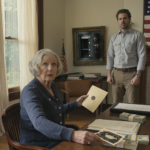

The cold of the marble floor was the first thing I felt, a brutal shock that shot up my spine. One moment, I was the matriarch of the Ellison family, sitting at the head of my own Christmas dinner table. The next, I was on the ground, my seventy-two-year-old body aching from the impact, looking up at the cruel face of my own son.
His voice echoed in the sudden, deathly silence of the room.
“That place belongs to my mother-in-law. Get out. And don’t come back.”
Just an hour before, the scene had been something out of a magazine. The Ellison Ranch in Dallas—our family’s heart for over forty years—was dressed in its holiday best. A magnificent pine tree, so tall its angel topper nearly brushed the vaulted wooden ceiling, glittered with a lifetime of ornaments.
The fireplace crackled, casting a warm golden glow on the faces of my family. The air smelled of roasted turkey, cinnamon, and pine, the scent of Christmas, the scent of home. I had spent the entire week preparing, and my hands, though wrinkled, still knew their way around a kitchen.
My heart found joy in creating this perfect day for the people I loved most.
My grandchildren, Emily and Jacob, had helped me decorate. Emily, at sixteen, was whip-smart and sensitive, with my late husband Frank’s thoughtful eyes. Jacob, at thirteen, was all heart—a bundle of pure, uncomplicated affection.
They were my world.
My son David arrived with his wife Monica and her mother, Helen. I greeted them all with hugs, though Monica’s was stiff, her cheek cold against mine. Helen, as always, was impeccably dressed, a picture of serene elegance.
But her eyes, when they met mine, held a glint I could never quite decipher. It was a polite, smiling coldness.
We gathered in the grand dining room. The long mahogany table was set with our finest china and silver, glowing under the soft light of a dozen candles. I moved to my customary seat at the head of the table, the place I had occupied beside my husband for four decades.
It was more than a chair. It was a symbol of my place in this family, in this home that Frank and I had built from nothing.
As I was about to sit, David stepped forward. His face was pale, his jaw tight.
“Mother,” he said, his voice strained.
Monica stood just behind him, her hand on his arm, a silent commander. Helen had already seated herself in the chair to the right of the head, watching the scene unfold with an unnerving calm.
“Yes, David?” I smiled, though a knot of unease tightened in my stomach.
He cleared his throat.
“That seat… Helen will be sitting there tonight.”
I blinked, certain I had misheard. “What are you talking about? Helen’s seat is right there. This has always been my seat.” I let out a small laugh, trying to brush away the absurdity of it. “Don’t be silly, dear. Let’s not be difficult on Christmas.”
“I’m not being difficult,” he snapped, his voice rising.
Monica’s fingers tightened on his arm, a subtle squeeze of encouragement.
“Things are changing. Helen is the senior woman here now. This place belongs to her.”
The words hit me like stones.
The senior woman.
I looked at Helen. She offered a small, sympathetic smile that didn’t reach her eyes. It was the smile of a predator that had finally cornered its prey.
The air crackled with tension. The staff who had been quietly serving drinks froze in place. My breath caught in my throat.
I looked at my son—my only child, the boy I had raised—and saw a stranger.
“David,” I began, my voice trembling slightly. “This is my home. You know what this chair represents.”
“It represents the past,” he cut me off, frustration boiling over into rage. “You’re stuck in the past, Mother. It’s time for new leadership in this family, in this company. It’s my house now.”
“It is not your house until I am dead,” I said, my voice dropping to a whisper filled with sudden, cold fury.
That was when he did it.
He didn’t just ask again. He didn’t argue. He lost all patience.
He placed his hand flat on my shoulder and pushed.
It wasn’t a gentle nudge. It was a hard, deliberate shove, fueled by years of resentment I never knew existed. For a seventy-two-year-old woman, it doesn’t take much to lose your balance.
I stumbled backward, my heel catching on the leg of the chair. Time seemed to slow down. I saw Emily’s wide, horrified eyes from across the table.
I saw Jacob’s mouth open in a silent scream. I saw Monica’s lips curl into a faint, triumphant smirk.
Then impact.
My hip struck the marble floor with a sickening thud. The sharp, blinding pain was immediate, but the emotional shock was worse. My wine glass, which I’d still been holding, flew from my hand and shattered against the floor.
The sound was as sharp and violent as a gunshot.
A deathly silence fell over the room. It was broken by my grandson.
“Grandma!” Jacob screamed, jumping up from his chair to run to me.
But my eyes were locked on a small blinking red light in the corner of the room.
Emily—my beautiful, sensitive Emily—had been holding her new phone, intending to capture a video of our family’s happy Christmas dinner. Her hand was shaking, but the lens was pointed directly at the scene.
It had recorded everything.
My son’s cruel words. His violent push. My humiliating fall. The broken glass spreading like tears around me.
I saw it all reflected in her phone’s dark screen: the face of a heartbroken old woman on the floor, the victorious smiles of my daughter-in-law and her mother, and the face of the son I no longer recognized, standing over me without a shred of remorse.
The war had begun, and they had just handed me my first and most powerful weapon.
A betrayal of that magnitude doesn’t happen in a single explosive moment. It’s a cancer that grows in the dark, fed by whispers and secret resentments. Looking back, I can see the signs were all there, like faint cracks in a foundation.
I just didn’t want to see them.
The week before Christmas, while my heart was full of nothing but love for my family, the plot against me was already in motion. I remember that week so clearly. The Dallas air was crisp and cool, a welcome break from the usual Texas heat.
The city was a glow with festive lights, and I felt a genuine sense of peace. Frank had been gone for two years, and the holidays were still tinged with sadness.
But my grandchildren, Emily and Jacob, were a powerful antidote to grief.
Their excitement was contagious.
I spent an entire afternoon at Neiman Marcus, searching for the perfect gifts. For Emily, I found a beautiful first-edition copy of her favorite classic novel, bound in dark green leather. She had my husband’s love for books, a quiet intelligence that saw the world with an artist’s sensitivity.
I knew she would treasure it.
For Jacob, it was easier. He was all boy, full of energy and a love for the outdoors. I bought him the new mountain bike he’d been circling in catalogs for months, a gleaming machine of chrome and black.
I pictured his face on Christmas morning and smiled to myself in the middle of the bustling store.
I was so wrapped up in my joyful preparations, so blissfully unaware. I imagined them all at the ranch, opening their presents, the fire roaring, our family safe and happy in the home Frank and I had built.
I saw David, my son, smiling as he watched his children. In my mind, he was still the boy who used to run to me with scraped knees, the young man who had looked at me with such pride at his college graduation.
I was living in a past that I now realize no longer existed.
While I was choosing wrapping paper, my son was sitting in a dark, expensive restaurant downtown, selling his birthright for a bowl of soup.
I can picture the scene now as if I were a fly on the wall. The restaurant would have been one of Monica’s choices, all sharp angles, gleaming chrome, and hushed, self-important tones. It was the kind of place where deals were made, a cold and sterile environment for a cold and sterile conversation.
The three of them were there: David, my son; Monica, his ambitious wife; and Helen, her mother—the serpent in our garden.
They would have ordered a bottle of wine that cost more than most people’s weekly groceries. Helen would have guided the conversation, as she always did, with the practiced skill of a master puppeteer.
She never raised her voice. She never appeared angry.
She simply planted seeds of poison with a gentle, concerned smile.
“David, darling,” I can hear her saying, her voice smooth as silk. “You know how much I admire your mother. Margaret is one of the strongest women I’ve ever known.”
She would have paused, letting the compliment land, disarming him. Then she would continue, her tone shifting to one of deep, feigned concern.
“The world of construction, of business… it isn’t the same one she and Frank conquered. It’s faster now, more ruthless. Her ideas, while well-intentioned, are outdated.”
David would have shifted uncomfortably in his seat. A part of him—the boy I raised—would have wanted to defend me.
“Mother knows what she’s doing. She helped Dad build Ellison Construction from the ground up.”
That’s when Monica would have jumped in, playing her part perfectly.
“Of course she did, honey,” she’d say, placing her hand on his. “No one is denying that. But that was then. This is now. We just had a board meeting where she tried to earmark a million dollars for a new local arts program. A million. We have competitors trying to undercut us on the Bridgeport contract, and she wants to fund a ballet.”
Helen would have nodded gravely.
“It’s not about the money, David. It’s about focus. Your mother still sees the company as a family project, a way to do good in the community. That’s lovely, but it’s a liability in this day and age. You see the bigger picture. You have your father’s head for business… but you’re being held back.”
She knew exactly which buttons to push.
His entire life, David had struggled under the weight of his father’s legacy. Frank was a giant of a man, not just in stature but in character and accomplishment. David—who was not as driven and not as brilliant—had always felt like he was living in his father’s shadow.
Helen’s words were designed to hit him where it hurt the most: his insecurity, his desperate need to prove that he was his own man.
“She needs to understand that her time of running things is over,” Helen would have said, her voice dropping to a conspiratorial whisper. “It’s your time now. You have to be strong, David. Not for you, but for your own family, for Monica, for your children’s future.”
“She’s right,” Monica would chime in, her eyes hard. “We need to have complete control, David. Full authority to make the tough decisions without having to run them by her for approval. It’s time we took what is rightfully ours.”
The hesitation, I imagine, in my son’s eyes is the most painful part.
There must have been a moment, a flicker of a second, where his love and loyalty to me fought against the poison they were pouring into his ears. But it wasn’t a fair fight.
On one side was his mother, who he saw as a relic of the past. On the other were these two women stroking his ego, promising him the power and respect he craved.
They were offering him a crown.
All he had to do was betray his own mother.
I can see him picking up his wine glass, his knuckles white as he gripped the stem. He stared into the deep red liquid for a long moment. Then he took a slow drink, placed the glass back on the table with a soft click, and gave a single sharp nod.
A silent agreement had been forged in the dim light of that soulless restaurant.
The ambush was set, and I—miles away—was happily paying for a bicycle, completely oblivious to the fact that my own son had just agreed to push me out of my home, my company, and my life.
A few days before the Christmas Eve storm broke, there was a quiet dinner, a false peace. It was just the four of us—myself, David, and the children. Monica was conveniently away at a spa weekend with her mother, a trip I now see was likely a final strategy session.
At the time, I was just relieved to have my son and grandchildren to myself. I thought it was an opportunity to connect, to bridge the strange new distance I’d been feeling between us.
I was a fool.
I cooked David’s favorite meal: pot roast, slow-simmered for hours until it was tender enough to fall apart with a fork, with creamy mashed potatoes and glazed carrots. It was the taste of his childhood, a meal I hoped would remind him of simpler, happier times.
We sat at the smaller round table in the breakfast nook, a cozy space that looked out over the sprawling ranch lands as the Texas sun began to set, painting the sky in shades of orange and purple.
For a little while, it felt normal. Jacob chattered excitedly about his school’s basketball team, and Emily spoke quietly but passionately about a new photography project.
I watched David listen to his children, a soft smile on his face, and my heart ached with love. I saw a glimpse of the man he was supposed to be, the man I had raised.
That glimpse gave me the courage to bring up a subject that was dear to my heart.
“David,” I began, waiting for a lull in the conversation. “I had the most wonderful meeting today with the folks from the Children’s Music Foundation…”
His smile tightened almost imperceptibly.
“Oh?”
I pressed on, my enthusiasm making me blind to the warning sign.
“They’re doing incredible work providing instruments and free lessons to children in underserved communities right here in Dallas. Their current building is practically falling down, and they’re trying to raise funds for a new facility. I was thinking Ellison Construction could be the lead donor. We could fund the entire performance hall. Imagine it, darling—the Frank Ellison Performance Hall. It would be such a beautiful way to honor your father’s memory.”
I looked at him, my eyes shining with the vision of it. Frank had been a quiet philanthropist. He believed that the wealth we created came with a responsibility to the community that helped us thrive.
This project felt like a continuation of his very soul.
David put his fork down with a soft clink against the china. The sound seemed unnaturally loud in the suddenly quiet room. He took a slow sip of water, his eyes cold and unreadable.
“Mother,” he said, his voice flat and devoid of any warmth. “The company is not your personal charity fund.”
The words were so blunt, so dismissive. They felt like a physical slap.
I stared at him, my smile faltering. “I… I don’t understand. It’s a tax write-off, of course, and the PR would be wonderful, but more than that, it’s the right thing to do. It’s what your father would have wanted.”
“I’m not interested in what Dad would have wanted,” he said, a sharp, cruel edge to his voice. “I’m interested in profit margins and shareholder value. We’re in the middle of a bidding war for the new airport expansion. Every dollar counts. We are not a foundation. We are a construction empire, and I would appreciate it if you would let me run it as such.”
The air went thick with unspoken things.
Jacob looked down at his plate, his cheerful energy completely extinguished. Across the table, Emily’s eyes darted from her father’s hard face to my stunned one. I could see the worry clouding her features.
She felt the chill as keenly as I did. She knew in that instant this wasn’t a simple business disagreement.
It was a power play.
I tried to recover, to smooth over the ugly rift that had just torn through our meal. I forced a laugh, but it sounded brittle and hollow even to my own ears.
“Of course, dear. You’re the CEO. I was just making a suggestion.”
“Then please keep your suggestions to yourself,” he said, picking up his fork again as if nothing had happened. “I’ll handle the business decisions from now on.”
I wanted to argue. I wanted to scream at him, to remind him I wasn’t just some board member. I was his mother, the co-founder of the very company he was so arrogantly claiming as his own.
I had poured my own blood, sweat, and tears into Ellison Construction. My business acumen had saved Frank from ruin more than once, a fact we had always kept between us to protect his pride.
But I looked at the children, at their troubled faces, and I bit my tongue so hard I tasted blood.
I just nodded.
“All right, David.”
The rest of the dinner was an exercise in agony.
We talked about the weather, about school, about anything and everything except the elephant that was now sitting at the table with us. But the pot roast tasted like ash in my mouth.
The warmth of the room had evaporated, replaced by an icy cold that had nothing to do with the winter evening outside.
As I looked at my son, I saw the full extent of Helen and Monica’s influence. His words weren’t his own. They were echoes of their cold, calculating ambition.
He was wearing his father’s suit, sitting in his father’s chair, but he was a stranger to me.
The loving boy I knew—the one who respected and admired his parents—was gone. In his place was this hard, resentful man who looked at me not with love but with impatience, as if I were an obstacle in his path.
That night, for the first time, I truly understood. This wasn’t a phase. This wasn’t a simple case of my son wanting to find his own way.
A chasm had opened up between us, deep and wide, and perhaps impossible to cross.
He wasn’t just trying to run a company. He was trying to erase me from it.
And I knew, with a certainty that chilled me to the bone, that the quiet dinner was just the first tremor before the earthquake.
The drive from the ranch to Charles Bennett’s office was a blur. The familiar Dallas skyline—usually a symbol of the empire Frank and I had built—seemed alien and hostile. Every glittering skyscraper felt like a monument to the corporate ruthlessness that had infected my son.
My hip throbbed with a dull, persistent ache, but it was nothing compared to the pain in my heart.
Charles Bennett had been my husband’s lawyer, his best friend since they were boys, and the executor of his will. His office was an oasis of timeless dignity in a city obsessed with the new.
It was paneled in dark mahogany, lined with floor-to-ceiling bookshelves, filled with leatherbound legal tomes, and smelled faintly of old paper and good whiskey.
It was a place of secrets and trust.
He met me at the door, his usually cheerful face etched with grave concern. At seventy-four, Charles was still sharp as a tack, with wise, kind eyes that had seen it all.
He took one look at my face and simply said, “In here, Margaret. Let me pour you a brandy.”
I didn’t protest. I sank into one of the deep leather armchairs facing his massive desk as he handed me a heavy crystal glass. The fiery liquid did little to warm the ice in my veins.
“He pushed me,” I said, my voice a hollow whisper.
“Charles,” I went on, and recounted the whole sordid affair: the demand for my chair, David’s cold words, the shove, the fall in front of my grandchildren.
I spoke without tears, my shock having burned away everything but a cold, hard knot of grief.
Charles listened without interruption, his hands steepled under his chin. He didn’t seem surprised, which was somehow the most damning thing of all.
When I finished, he was silent for a long moment, his gaze distant.
“Frank saw this coming,” he said finally, his voice heavy. “He prayed it would never happen, but he knew it might. He knew David’s weakness.”
“What are you talking about?”
Instead of answering, Charles rose and walked to a large oil painting of a Texas landscape that hung on the far wall. He swung it aside, revealing the dark steel door of a walk-in safe.
He spun the combination dial with practiced clicks and pulled the heavy door open. From a private lockbox inside, he withdrew a thick, cream-colored envelope sealed with the familiar Ellison family crest in dark red wax—my husband’s seal.
He placed it on the desk between us.
“Frank added a special provision to his final directives,” Charles said. “Separate from the main will. He called it his poison pill clause.”
My hand trembled as I reached for the envelope.
“A poison pill? That’s a corporate term. A defense against a hostile takeover.”
“Precisely,” Charles said, his eyes meeting mine. “And Frank saw exactly what was coming. A hostile takeover of his family. He knew David was susceptible to influence, especially from Monica and her mother. He saw their ambition, so he left you a weapon of last resort.”
Charles leaned forward, his voice low and serious.
“The clause states that if David, as CEO and majority shareholder, subjects you to provable and irrefutable public humiliation, you are granted the immediate right to purchase his entire controlling stake in Ellison Construction. All of it for the symbolic sum of one United States dollar.”
I stared at him, the air leaving my lungs.
The audacity of it, the sheer strategic brilliance, was pure Frank. It was a master chess move from beyond the grave, but the implication was monstrous.
He wanted me to bankrupt my own son.
“No,” Charles corrected gently. “He wanted to give you a choice. He wanted to ensure that you would never be at the mercy of David’s weakness or Monica’s greed. He was giving you a loaded gun, Margaret, and trusting that you would only ever use it if they backed you into a corner so tight you had no other way out.”
A loaded gun.
The weight of it settled on me, heavy and cold.
For a moment, I recoiled. To pull that trigger would be to declare total war, to destroy what was left of my family.
It was unthinkable.
Then Charles asked the question that changed everything.
“It’s an explosive legal maneuver,” he said. “And they would fight it tooth and nail. The entire case would hinge on one thing: the proof. The humiliation can’t be just your word against his. It has to be absolute, undeniable—something a judge could look at and have no doubt.”
He leaned in.
“Do you have proof, Margaret?”
My mind, which had been a whirlwind of pain and confusion, suddenly went still and silent. The image that flashed behind my eyes was as clear as a photograph.
The small blinking red light of Emily’s phone.
The screen capturing the entire horrific scene.
My son’s face twisted in anger. His hand on my shoulder. My body falling. The shatter of the glass. The triumphant smirk on Monica’s face.
It wasn’t just proof.
It was a verdict.
I looked at Charles, and I felt the last of my hesitation burn away, replaced by something I hadn’t felt in years: the cold, calculating fury of a woman who had just been handed the means to fight back.
My memory of that evening now plays back in fragments, each one sharp and clear, like shards of broken glass. But the moments just before the fall are what haunt me the most.
That was when the battle lines were drawn—not with a cannon blast, but with a whisper and a smile.
That was when the air in my own home turned to poison.
I was standing near the fireplace, speaking with Jacob about his Christmas wish list, when Helen made her entrance. She didn’t just walk in.
She arrived.
She was wearing a deep emerald green velvet dress that clung to her in a way that was both elegant and vaguely predatory. Diamonds glittered at her throat and ears, cold and brilliant.
She moved through the room not as a guest, but as a queen taking possession of her court.
I turned to greet her, a polite smile on my lips.
“Helen, you look stunning. Merry Christmas.”
“Margaret, dear,” she said, her voice a low purr. She air-kissed the space beside my cheek. “You’ve made the place look so festive, so traditional.”
There was a subtle emphasis on the last word, a hint of condescension that I chose to ignore.
My unease began to grow when she didn’t mingle. Instead, she glided directly to the dining room. I watched as she surveyed the magnificent table I had spent all afternoon setting.
Then, with a quiet, deliberate grace, she placed her evening bag on the table next to the chair to the right of the head—my husband’s former seat, the seat of honor.
And then she sat down, crossing her legs, the picture of serene entitlement.
It was a blatant power play, and everyone in the room felt it. The serving staff, putting the final touches on the place settings, exchanged nervous glances.
Even Jacob seemed to sense the shift in the atmosphere, his cheerful chatter fading into silence.
It was a declaration. She was no longer a guest.
In her mind, she had already been promoted.
I saw David and Monica standing near the entryway, their heads close together. They were a tight, conspiratorial unit.
Monica had her hand locked on David’s forearm, her crimson nails digging slightly into the fabric of his suit jacket.
I couldn’t hear her words, but I could read the intensity in her expression, the way her eyes bored into him.
It was the look of a handler giving a final, urgent command to a prized animal before letting it off the leash.
Later, piecing it all together, I could almost hear her whisper, her voice a venomous hiss in his ear.
“It’s time, David. The pleasantries are over. Are you going to be the man of this house, or are you going to let her treat you like a little boy forever? Show her who’s in charge now.”
I watched my son’s face. I saw the conflict there, the flicker of doubt, the shadow of the boy who loved his mother.
But it was fleeting.
Under Monica’s relentless pressure, his features hardened, his jaw set. He straightened his shoulders, pulling himself up to his full height, a pale imitation of his father’s confident stance.
He was steeling himself for what was to come.
The writing was on the wall in bold, cruel letters, and I had been too busy admiring the Christmas decorations to read it.
The pressure from those two women was a physical force in the room. It was a vice, and my son was caught in the middle, being squeezed until his own character and conscience were crushed.
Helen, with her silent, regal disapproval from the table, and Monica, with her sharp, whispered provocations, had become the puppet masters.
David was about to dance on their strings.
I decided to try and seize back control, to pretend this wasn’t happening. I clapped my hands together, forcing a bright, cheerful tone into my voice.
“All right, everyone. Shall we take our seats? The turkey is about to be carved.”
My voice cut through the thick tension, but it didn’t dissipate it. The staff scurried to their positions.
Emily and Jacob moved uncertainly toward their chairs.
Monica gave David’s arm one last hard squeeze, then released him, a faint, knowing smirk on her lips.
She had wound him up and set him loose.
I turned and walked toward my chair at the head of the table, the one that had been mine for forty years. Every step felt heavy, as if I were wading through water.
Every eye was on me.
The cheerful crackle of the fire in the hearth suddenly sounded deafening in the strange silence.
This was it.
This was the moment where the cold war that had been brewing in my family was about to turn hot.
As I reached for the back of my chair, I saw David move out of the corner of my eye. He wasn’t walking to his own seat.
He was walking directly toward me.
His expression was a mask of grim determination.
The storm was no longer gathering.
It had arrived.
I don’t remember getting up off the floor. I don’t remember the hands that may or may not have helped me.
My memory of leaving the dining room is a tunnel of roaring silence, the horrified faces of the staff and my grandchildren blurring into a meaningless watercolor of shock.
The only thing I felt was the searing cold of the marble that had seeped into my bones and the even colder reality of what had just happened.
My son—my own son—had put his hands on me.
I walked, not ran, up the grand curving staircase of my home. Each step sent a jolt of pain through my hip, a grim metronome marking my retreat.
I kept my back straight, my head held high.
I would not give them the satisfaction of seeing me crumble.
Not yet.
I could feel their eyes on my back, a combination of shock, guilt, and—I was certain—cold-blooded satisfaction.
My bedroom was my sanctuary, the one place in this sprawling house that was truly mine. It was decorated in soft creams and blues, filled with books and photographs of a life I thought I understood.
I stepped inside, and the first thing I did was turn the heavy, ornate brass lock on the door.
The loud, definitive click was the sound of a drawbridge being raised, a fortress wall being sealed.
I was safe for now.
I leaned my back against the solid wood of the door and squeezed my eyes shut, my breath coming in ragged, shallow gasps. The dam of composure I had so carefully constructed was about to break.
A sob, hot and raw, clawed its way up my throat.
This couldn’t be real.
It was a nightmare, a grotesque distortion of a Christmas dinner.
Any moment now, I would wake up.
But the throbbing in my hip was real.
The shattered image of my son’s face—twisted with a rage I’d never seen—was real.
A soft, hesitant knock came at the door.
“Go away!” I choked out, my voice thick with unshed tears.
“Grandma,” a small, trembling voice whispered through the wood. “It’s me, Emily. Please.”
My heart fractured a little more.
Emily, my sweet, sensitive girl.
She shouldn’t have to see this, to be part of this ugliness.
But I couldn’t turn her away.
I took a deep, shuddering breath, wiped the single tear that had escaped from the corner of my eye, and unlocked the door.
She stood in the hallway, her face pale and streaked with tears, her new phone clutched in her hand like a piece of damning evidence. She looked so small, so lost.
“Grandma, I’m so sorry,” she whispered, her voice breaking. “I was just trying to get a picture of the candles. And then… and he…”
She couldn’t finish. Her words dissolved into a fresh wave of sobs.
I pulled her into my arms, holding her tight.
“Oh, my sweet girl,” I murmured into her hair. “This is not your fault. None of this is your fault. You hear me?”
She nodded against my shoulder, but her body was still shaking.
After a long moment, she pulled back slightly and held out the phone to me. Her hand was trembling so violently the device was a blur.
“I… I think you need to see this,” she said, her eyes pleading with me to understand.
I took the phone from her. Its cool, smooth surface felt alien in my hand.
“Go to your room, sweetheart,” I told her gently. “Lock your door. I’ll come see you in a little while.”
She hesitated, looking as if she wanted to stay to protect me. But she saw the new, hard look in my eyes and simply nodded, giving my hand one last squeeze before turning and hurrying down the hall.
I locked the door again and walked on unsteady legs to a wingback chair near the window.
Outside, the last light of day had faded, and the vast Texas sky was a blanket of dark, indifferent velvet. For a moment, I just sat there, the phone heavy in my lap.
Did I really want to see it?
Did I want to relive the single most humiliating moment of my life?
Part of me wanted to throw the phone against the wall, to shatter it into a million pieces and pretend it never happened. Part of me—the mother in me—wanted to find excuses for David, to believe he had just snapped under pressure, that he didn’t mean it.
But the other part of me, the part that had survived droughts and recessions, the part that had stood shoulder-to-shoulder with Frank as we clawed our way to the top, knew that sentiment was a luxury I could no longer afford.
I needed to see the unvarnished truth.
My hand was shaking as I pressed the play button.
The video started with the sounds of a happy family. Jacob was laughing at something. I could hear my own voice, bright and cheerful.
The camera panned unsteadily across the beautifully set table, the glittering tree, the candles glowing.
It was a perfect Christmas scene.
And then the camera settled on me as I approached the head of the table.
Watching it from this third-person perspective was a brutal, out-of-body experience.
I saw it all with a clarity that stole my breath. I saw David’s approach, his face a mask of false confidence.
I heard his cold, rehearsed words. I saw my own confused, hurt expression.
And then I saw the push.
It was worse than I remembered.
It wasn’t a moment of lost temper.
It was deliberate.
Calculated.
An act of violence.
I watched my own seventy-two-year-old body stumble backward, my arms flailing, my face a mask of pure shock.
I saw the fall, the sickening thud as I hit the unforgiving marble.
But it was the aftermath that truly turned my blood to ice.
As my on-screen self lay stunned on the floor, the camera—still recording—caught the reactions. David stood over me, his expression not of horror or regret, but of grim, resolute justification.
And behind him I saw Monica.
The mask slipped.
For one fleeting, terrible second, a smirk of pure, unadulterated triumph curled her lips.
She had won.
In that instant, watching that smirk, something inside me broke. But it wasn’t my spirit.
It was the last fragile thread of maternal love and denial that I had been clinging to.
The pain didn’t vanish, but it began to change, to transmute. It cooled and hardened, crystallizing from raw, weeping grief into something sharp, dense, and powerful.
It became rage.
A cold, clear, focused rage.
I didn’t cry.
The tears that had been welling in my eyes simply evaporated, burned away by this new volcanic heat rising within me.
The woman who had been pushed to the floor was a victim.
The woman watching this video was not.
My gaze drifted from the phone screen to the large silver-framed photograph on my bedside table. It was Frank, taken on our fortieth anniversary.
He was smiling, his eyes crinkling at the corners, full of the strength and love that had been the bedrock of my life.
I looked at his image, and it wasn’t a plea for help.
It was a promise.
They will not destroy what we built, Frank. I will not let them.
My hand, which had been trembling moments before, was now perfectly steady.
My movements were calm, deliberate.
I stood up, walked to my nightstand, and picked up my own phone.
My fingers didn’t falter as I scrolled through my contacts and found the name: Charles Bennett.
He answered on the second ring, his voice warm with holiday cheer.
“Margaret? Merry Christmas.”
I took a breath.
When I spoke, my voice was not the voice of a weeping, broken old woman. It was a voice he hadn’t heard in years—the voice of the woman who had once stared down bankers and union bosses without blinking.
It was choked with emotion, yes, but layered with steel.
It was the voice of a queen reclaiming her throne.
“Charles,” I said, my words precise and deadly. “I have the proof. Activate it.”
Christmas morning dawned bright and cold over Dallas.
In David and Monica’s sterile modernist mansion—a house of glass and white marble that had always felt more like a corporate headquarters than a home—the mood was one of triumphant celebration.
They had done it.
The coup was complete.
I imagine them waking late, wrapped in thousand-thread-count sheets, the previous night’s ugliness already a distant, justified memory.
They would see it not as a betrayal, but as a necessary business decision, a changing of the guard.
They were the future.
I was the past.
There would have been no frantic early morning rush of children eager for presents.
Emily and Jacob were with me at the ranch, a fact that probably brought David and Monica a sense of relief.
They could celebrate their victory in peace.
I see them in my mind’s eye standing in their cavernous living room, glasses of expensive champagne in hand, toasting each other in front of a ridiculously oversized, professionally decorated Christmas tree that was as perfect and soulless as the rest of their house.
“To the new era of Ellison Construction,” Monica would have said, her voice smug, her eyes glittering with ambition.
“And to its new chairman,” she would clink her glass against David’s, the crystal ringing out in the quiet house.
“To us,” David would reply, a proud, foolish smile spreading across his face.
He finally felt like the man of the house, the king of the castle.
He was blind to the fact that he was merely a prince consort, and Monica was the one truly wearing the crown.
He probably expected his phone to be blowing up. He likely anticipated a barrage of angry, tearful, or pleading calls from me.
Forty-seven missed calls.
A hundred desperate texts.
That’s what he would have considered a victory.
It would have fed his ego, confirming he had broken me, that I was now powerless and pleading for scraps from his table.
But the morning passed in silence.
My number never appeared on his screen.
It was Monica, of course, who saw it first.
She was surgically attached to her phone, her thumb in a state of perpetual scrolling, while David was admiring a new, obscenely expensive watch she had gifted him.
She was scanning his emails, which he had long ago given her full access to.
“Well, well,” she would have murmured, a small, cruel smile playing on her lips. “What have we here?”
David, still basking in the glow of his new authority, would have looked over her shoulder.
“What is it?”
“An email,” she’d say, her tone dripping with amusement. “From Charles Bennett’s office. Sent at 6:00 a.m. on Christmas morning. How festive.”
I can picture them reading it together, their heads bent over the small, glowing screen.
The language of the email would have been brutally formal, stripped of all sentiment.
It was pure legal ice.
Subject: Formal Notice of Intent to Enforce Clause 12B of the Ellison Family Trust and Holdings Agreement.
Dear Mr. Ellison,
This letter serves as formal and official notification that, as of 9:00 p.m. on December 24th, a triggering event as defined in Clause 12B of the aforementioned agreement has occurred.
Consequently, Mrs. Margaret Ellison is hereby exercising her irrevocable right to purchase your full and complete controlling interest (51%) in Ellison Construction Incorporated. As stipulated, the purchase price for this transfer of shares is contractually fixed at the sum of $1 USD.
Please expect to receive formal transfer documents and further instructions from our office within the next business day.
We advise you to secure legal counsel.
Sincerely,
Charles Bennett
Bennett & Associates
There would have been a moment of stunned silence as they processed the words.
Then the laughter would begin.
It wouldn’t be a small chuckle of disbelief.
It would be a full-throated, condescending roar.
Monica would throw her head back and laugh, a sharp, ugly sound that echoed off the marble floors.
“Is she serious?” Monica would gasp, wiping a tear of mirth from her eye. “A dollar? The old woman has finally lost her mind. This is pathetic.”
David’s own laughter would be a beat behind hers, a little less certain at first, then growing in volume as he took his cue from his wife.
“She’s bluffing. It’s a scare tactic. What did she think—that I’d see this and come running back to her, begging for forgiveness? It’s a Hail Mary pass from a quarterback with a broken arm.”
Monica would sneer, her confidence absolute.
“She’s got nothing. The clause itself is probably unenforceable. Some sentimental nonsense your father cooked up that would never hold up in court.”
They would have dissected it, picking it apart with the arrogance of people who believe they are untouchable.
Their entire analysis would have hinged on one simple, fatally flawed assumption.
“And let’s be real,” David would say, puffing out his chest. “Even if, in some fantasy world, this clause was ironclad… where would she get the money?”
Monica would nod, swirling her champagne.
“Exactly. She’s asset-rich but cash-poor. All her wealth is tied up in the company—the company you control. To buy you out, she’d need access to hundreds of millions in liquid capital to cover the company’s debts and operational costs. Even if the share price is a dollar, no bank would ever give her that kind of loan without the company as collateral. And we would never approve it.”
She’d lift her glass.
“It’s a dead end. She has absolutely no way to fund it. She doesn’t have a leg to stand on.”
They were so sure, so wrapped up in their own cleverness.
They saw the world through a lens of balance sheets and stock prices. And in that world, they were invincible.
They couldn’t conceive of a strategy that relied on anything else—on loyalty, on a father’s foresight, on a granddaughter’s love.
So they dismissed it.
They laughed it off as the desperate, last-ditch effort of a bitter old woman.
They deleted the email, poured another glass of champagne, and went about their Christmas day, secure in the knowledge they had won.
They were celebrating a victory, completely unaware that the single, quiet email they had just laughed at wasn’t a pathetic bluff.
It was the sound of a well-oiled guillotine sliding into place.
While David and Monica were laughing in their glass house, Helen was sitting in the quiet, silk-paneled study of her own home.
And she was not laughing at all.
Monica, in her gloating triumph, had forwarded Charles Bennett’s email to her mother with a simple, smug message attached.
Can you believe the nerve? She’s officially lost it. Lol.
Helen read the email once.
Then she read it again, her perfectly manicured finger scrolling slowly down the screen.
There was no amusement in her cold, intelligent eyes.
David and Monica saw a pathetic bluff.
Helen saw a declaration of war from a player she had never underestimated.
She knew my late husband, Frank. He was a brilliant, tough-as-nails businessman, but he was also a sentimentalist when it came to his family.
This poison pill clause, however, was not the work of a sentimentalist.
It was the cold, hard calculation of a master strategist.
Frank Ellison did not build half measures into his legal directives.
If the clause existed, Helen knew with chilling certainty it was ironclad.
More importantly, she knew me.
She had spent years observing me, studying me with the detached curiosity of a biologist examining a rival species.
She knew that beneath the polite exterior of the society hostess and doting grandmother was the woman who had helped Frank build his empire.
I was not prone to hysterics.
I did not make empty threats.
If I had told Charles Bennett to activate that clause, it was because I held a winning hand.
The only question was: what was my ace in the hole?
The phrase provable and irrefutable public humiliation stuck in her mind.
What proof could I possibly have?
A witness?
A recording?
It didn’t matter.
The fact that I was confident enough to make the move was all the proof Helen needed that David and Monica had blundered—and blundered badly.
They had mistaken a sleeping lioness for a house cat.
And now they were about to get mauled.
Helen did not waste a single second on recriminations.
Emotion was a liability.
Action was everything.
She immediately saw the new shape of the battlefield.
This was no longer a simple two-sided coup.
It was a chaotic mess, and chaos was a ladder.
Her first call was to her publicist, Michael.
“Darling,” she said, her voice a mask of distress and sorrow. “Something terrible has happened. An internal family matter has escalated. I need you to release a statement on my behalf immediately.”
Within the hour, a carefully worded statement was leaked to the Dallas society pages and key financial news outlets.
Helen Dwinter is profoundly saddened and deeply disturbed by the recent reports of a conflict within the Ellison family. She was not party to, nor did she have any prior knowledge of, the regrettable incident that took place on Christmas Eve. Her only wish is for a swift and peaceful resolution. Her primary concern at this time, as it has always been, is for the stability of Ellison Construction and the preservation of the legacy of its great founder, the late Frank Ellison.
It was a masterpiece of plausible deniability.
With a few sentences, she had painted herself as a concerned, innocent bystander.
She had publicly condemned David’s actions without ever mentioning his name.
She severed herself from him like a surgeon excising a tumor.
She had thrown her own daughter and son-in-law directly under the bus while positioning herself as the noble guardian of Frank’s legacy.
The snake had shed its skin.
Her second phase began immediately after.
She picked up her private phone and started making calls—not to lawyers, but to the handful of key members on the Ellison Construction Board of Directors.
Her first call was to John Carmichael, a gruff, old-school oil man who had served on the board with Frank for thirty years.
“John, it’s Helen,” she said, her voice now filled with a different kind of performance: that of a trusted peer in a time of crisis. “I’m afraid I’m calling with terrible news. I’m sure you’ll be hearing whispers soon, so I wanted you to hear it from me first.”
She laid out a carefully edited version of the story.
David, under immense pressure, had suffered a lapse in judgment and behaved appallingly toward me. As a result, I—in a state of understandable emotional distress—was now making rash legal threats that could destabilize the entire company.
“This is no longer a family squabble, John,” she said, her voice low and serious. “This is a five-alarm fire. David has proven he is too volatile to lead. Margaret, God love her, is thinking with her heart, not her head. The company is about to be torn apart by their personal war. The shareholders are going to panic.”
She let him absorb the impending disaster.
Then she offered the solution.
“The board needs to act,” she said calmly. “We need a steady, neutral hand at the tiller to guide us through this storm. Someone who isn’t emotionally compromised. Someone who respected Frank and who can protect what he built.”
She drew in a breath.
“I am prepared to put my name forward to serve as interim chairwoman until this unfortunate crisis is resolved.”
She wasn’t an ally of David and Monica, fighting for their control.
She wasn’t an ally of mine, seeking to restore order.
She was a third power, emerging from the smoke and chaos.
She was a shark that had been circling, and having smelled blood in the water, she was now making her move.
The war for Ellison Construction was no longer a duel.
It was now a viper’s nest, and the three-way battle had officially begun.
The first forty-eight hours after Christmas were a brutal lesson in modern finance.
As Monica had so smugly predicted, my plan hit a brick wall, and it hit hard.
I went to the banks—the same institutions where the Ellison name had been golden for forty years. I met with bankers who had called my husband a friend, men who had attended his funeral and spoken of his integrity.
They were all very polite.
They offered me coffee and condolences, and then, one by one, they turned me down flat.
David had been busy.
He had used his power as CEO to poison the well, warning every major lender in Dallas that Ellison Construction was in the midst of a hostile takeover attempt, and that any capital loan to me would be at extreme risk.
He painted me as an unstable, emotional widow on a vendetta.
He made me a pariah overnight.
By the third day, I was at my wit’s end.
I had a loaded gun.
But I had no ammunition to fire it.
Charles Bennett and I sat in his office, the grim reality of our situation settling over us.
We had the law on our side, but in the world of high finance, cash is king.
And our coffers were empty.
“There’s no one left to ask, Margaret,” Charles said, the defeat heavy in his voice.
I stared out his window at the steel and glass canyons of the city.
He was wrong.
There was one person left.
One name so unthinkable, so far beyond the pale, that I hadn’t even allowed myself to consider it until now.
“Get me a meeting with Arthur Vance,” I said, my voice quiet but firm.
Charles looked at me as if I had just suggested we set the building on fire.
“Arthur Vance? Margaret, are you out of your mind? He was Frank’s bitterest rival. They spent thirty years trying to put each other out of business. The man is a shark.”
“I know exactly who he is,” I replied, my gaze unwavering. “And right now, a shark is exactly what I need.”
Arthur Vance’s mansion was the physical opposite of my home.
Where the Ellison Ranch was warm wood, worn leather, and treasured memories, his home was a monument to cold, modern power.
It was all glass, white marble, and sharp angles, filled with abstract art that I found jarring and soulless.
It was the home of a man who admired strategy, not sentiment.
He met me himself in a vast minimalist living room that overlooked the city.
At seventy-five, Arthur was lean and sharp, his eyes a pale, piercing blue that missed nothing.
We had been social adversaries for decades, but we had always shared a quiet, grudging respect for one another’s intellect.
He respected me far more than he had ever respected my son.
“Margaret,” he said, foregoing any pleasantries. “To what do I owe this unexpected pleasure?”
I didn’t sit down.
I had not come for a social call.
“Let’s cut to the chase, Arthur. You’ve heard the rumors.”
“I hear everything,” he replied, a faint calculating smile on his lips.
“My son has locked me out of my own company. I have a legal mechanism to take it back, but he’s blocked me at every bank in the state. I’m legally entitled to buy his shares, but I lack the capital to run the company once I do.”
I held his gaze.
“I am backed into a corner.”
He watched me, his expression unreadable, letting the silence hang in the air.
“I need your money, Arthur,” I said, laying my cards on the table. “And you need the one thing you’ve never been able to get. A door into Ellison Construction—a door that only I can open for you.”
He walked to the floor-to-ceiling window and looked out at the city below, his hands clasped behind his back.
He knew the deal of a lifetime when he saw it.
He was the only person in Texas with the resources and the nerve to defy David, and the only one who would relish the fight.
He turned back to face me.
“Forty percent,” he said, his voice flat and non-negotiable. “I’ll provide the full line of credit you need to operate, and I’ll fund your legal battle to the bitter end. In exchange, upon your successful acquisition of your son’s shares, you will sign over forty percent of the company to me. That’s my price.”
It was a devil’s bargain.
I would be giving away nearly half of the empire Frank and I had built.
I would be handing our greatest enemy a stake in our legacy.
But the alternative was to let it all fall into the undeserving, incompetent hands of Monica and David, to let them tarnish everything Frank had stood for.
I didn’t hesitate.
“You have a deal.”
I held out my hand.
Arthur Vance looked at it for a moment, then took it in his own firm, dry grip.
The handshake was brief, businesslike.
An unholy alliance had just been formed.
I had sacrificed a piece of my kingdom.
But in doing so, I had just bought myself an army.
The Ellison Construction boardroom is on the top floor of a skyscraper in downtown Dallas. It’s a space designed to project power, with a twenty-foot-long mahogany table polished to a mirror shine and a wall of glass offering a god’s-eye view of the city we had built.
I had chosen the decor myself years ago, but that morning, walking into it felt like entering a foreign country.
They were all there: the entire board of directors, a collection of grim-faced men in expensive suits, summoned by their CEO for an emergency meeting.
At the head of the table, in the seats that had once belonged to Frank and me, sat David and Monica.
My son looked every bit the part of the powerful executive, his suit perfectly tailored, his hair perfectly quaffed. He radiated an air of impatient authority.
Beside him, Monica was a portrait of icy composure, her hands folded neatly on the table, a slim leather portfolio in front of her.
They looked confident.
Invincible.
From their perspective, this was the final act. They had weathered my pathetic legal threat, secured the banks, and were now about to publicly consolidate their power, and formally cast me out.
They thought this meeting was their coronation.
They had no idea it was their execution.
The room fell silent as the heavy oak doors swung open.
Every head turned.
The expressions on the faces of the board members shifted from nervous anticipation to stunned disbelief.
David’s jaw literally dropped.
I walked in first, my steps slow and deliberate on the plush carpet. I wore a simple but impeccably tailored navy blue suit, my hair styled, my expression serene.
I was not the hysterical old woman they were expecting.
I was the matriarch of Ellison Construction, and I had come to reclaim my house.
The second shockwave hit the room a moment later as Charles Bennett followed me in, carrying a briefcase.
The third, and most powerful, was the man who entered behind him.
Arthur Vance.
The sight of my husband’s greatest rival walking into the Ellison boardroom sent a ripple of audible gasps through the room.
Arthur, looking perfectly at ease in his own bespoke suit, simply nodded to the assembled board members as if he were attending a regular Tuesday meeting.
He was followed by a team of three sharp, predatory-looking lawyers from his own firm, who moved with the silent efficiency of a wolfpack.
I saw Helen seated at the far end of the table. She had positioned herself as the wise elder, the neutral party ready to step in and save the company from the family’s implosion.
Her mask of calm was flawless.
But I saw the flicker of genuine shock in her eyes as she took in the sight of Arthur Vance.
This was a variable she had not accounted for.
Her carefully constructed plans had just been hit by a tornado.
David was the first to find his voice.
He shot to his feet, his face turning a blotchy red.
“What is the meaning of this? Mother, you are not welcome here. And him?” He jabbed a trembling finger toward Arthur. “This is a private meeting of the Ellison Construction Board of Directors. Security!”
Two security guards who had been standing by the door took a step forward, but Charles held up a hand.
“That won’t be necessary,” Charles said, his voice calm and authoritative, cutting through David’s blustering. “Mrs. Ellison is here as the primary stakeholder of the Ellison Family Trust. And Mr. Vance is here as her financial counsel.”
“Financial counsel?” Monica scoffed, her voice dripping with derision. “What is this, a joke? You have no standing here. We are moving to have you formally removed from the trust on grounds of incompetence.”
“All in due time,” Charles said smoothly, not rising to the bait. “But first, there is the matter of the agenda item I submitted this morning: the enforcement of Clause 12B.”
David let out a harsh, barking laugh.
“Clause 12B is a fantasy. It’s a non-binding, sentimental piece of garbage, and you have absolutely no grounds to enforce it. This meeting is over. Get out.”
“On the contrary,” Charles said, opening his briefcase. “The grounds are unfortunately quite solid.”
He retrieved a small, slim laptop and a projector remote.
“As you all know,” he said, addressing the now utterly bewildered board, “Clause 12B is a unique provision triggered by an act of provable and irrefutable public humiliation against Mrs. Ellison by the acting CEO. We are here today to provide that proof.”
A palpable tension seized the room.
The board members shifted in their seats, exchanging uneasy looks.
David and Monica stared, a flicker of uncertainty finally breaking through their arrogant facade.
“What proof could we possibly have?”
“This is ridiculous,” David stammered, but his voice had lost its conviction.
Charles didn’t answer.
He simply aimed the remote at the large screen that descended silently from the ceiling at the far end of the room and pressed a button.
The screen flickered to life.
For a moment, there was just the image of our beautifully decorated dining room: the Christmas tree glittering, the candles glowing.
The sound of cheerful family chatter filled the silent boardroom.
I saw a few of the board members relax slightly.
This was just a home video.
Then the camera found me.
It found David.
The audio became sharp and clear.
Every person in that room heard my son’s voice, cold and cruel.
“That seat… Helen will be sitting there tonight.”
They heard my confused reply, my attempt to laugh it off.
They heard him snap back, his voice rising with anger.
“It represents the past. You’re stuck in the past, Mother. It’s my house now.”
I watched David’s face as he was forced to listen to his own cruel words echo through the chamber of his power.
The color drained from his cheeks, leaving behind a pasty, grayish pallor.
Monica sat frozen beside him, her knuckles white where she gripped the edge of the table.
Across the room, Helen’s serene mask finally cracked, replaced by a look of cold, furious disbelief.
She was watching her puppet—her chosen king—publicly humiliate himself.
Then came the moment on the giant screen.
Every person in that room saw my son place his hand on my shoulder.
They saw him push me.
They saw me—our founder’s wife, a seventy-two-year-old woman—stumble and fall hard on the marble floor.
The collective gasp in the boardroom was sharp and visceral.
One of the older board members, a man who had known me for thirty years, muttered, “Good God…”
The video wasn’t done.
The sound of my wine glass shattering on the floor was like a gunshot in the tomb-like silence of the room.
And then the camera, in its shaky, amateur horror, caught the final damning detail.
Monica’s triumphant smirk.
That was it.
That was the kill shot.
The image of that smirk projected ten feet high for the entire leadership of Ellison Construction to see was more devastating than the fall itself.
It revealed the malice, the conspiracy, the cold-blooded intent behind the act.
Charles clicked the remote, and the screen went black.
No one spoke.
No one moved.
The silence that filled the room was absolute, profound, and suffocating.
It was the silence of a tomb.
All eyes were on David.
He was slumped in his chair, his mouth slightly open, his face as white as a sheet.
He looked like a man who had just watched his own soul die.
He was utterly, completely, and irrevocably broken.
I let the silence hang for a long, heavy moment.
I let them all absorb the full weight of what they had just witnessed.
I let them sit with the ugliness of it.
The shame of it.
Then I rose slowly from my chair.
I reached into my jacket pocket and withdrew a single crisp one-dollar bill.
I walked the length of the table, my heels clicking softly on the floor, the only sound in the world.
I stopped beside my son’s chair.
He didn’t look up at me.
He couldn’t.
I placed the dollar bill on the polished mahogany table directly in front of him.
It lay there, a small green rectangle of ultimate ruin.
My voice, when I spoke, was not loud.
It did not need to be.
It was calm, clear, and carried the weight of absolute victory.
“According to the clause,” I said, my gaze sweeping across the stunned faces of the board, “this company is now mine.”
The only person in the room who wasn’t in a state of shock was Arthur Vance.
He was leaning back in his chair, a small, almost imperceptible smile of pure intellectual satisfaction on his face.
He had not come to see a fight.
He had come to witness a masterpiece of strategy.
And he had not been disappointed.
In the days that followed the board meeting, a deep and unnatural quiet settled over the Ellison Ranch.
The dust from the explosion had settled, but the air was still thick with the fallout.
The war was over, but the silence that remained was not the silence of peace.
It was the silence of a graveyard.
David and Monica came to collect their things on a gray, overcast afternoon.
There was no confrontation, no final dramatic showdown.
The time for words, for anger, for anything but the grim business of severance, was long past.
They moved through the house like ghosts, their footfalls echoing in the empty halls.
I watched them from the landing of the grand staircase, unseen.
David was a hollowed-out version of the son I once knew.
His shoulders were slumped, his face was gaunt and colorless, and he avoided looking at anything for too long, as if the very objects in his childhood home were now judging him.
He packed his belongings with the slow, mechanical movements of a man in a trance, a man who had lost everything and was only now beginning to comprehend the depths of his own foolishness.
He had made his bed.
Now he had to lie in it.
Monica was a different story.
Her silence was not born of shock or shame.
It was a coiled, furious thing.
She packed with a brutal, angry efficiency, her movements sharp and jerky.
She slammed drawers and cupboards shut, the sounds like punctuation marks in her wordless rage.
She didn’t look broken.
She looked like a cornered animal—temporarily defeated, but already plotting her next move from the ruins of this one.
She didn’t spare a single glance for the home she had schemed so desperately to control.
For her, it was just a prize that had been snatched from her grasp.
As they carried the last of their designer suitcases out the door, she never once looked back.
Helen, in her typical fashion, had been far more pragmatic.
She hadn’t bothered with a formal farewell.
By the time the ink was dry on the preliminary transfer documents, she had already vanished.
No phone call.
No note.
She had simply disappeared from our lives as cleanly and silently as she had entered them.
She had played her hand and lost, and like any good gambler, she knew when to fold and walk away from the table without a fuss.
She had cut her losses and moved on to the next game.
After they were all gone, I walked through the quiet rooms of my house.
It felt cavernous.
Empty.
The grand dining room, where my humiliation had been staged, was now just a room with a table.
The living room, where we had once laughed and opened Christmas presents, was just a space with furniture.
The victory I had fought so hard for felt profoundly hollow.
There was no surge of triumph.
No feeling of vindication.
I just felt tired.
A deep, soul-crushing weariness settled into my bones.
The taste of victory was the taste of ash in my mouth.
The next day, Arthur Vance came to the ranch.
He didn’t bring his team of lawyers this time.
He came alone.
We sat in Frank’s study, a room where so many landmark deals had been signed.
Charles Bennett was there with me, and he laid out the final, ironclad documents on the massive oak desk.
The paperwork that would formally transfer forty percent of Ellison Construction to my husband’s greatest rival.
Arthur read through the documents with his usual sharp, dispassionate focus.
He wasn’t gloating.
This wasn’t personal for him.
It was just business.
And it had been a very, very good piece of business.
“It’s all in order,” he said finally, placing the papers down.
“A deal’s a deal, Arthur,” I said, my voice steady.
I picked up the heavy gold-plated pen that had belonged to Frank, the one he’d used to sign the company’s incorporation papers all those years ago.
For a fleeting second, my hand hesitated over the signature line.
This was it.
I was willingly giving away a massive piece of the legacy Frank and I had bled for.
I was letting the enemy through the gates.
But I remembered David’s face.
Monica’s smirk.
My resolve hardened.
I had saved the soul of the company, even if it meant sacrificing a part of its body.
I signed my name.
The stroke of the pen was the only sound in the room.
I pushed the documents across the desk to Arthur.
He countersigned without a word, his own signature a sharp, angular script.
It was done.
He stood up, gathering his copies.
“You fought a good fight, Margaret,” he said, a note of genuine intellectual respect in his voice.
It was the highest compliment he was capable of giving.
“Frank would have been proud of your strategy,” he added.
“Frank would have hated that it ever came to this,” I replied softly.
He gave a curt nod, as if to concede the point.
Then he left.
I sat there in the study, staring at the empty chair where he had been, feeling the full weight of what I had just done.
I had won the war.
But the cost had been staggering.
My son was gone.
My family was fractured.
And my company was now partially owned by a shark.
Was this what I had wanted?
Power?
Control?
No.
I realized with a sudden, painful clarity that all I had ever truly wanted was the peace that had been stolen from me.
I was still sitting there, lost in the quiet wreckage of my thoughts, when I heard a different kind of sound break the silence.
It wasn’t the sound of packing.
Or lawyers.
It was the sound of life.
The thunder of small feet on the grand staircase.
The sound of unrestrained laughter.
The study door burst open, and Jacob and Emily tumbled in.
“Grandma!” Jacob yelled, launching himself at me.
His arms wrapped around my neck in a tight, fierce hug that almost knocked the wind out of me.
Emily was right behind him, her arms wrapping around us both.
She rested her head on my shoulder, her grip just as strong.
“We saw the cars leave,” Emily whispered, her voice thick with emotion. “Are you okay?”
I held my grandchildren—my two precious, beautiful grandchildren—and for the first time in days, I felt something other than exhaustion and grief.
I breathed in the scent of their hair.
Felt the warmth of their small, strong bodies clinging to me.
“This… this was real.”
“We’re not going anywhere, Grandma,” Jacob said, his voice muffled against my suit jacket. “We’re going to stay here with you. Always.”
Tears—hot and real—finally welled in my eyes and spilled down my cheeks.
They weren’t tears of sadness.
Or anger.
They were tears of a deep, profound, heartbreaking relief.
I had lost a son.
But I had not lost my family.
I had lost a piece of my company.
But I had not lost my legacy.
My legacy was right here.
Holding me.
Loving me.
And in that moment, surrounded by the ashes of my old life, I finally felt the first fragile flicker of a new and different kind of peace.
A year has passed.
The seasons have turned.
And so has my life.
I no longer live at the Ellison Ranch.
The grand, silent house—with its sprawling lands and painful memories—was a gilded cage.
And I have finally set myself free.
My home now is a small, beautiful house nestled on the shore of a quiet lake a little ways outside of Dallas.
It’s a house filled not with the ghosts of the past, but with sunlight and the scent of lake water and baking bread.
Instead of long, echoing hallways, I have cozy rooms filled with books.
Instead of acres of manicured lawns, I have a small, wild, beautiful garden that I tend to myself.
This morning, the Texas sun is warm on my back as I prune my rose bushes.
The petals are a deep, velvety red.
Their fragrance fills the air.
This is where I find my peace now: with my hands in the soil, coaxing life from the earth.
The silence here is different from the silence at the ranch.
It isn’t an absence of sound.
It’s a presence of peace.
The gentle lapping of water against the shore.
The buzz of a honeybee.
The cheerful, uncomplicated song of a cardinal in the old oak tree.
A familiar crunch of tires on the gravel driveway pulls me from my thoughts.
A smile spreads across my face, genuine and easy.
I pull off my gardening gloves and turn, just as two figures spill out of a car, their laughter preceding them.
“Grandma!” Jacob yells, his fourteen-year-old voice cracking with the endearing awkwardness of adolescence.
He’s all long limbs and boundless energy, and he closes the distance between us in a few loping strides, wrapping me in a hug that lifts me clean off the ground.
Emily—now a poised and graceful seventeen—follows at a more sedate pace, but her smile is just as bright.
“We brought you that new mystery novel you wanted,” she says, holding up a book as she gives me her own warm embrace.
“And Jacob ate half the cookies we were supposed to bring on the drive over.”
“Did not,” Jacob protests, his mouth already full of another cookie.
Their weekend visits are the rhythm of my new life, the steady, joyful beat of my heart.
We spend our time fishing off the small wooden dock, baking, playing board games, and talking.
We talk about everything: their friends, their school, their dreams for the future.
We never talk about that Christmas.
We don’t have to.
We survived it.
And the bond forged between us in that fire is stronger than steel.
After the boardroom meeting, the path forward became surprisingly clear.
The fight had taken its toll, and I had no desire to return to the cutthroat world of corporate power plays.
Arthur Vance, true to his nature, saw an opportunity.
He made me an offer.
Not for another forty percent.
But for the rest of my controlling interest in Ellison Construction.
It was a fair offer.
A ridiculously generous one.
He didn’t have to make it.
He already had his foot in the door.
But I think, in his own way, he understood.
He wasn’t just buying a company.
He was buying my freedom.
And he knew the price was high.
I accepted.
I kept only a small, non-controlling block of shares, which I placed into a tightly managed trust fund for Emily and Jacob.
My children’s children would never have to worry about money.
But they would have to make their own way in the world.
They would have to build their own legacies, not inherit a tarnished one.
I walked away from the empire I helped build.
I left the money, the power, the influence, and the name on the side of the skyscraper.
And I have never, for one single moment, regretted it.
Later that afternoon, after a long and lazy lunch on the porch, Emily brings me the mail.
It’s the usual collection of bills and catalogs, but there’s one thing that stands out.
A postcard.
The picture on the front is of a sleek, modern skyscraper in Shanghai.
The handwriting on the back is sharp and angular, instantly recognizable.
Margaret,
Heard you sold the rest of your shares. Smart move. You won. You know, you always win.
—A. V.
I hold the postcard for a long time, looking at Arthur’s familiar, arrogant script.
He thinks I won the war we fought—the corporate battle, the fight for control of Ellison Construction.
He sees the world in terms of wins and losses, of territories conquered and deals closed.
He will never understand the truth.
My victory wasn’t the moment I placed that dollar bill on the boardroom table.
My victory wasn’t bankrupting my son.
Or outmaneuvering my enemies.
My real victory is this.
It’s the warmth of the sun on my face.
It’s the sound of my grandson’s laughter as he skips a stone across the lake.
It’s the quiet pride in my granddaughter’s eyes as she talks about the university she wants to attend.
They tried to take everything from me: my home, my company, my dignity.
They thought those things were the source of my strength.
They thought power was something you owned, a title you held, a number in a bank account.
They were so busy fighting for the throne.
They never realized the real kingdom was something you carry inside your own heart.
They lost the moment they forgot what it means to be a family.
I look up from the postcard and out at the sparkling water.
Jacob is trying to teach Emily his stone-skipping technique, and she’s laughing, her head thrown back in the golden afternoon light.
My heart feels full—not with the hollow pride of ownership, but with the quiet, profound joy of belonging.
This is my legacy.
Not the steel and glass towers downtown.
But this.
This peace.
This love.
This is the one thing they could never have taken from me.
News
My son looked me dead in the eye and said he’d sell the Connecticut house my late husband and I built, just to buy his wife a shiny new Mercedes—then gave me 24 hours to pack—because “she matters more.” I smiled, nodded, and started folding sweaters, while the truth sat in a folder he’d never thought to ask about.
My son said, “I decided to sell your house to buy a new car for my wife. She’s more important…
In a Chicago courtroom filled with reporters and family friends, my parents tried to bankrupt me in public—just to make sure the whole city believed I was broke. They wanted humiliation, headlines, and the end of my name. But when the judge asked one single question, their lawyer went pale—and my father’s empire began to crumble before everyone’s eyes…
I sat in a bankruptcy courtroom packed with strangers—not because I was out of money, but because my parents…
After my husband’s death, I decided to open his old safe. Inside was $500,000 in cash and some documents. But when I saw the third item, a cold wave of terror swept over me… and for the first time in fifty years of marriage, I realized how little I’d truly known the man I’d shared my life with.
After my husband’s death, I decided to open his old safe. Inside was $500,000 in cash and a stack…

On the morning I boarded a packed CTA bus for my divorce hearing at the Cook County courthouse, I thought I was just a discarded wife trying to arrive with my head high—until a frail old man stumbled at the door, I caught him, and the quiet “thank you” he gave me became the first domino in a chain that would make my powerful attorney-husband lose his breath.
What if the path to a divorce hearing turned into the moment that would change your destiny forever? Today, I…
For seven months, every single night at exactly 2:47 a.m., my husband would rise from our creaking bed, cross the dark room, and stand on my side just watching me breathe—until the night I pretended to sleep and finally heard what he was whispering, and the truth behind that 2:47 ritual shattered everything I thought I knew about my life.
For seven months, every single night at 2:47 in the morning, my husband would stand right next to my…
My son and his wife left me for a seven-day cruise with my “mute” 8-year-old grandson, but the second the lock clicked, he looked up and whispered, “Grandma, don’t drink the tea Mama made for you”—and that was the moment I realized this week wasn’t babysitting… it was a test I might not survive.
My son and his wife flew off on a cruise, leaving me alone for a week with my 8-year-old grandson,…
End of content
No more pages to load