My daughter-in-law announced it on New Year’s Eve.
“We’re going to put you in a nursing home. You’re too old to be useful.”
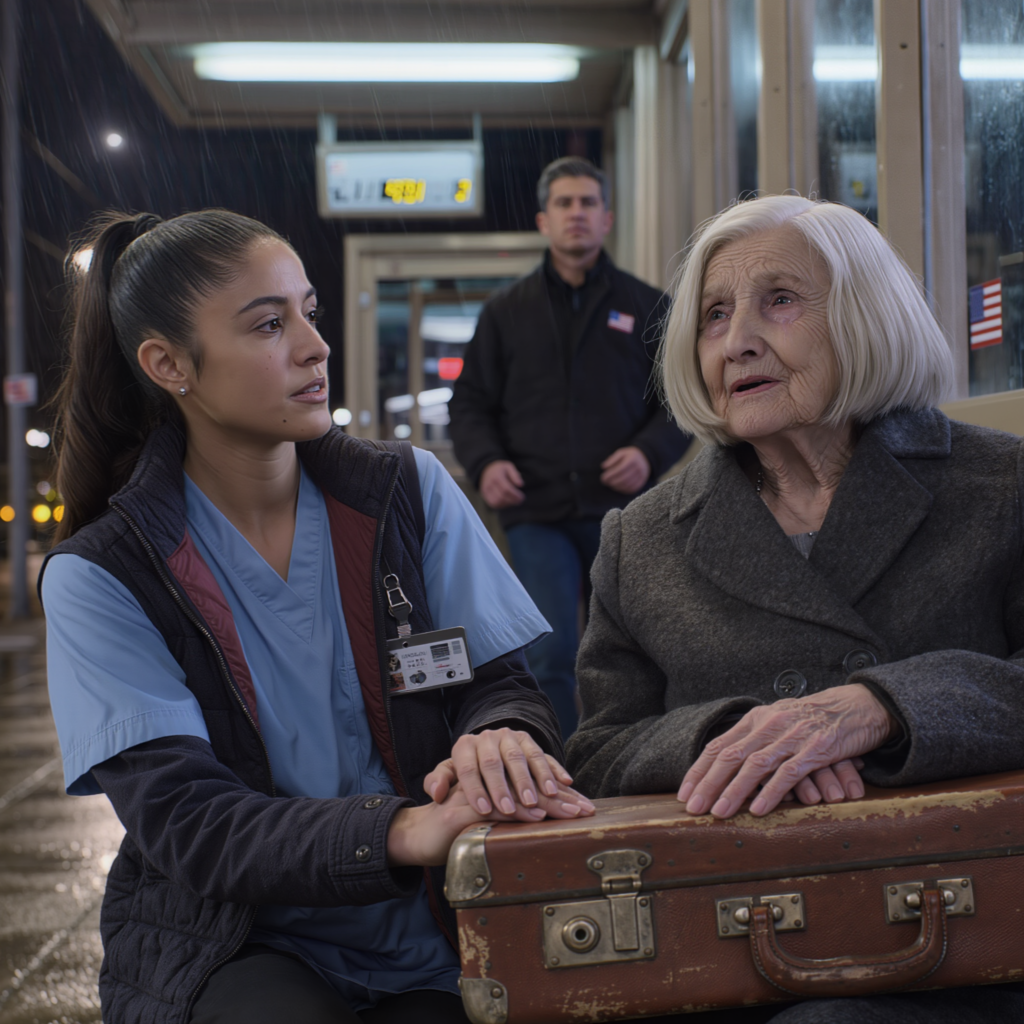
Heartbroken, I packed my bags and decided to run away. At the bus station, I couldn’t stop crying. A young woman asked if I was okay, so I told her everything. She made a phone call and said:
“Dad, I found her.”
“Yes, I’m sure.”
“Don’t forget to subscribe to Granny’s voice and comment where you’re watching from.”
I zipped up my old brown suitcase, the same one I’d carried on my honeymoon fifty years ago. My fingers shook, not because I’m seventy-three years old, but because my heart felt like it had been ripped into tiny pieces.
We’re putting you in a nursing home. You’re useless now.
Those terrible words came from Rebecca, my daughter-in-law, just one hour ago. She said them while putting on her fancy earrings, getting ready for their big New Year’s party—the party where I wasn’t wanted.
My son Connor, my baby boy, the child I raised by myself after my husband got sick and died, just stood next to her like a statue. He wouldn’t look at my face. His quiet voice hurt more than any mean words ever could.
“Ma, you’ll like it there,” he said to the shiny floor tiles. “They have activities, card games, movie nights. It’s what’s best for everyone.”
Best for everyone—like I was an old broken chair they needed to throw away.
I came to live with them three years ago after I fell and broke my hip. Connor said I needed family around me. That was before Rebecca took over everything, before this giant house with the swimming pool, before I became like a ghost that nobody could see.
I made their breakfast every morning. I folded their laundry. I watered all the plants in their big garden. I watched their twin daughters until the girls got older and started acting embarrassed when their friends saw me.
I tried so hard to be helpful, thinking that being helpful meant they would want me. I was wrong. Now I was just old and useless, taking up space in their guest bedroom that Rebecca wanted to change into her yoga room.
The house was filled with noise and people rushing around. Workers brought in tables and chairs. Flower people carried huge vases into the living room.
I wasn’t allowed to sit on the couch anymore because Rebecca said I might spill something.
They gave me a peanut butter sandwich on a napkin for dinner. I ate it alone while they laughed downstairs, tasting fancy foods I’d never seen before.
I looked at my small bedroom, the pictures sitting on the table next to my bed: Connor missing his front teeth when he was six, Connor wearing his cap and gown at college, Connor’s wedding day where I wore a yellow dress that Rebecca called old-fashioned in a mean way.
The blanket my grandmother sewed with her own hands. The pile of puzzle books I did because I was too scared to ask if I could watch their big TV.
This is what my life became—tiny and sorry, just waiting and waiting.
But they forgot about something important.
My sister’s lake house. She gave it to me when she died five years ago. It’s a small wooden cabin four hours away in a town called Pine Lake.
I haven’t been there since her funeral. It probably has spiderwebs and broken things, but it’s mine.
Connor doesn’t know I have it because I never told him. Something inside me whispered to keep it secret, to keep one thing they couldn’t take away or change.
I decided two hours ago, standing outside the kitchen and watching Rebecca show her friends paint colors for my yoga room, that I wasn’t going to any nursing home. I was leaving tonight—right now—before they could call people and sign papers and throw me away like trash.
I saved some money, about two thousand dollars hidden in an envelope inside my underwear drawer. Money from birthday cards my cousin sent me, and the few dollars I could hide from my Social Security check before Connor started helping me with my money.
It wasn’t much, but it had to be enough.
I packed fast, only taking what I could carry in one suitcase: clothes, my toothbrush, my grandmother’s blanket, the pictures, and a small metal box with my wedding ring inside.
Some letters from my husband, and the last Mother’s Day card Connor made me when he was eight years old with crayons and stickers.
Everything else could stay here. Rebecca could have all of it.
The hardest part was writing the note. I sat by the window listening to champagne bottles popping downstairs. I tried to write nice words, but I couldn’t.
“I’m leaving so I won’t bother you anymore. Don’t try to find me. I hope your party is fun.”
I left it on my pillow and walked out while everyone was in the backyard looking at the fireworks they bought. Nobody saw me leave through the front door.
Nobody noticed me for a long time anyway.
The bus station felt cold and empty on New Year’s Eve. Most people were home with their families—real families who actually wanted them there.
I sat on a hard plastic bench with my suitcase by my feet and looked at the bus times on the wall. One bus to Pine Lake left at 11:15. It was 9:30 right now.
The bright white lights buzzed and made everything look sick and strange. A man with dirty clothes slept on some chairs near the snack machines. Two teenagers were arguing quietly near the ticket counter.
I sat alone watching the big clock, each minute taking me further away from the life I used to know.
That’s when the tears started falling. Not small quiet tears, but big loud crying that made my whole body shake—the kind of crying that comes from deep inside where all the sadness lives.
From feeling unwanted, thrown away. Knowing that the people you gave everything to could look at you and only see a problem.
That your son—your precious baby you rocked to sleep and sang to when he had bad dreams—could stand there silent while his wife erased you like a mistake.
I put my hand over my mouth, embarrassed even now, even here, to be loud with my crying.
“Excuse me, are you all right?”
I looked up with tears making everything blurry, and saw a young woman kneeling in front of me. She looked about twenty-five, with warm brown eyes and black hair in a braid. She had blue hospital clothes under her jacket—maybe she was a nurse or a medical assistant.
“I’m okay,” I said, the lie everyone tells. “It’s just been a really hard night.”
She didn’t leave.
“You don’t look okay at all. Can I call somebody for you? Do you have family nearby?”
The word family made me laugh, a terrible broken sound that scared both of us.
“No family,” I said. “Not anymore.”
She sat down right next to me on the bench. Her sitting there felt nice and comforting.
“My name is Rachel,” she said. “I’m good at listening if you want to talk. I have time before my bus comes at 11:30.”
Maybe it was because she was kind. Maybe it was because I’d been lonely for so long— invisible for years and years. Maybe it was because she was a stranger and strangers are safe.
You can tell them true things because you’ll never see them again.
For whatever reason, my mouth started talking and I couldn’t stop.
I told her everything about Connor and Rebecca, about the nursing home words, about the New Year’s party I couldn’t go to, about living in the guest bedroom like a ghost nobody could see.
About eating meals by myself, about slowly disappearing until I was just background noise in my own son’s house.
I told her about the lake house and running away at seventy-three because it was better than being locked away like a broken toy.
I told her about my note and my two thousand dollars that was supposed to be my fresh start.
She listened without talking, holding my hand tight.
When I finished, she took out her phone.
“I need to make a quick call.”
“Okay,” I nodded, too tired and empty to wonder why.
She walked a little bit away, talking quiet but serious. I heard pieces of her words.
“I found her.”
“Yes, I’m completely sure.”
“The bus station on Oak Street.”
“Papa, please hurry.”
She came back and sat down again, still holding my hand.
“Help is coming very soon. I promise you that. Just stay here with me for a little while.”
“I don’t understand what’s happening,” I said, my brain all foggy and confused.
“You will soon.”
She smiled, and there was something special in that smile—like she knew a wonderful secret.
“Mrs. Chen,” she said, “do you remember being a school librarian a really long time ago?”
The question was so surprising I almost didn’t know what to say.
“Yes,” I said. “I was a librarian for forty years at Lincoln Elementary before I stopped working. Why are you asking me that?”
“Did you know a student named Marcus?” she asked. “Marcus Washington?”
The name made something move in my memory like dust flying around in sunlight.
Marcus.
There were thousands of children over all those years. Then I remembered clearly a small boy with big curious eyes who loved reading more than anything in the world.
His family didn’t have money. He came to school hungry, with holes in his sneakers.
His mama worked three jobs trying to feed her kids and keep a roof over their heads. She was proud and strong, but she couldn’t buy everything her children needed.
So I bought things myself quietly. Not expensive things—I didn’t have much money either—but important things.
Shoes that fit his growing feet. A warm jacket from the thrift store. Notebooks and pencils and crayons.
I told Marcus they were extra supplies the school didn’t need, donations from other kids’ parents. I said that because I knew his mama’s pride wouldn’t let her take charity.
I did it because children shouldn’t suffer when it’s not their fault.
I never told anyone about it. I never thought it was anything special.
It was just the right thing to do—what you’re supposed to do when you see someone needs help.
“You remember him?” Rachel asked softly, watching my face real close.
“I remember Marcus,” I said. “Such a smart, wonderful boy. But I don’t understand why you’re asking about him.”
“He’s my papa,” she said, her voice shaking, “and he’s been searching for you for forty years.”
The bus station felt like it was spinning around me. Everything felt unreal and strange.
Rachel’s words hung in the air like something I could almost touch but couldn’t believe was true.
“Your papa?” I said slowly, testing if the words were real. “Marcus Washington is your papa?”
“Yes, ma’am.”
She squeezed my hand even tighter. Her eyes were shiny with tears, wanting to fall.
“He talks about you every single day. Mrs. Chen, the school librarian who saved his life. He tried so hard to find you for years and years, but you moved away after you stopped working and the school’s old papers were thrown away.”
“It was so long ago,” Rachel went on, “with different computers and record books. He hired people to search. He looked on the internet and Facebook and everywhere. He found other teachers from back then, but never you.”
I shook my head, overwhelmed, like a giant wave was crashing over me.
“I didn’t do anything special at all,” I whispered. “I just bought a little boy some shoes and school supplies.”
“You did way more than that,” Rachel said, her voice cracking. “Do you know what it meant to him to feel seen? To know that somebody cared if he had food in his belly and shoes without holes?”
“His mama was working herself sick—proud, and scared, and trying so hard to survive. She couldn’t give her babies everything, and it broke her heart into pieces.”
“But you,” Rachel said, pressing my hand, “you made Marcus feel like he mattered to someone. Like he was important.”
The memories came rushing back now like a flood, sharper and clearer.
Marcus Washington, six years old, sitting in the book corner with his favorite story about dinosaurs. His torn shoes sitting next to him because they hurt his feet so bad.
The careful way he ate his lunch, making every bite last as long as it could.
How I started packing two sandwiches every day, telling him I always made too much food by accident.
The happy, proud look on his little face when I gave him that winter coat, saying another student grew too big for it.
“He was so incredibly smart,” I said quietly, the memories making me smile. “I remember thinking he could do anything in the whole world if someone just gave him a chance.”
“He did everything,” Rachel said, smiling through tears. “He got scholarships to college, went to law school, and became a lawyer. Now he’s one of the best lawyers in our whole state.”
“He helps immigrant families just like his family was. Makes sure people don’t get cheated or hurt. Fights for people who can’t fight for themselves.”
“And he says it all started because one librarian showed him that kindness was real, that strangers could care about other people, that he was worth someone’s time and help and love.”
I couldn’t talk at all. My throat closed up around feelings too big for words to hold.
“He got married when he was thirty,” Rachel continued. “His wife was a teacher, too. He says that wasn’t an accident or coincidence.”
“They had me and my little brother. Papa built this amazing, beautiful life, and he never forgot where he came from. Never forgot you—even for one single day.”
Rachel wiped her eyes with her sleeve.
“Every year when school starts, he buys supplies for poor kids. Shoes and coats and backpacks and everything they need. He calls it the Chen Library Fund, but doesn’t tell anyone it’s him. He’s been doing it for fifteen years now.”
The Chen Library Fund—named after me, for something I did without thinking twice, without expecting anything back, without even remembering it was important until right this second.
“Rachel, I can’t…” I struggled for words that made sense.
“You don’t need to say anything at all,” she said gently. “Just wait here. He’s coming right now.”
“He was at a dinner party when I called him, but he left everything immediately. Mrs. Chen, you have no idea how much this means to him—finally finding you after all these years.”
We sat quiet for a moment. The bus station’s bright, ugly lights suddenly didn’t feel so mean anymore, more like a stage where something magical was about to happen.
The sleeping man still snored on his chairs. The teenagers had stopped fighting and were hugging now.
The clock kept ticking toward 10:30.
“How did you know it was me?” I asked finally. “You weren’t even born yet when I knew your papa.”
“The photographs,” Rachel said.
She pulled out her phone and showed me the screen.
“Papa has pictures from his elementary school. He got copies from Lincoln before they threw away all the old stuff. He showed them to us a million times, telling stories about every teacher—especially you.”
“He described you so many times—how kind you were, your smile, the way you always wore your hair. When I saw you sitting here crying, something just clicked in my brain.”
“Your age was right, and something about your face. I know it sounds crazy, but I just knew I had to ask you.”
I stared at the picture on her phone: a library from 1985, children sitting in rows for picture day.
And there I was—forty years younger with brown hair instead of white, my face smooth instead of wrinkled. Standing behind a group of first graders with my hands on two children’s shoulders.
I remembered that day clearly, remembered the photographer telling us to smile, remembered thinking how lucky I was to work with children to help them learn and grow.
One of those children remembered me, carried me forward through all the years. Built something wonderful partly because of shoes I bought at the discount store for twelve dollars.
“I need to warn you about something,” Rachel said, her voice dropping lower and more serious. “Papa is very protective of people he loves. Really, really protective.”
A small worried feeling moved through my chest like a bird fluttering.
“I don’t want to cause any trouble for anyone,” I said. “I just want to go to my sister’s lake house and be left alone in peace.”
“Mrs. Chen,” Rachel said, her face determined and strong, “you deserve so much more than being left alone.”
“What they did to you is wrong—against the law, probably wrong in every way. Definitely.”
“My papa… well, he’s a lawyer. Very, very good one. He helps people who’ve been hurt unfairly.”
“I don’t want revenge,” I said fast. “I just want some peace and quiet.”
“There’s a big difference between revenge and justice,” Rachel said. “And there’s a difference between being alone and being taken care of.”
“You gave my papa a chance when he needed it most. Please let him give something back to you now.”
Before I could answer, the station doors flew open and a man walked through them with a kind of power that made people move out of his way.
He was tall, wearing an expensive dark suit that probably cost more than all my clothes put together. His hair was gray on the sides, but his face still had hints of the child I once knew.
His eyes swept the station, then locked on me.
For a moment, we just stared at each other across the dirty waiting room.
Then he was walking toward me, and I was standing up without meaning to, and forty years were disappearing into nothing.
“Mrs. Chen,” he said, and his voice broke when he said my name.
“It’s really you.”
“It’s really you, Marcus,” I whispered. “Little Marcus Washington.”
“Not so little anymore,” he said, and he smiled.
And there it was—the same sweet, beautiful smile that used to light up his whole face when he learned something new or finished a hard puzzle.
“But yes, ma’am,” he said. “It’s me.”
He stood right in front of me, this successful, powerful man in his expensive suit, and I could see the six-year-old boy overlaid on his face like a ghost.
The same eyes. The same honest expression. The same need to connect.
“I can’t believe Rachel found you,” he said. “After all these years of searching everywhere, and here you are at a bus station on New Year’s Eve, running away from people who should have loved you like treasure.”
His words broke something open deep inside me. Fresh tears poured down my face.
“Oh, Mrs. Chen…”
He stepped forward and hugged me, so gentle and careful.
“You don’t run anymore,” he said. “Not from this.”
“Rachel told me everything. Your son, his wife, the nursing home threat, the note you left—all of it.”
I pulled back, feeling embarrassed and small.
“I’m sorry she bothered you with my problems,” I said. “I’m just a foolish old woman who needs to stop—”
“Stop right there.”
The word was firm but still kind.
“You are not foolish. You are not a bother. You are the woman who changed my entire life, and I’ve been searching for you so I could say thank you properly.”
He reached into his jacket and pulled out a business card, then pressed it into my hand.
“This is who I am now,” he said, “because of who you were then.”
I looked at the card: heavy fancy paper with raised letters.
Marcus J. Washington, Senior Partner.
Washington and Associates, Immigration and Family Law.
“I remember you,” I said softly. “I remember the little boy who loved books more than anything, who tried so hard at everything. Who never complained, even when I could see his shoes were hurting his feet.”
“You saw me,” Marcus said simply. “In a world that wanted to pretend my family didn’t exist, that wanted us invisible—you saw me.”
“You spent your own money,” he said, his voice thick with emotion. “Money I know you didn’t have extra of, because librarians never do, to make sure I had what I needed.”
“Do you know what that taught me about life?”
I shook my head, unable to make words come out.
“That I mattered as a person. That strangers could be kind for no reason. That the world wasn’t just a harsh, cruel place where you fight alone to survive.”
“You taught me that helping people wasn’t being weak or stupid. It was being strong. It was what made us human.”
“You planted a seed, Mrs. Chen, and it grew into everything I am today.”
Rachel moved next to her papa, standing together like a team.
“We’re not letting you get on that bus to hide in some falling-apart lake house,” she said. “We’re not letting you disappear because your son is too blind to see what he’s throwing away like garbage.”
“I don’t want to impose on anyone,” I started to say, but Marcus cut me off.
“Impose?”
He laughed, but there was steel underneath the sound.
“Mrs. Chen, I’m a millionaire lawyer. I have resources you can’t even imagine. I have connections everywhere.”
“I have power and influence,” he said, and his eyes hardened, “and I’m about to use all of it to help you.”
Something in his voice sent a shiver through me— not fear exactly, but anticipation, like something big was about to happen.
“What do you mean by that?” I asked.
He looked at me with an expression I couldn’t quite understand: part determination, part righteous anger, part protective love.
“I mean your family is about to learn what happens when you throw away someone I love,” he said. “Someone who matters. Someone who changed the entire path of my life with simple kindness and a twelve-dollar pair of shoes.”
“Marcus, I don’t want trouble or fighting,” I said. “I just want peace.”
“You’ll have peace,” he promised, squeezing my shoulder gently. “But first, we’re going to make sure you’re protected and safe. Make sure you have choices.”
“Make sure you never have to run away in the middle of the night again because you’re scared of being locked up somewhere against your will.”
“I have my sister’s lake house,” I said weakly. “It’s not fancy, but it’s mine and mine alone.”
“We’ll check on that house,” Marcus said. “Make sure it’s in good shape. Get it fixed up if it needs repairs.”
“But tonight,” he said, softening, “you’re coming home with us.”
“Rachel’s mama has been getting the guest room ready since Rachel called. We have plenty of space. We have everything you need.”
“And we have forty years of gratitude to pay back to you.”
“I couldn’t possibly do that,” I whispered.
“Yes, you can,” he said. “Yes, you will.”
He smiled and his face changed from scary lawyer to the kind boy I once knew.
“Please, Mrs. Chen, let me do this. Let me show you what became of those seeds you planted.”
“Let me give you what you gave me all those years ago—safety and comfort and the knowledge that someone sees you and knows you matter.”
The clock showed 10:45. My bus would come in thirty minutes.
I looked at the ticket in my shaking hand, then at Marcus and Rachel standing in front of me like guardian angels in this ugly bus station.
“What about my son?” I whispered. “What happens when he finds my note?”
Marcus’s face grew hard and serious.
“Leave your son to me.”
Marcus’s car wasn’t what I expected at all. I thought it would be flashy and show-offy, the kind of car that screamed, Look how rich I am.
Instead, it was a regular blue sedan—nice but normal—with car seats in the back that told stories about grandchildren.
Rachel sat in the back seat with me, still holding my hand like she was afraid I’d disappear if she let go.
“My wife Angela is going to cry when she meets you,” Marcus said from the driver’s seat as we drove through the empty New Year’s Eve streets. “Fair warning, she gets very emotional about things like this.”
“Things like what?” I asked, still feeling dazed like I was in a dream.
“Miracles,” he said. “Answered prayers. Full-circle moments.”
He looked at me in the rearview mirror.
“I’ve told her about you so many times, she feels like she already knows you. The librarian who bought me shoes. The librarian who saw a scared immigrant kid and decided he deserved dignity and respect.”
The word dignity hit me like a punch.
It was exactly what had been taken from me so slowly at Connor’s house that I didn’t even notice it happening.
The small embarrassments. The dismissals. The way Rebecca would talk about me like I wasn’t even in the room.
“We need to think about what’s best for her,” she’d say, like I couldn’t think for myself anymore, like being seventy-three meant I lost the right to make my own choices.
“I still can’t believe you remembered me after all this time,” I said quietly. “It’s been so many years.”
“Mrs. Chen,” Marcus said, his voice strong and firm, “you don’t forget the person who saves your life.”
“My mama worked herself to the bone, but there was never enough money or time. She loved us desperately, but she was drowning trying to survive in America.”
“And then there was you, making sure I had what I needed, treating me like I mattered just as much as the rich kids whose parents were doctors and lawyers.”
“You did matter,” I said. “All my students mattered to me.”
“But you proved it with actions,” Marcus said. “You didn’t just say nice words. You did something real.”
“You spent money you probably needed for your own bills to buy a kid you barely knew a pair of shoes and a winter coat.”
He stopped at a red light, the car sitting still in the empty intersection.
“Do you know what I did when I made my first million dollars?”
I shook my head.
“I tried to find you,” he said. “I wanted to pay you back every penny. Wanted to show you what that scared six-year-old became.”
“I hired private investigators. Called the school district over and over. Searched every database I could get access to.”
“Nothing,” he said, the word bitter. “You vanished like smoke.”
The light turned green and we moved forward into a neighborhood that got nicer and nicer. Houses got bigger. Yards got prettier with flowers and trees.
“I never stopped looking,” Marcus said. “Every single year on my birthday, I’d spend hours searching again—different words in the computer, different ways of looking.”
“I found other teachers from those years, but never you.”
“I moved after I retired,” I explained. “Sold my little house to help Connor with his down payment.”
“He said it made sense for us to pull our money together, that I’d be happier living with family than alone in my old neighborhood where my friends were dying or moving away.”
Rachel made a sound next to me, something between a sigh and a growl.
“Let me guess,” she said quietly. “You gave him the money and then he treated living with you like he was doing you a huge favor.”
The truth of it stung like a bee.
“He’s my son,” I whispered. “I wanted to help him succeed.”
“Helping is supposed to go both directions,” Rachel said. “It’s supposed to be mutual and respectful.”
“Not what they did to you tonight. That’s not help. That’s using someone.”
We pulled into a curved driveway in front of a gorgeous two-story house. Warm yellow light poured from the windows.
It looked like houses in magazines—elegant but cozy, the kind of house that held family dinners and birthday parties, the kind of house where people loved each other.
The front door opened before we even got out of the car and a woman rushed out into the night.
She looked about my age, with silver hair and a face that made you feel warm inside just looking at it. She wore an apron over her dress, and her eyes were already crying happy tears.
“Angela,” Marcus said, coming around to help me out of the car. “This is Mrs. Chen.”
Angela put her hands over her mouth, looking at my face like she was trying to remember it forever. Then she stepped forward and hugged me with a fierce tenderness, like she was greeting family she hadn’t seen in years.
“Welcome home,” she whispered in my ear. “Oh, Mrs. Chen, welcome home, sweet lady.”
I couldn’t help myself. I started crying all over again.
This woman—this complete stranger—was hugging me with more warmth and love than my own daughter-in-law had shown me in three whole years.
The difference was unbearable and healing at the exact same time.
“Come inside right now,” Angela said, keeping one arm around my shoulders like I might fall. “You must be exhausted and starving.”
“When Rachel called, I started making gumbo,” she said, voice bright through tears. “Marcus’s favorite comfort food. There’s plenty for everyone.”
The inside of the house was even more beautiful: warm, happy colors, comfortable furniture that looked lived-in.
Photographs covered every wall and table.
A Christmas tree still glowed in the corner with presents underneath waiting for morning.
The whole house smelled like home—cooking food, pine tree, and that special scent of a place where people actually lived and loved and belonged.
“The guest room is all ready,” Angela said, guiding me toward the stairs. “Fresh sheets, clean towels, everything you could possibly need.”
“But first, let’s get some good food in you. You look like you haven’t had a proper meal in weeks and weeks.”
She was right.
Rebecca’s cooking was all kale and quinoa and chia seeds, health food that left me hungry again an hour later.
She made comments about my weight, suggested I didn’t need heavy foods at my age.
I learned to hide crackers in my room for when hunger woke me up at night.
The kitchen was huge and perfect, with a big wooden table that could fit twelve people.
Angela sat me down in a soft cushion chair and immediately started pouring gumbo into a bowl.
Rich, delicious-smelling soup with rice and shrimp and sausage.
A basket of cornbread appeared, still hot from the oven. A glass of sweet tea with lemon.
“Eat,” she said gently, like she was talking to a child. “Please eat and tell us everything that happened.”
So I did—between bites of the best gumbo I ever tasted in my whole life.
I told them everything, not just tonight, but the past three years.
How I moved in with Connor and Rebecca after my hip broke.
How little by little I got pushed into smaller and smaller spaces in their lives.
The separate meals. The comments about my old-fashioned clothes and outdated ideas.
The way Rebecca’s friends would look right through me like I was furniture.
The granddaughters who grew too busy and too cool for their grandmother, who cringed and pulled away when I tried to hug them.
I told them about the Thanksgiving I spent alone in my room because they had a couple’s-only dinner party.
About the time Rebecca threw away my favorite sweater because it looked ratty—even though my grandmother knitted it with her own two hands.
About hearing Connor tell his friend that having me there was challenging, but they were making it work—making it work like I was a problem to solve.
Marcus’s expression grew darker and angrier with every detail I shared.
Angela kept filling my bowl, kept touching my hand, kept making little sounds of sympathy and anger.
And tonight, I finished my story.
“Rebecca just said it straight to my face,” I told them. “We’re putting you in a nursing home. You’re useless now.”
Just like that, like I was a broken toaster they were replacing with a new one.
“What did Connor say to that?” Marcus asked, his lawyer brain already working.
“He agreed with her,” I said, setting down my spoon as my hunger faded with the awful memory. “Said it would be good for me that I’d have people my own age there.”
“He wouldn’t look at me. His own mother who gave birth to him, and he couldn’t even look at me while he agreed to throw me away.”
“The note you left behind,” Rachel said. “Did you tell them where you were going?”
“Oh, I just said I was leaving so I wouldn’t be a burden anymore,” I said. “That they shouldn’t look for me.”
Marcus pulled out his phone from his pocket.
“What’s Connor’s phone number?”
“Why do you need that?” Alarm shot through my whole body.
“Marcus, please. I don’t want to cause problems or drama.”
“Mrs. Chen,” Marcus said, his voice gentle but impossible to argue with, “you’re not causing problems. You’re the victim of elder abuse—emotional abuse, financial exploitation, possibly illegal coercion.”
“Your son needs to understand there are consequences for treating people this way, especially his own mother who sacrificed everything for him.”
“I don’t want to fight with him, though,” I whispered. “He’s all the family I have left.”
“No,” Angela said, reaching across the table and grabbing both my hands tight. “You have us now. You have people who see your value and worth, who understand what you deserve.”
“You’re not alone in this world anymore.”
“But he’s my son,” I said, my voice breaking. “I raised him from a tiny baby. I sacrificed everything I had for him.”
“How did it come to this? How did my baby turn into this?”
Marcus’s face softened with understanding.
“Sometimes people take advantage of the ones who love them most because they know they can,” he said. “Because they know you’ll forgive them and make excuses for them and sacrifice for them over and over.”
“It doesn’t make it right. It actually makes it worse.”
He was absolutely right, and I knew it deep in my heart.
I’d been making excuses for Connor for three whole years.
He’s busy with work.
He’s stressed out.
Rebecca is demanding and difficult.
The girls need all his attention.
Every mean thing, every dismissal, every moment of feeling invisible—I explained it all away because the truth was too painful to look at.
My son didn’t value me anymore.
Maybe he stopped valuing me years and years ago.
So gradually and slowly, I didn’t notice until I completely disappeared.
“I need to see the lake house first,” I said, trying to take back some control. “My sister’s place—it’s been empty for five years. It’s probably a disaster.”
“We’ll send someone first thing tomorrow morning,” Marcus promised. “I have contractors I trust completely.”
“They’ll look at everything and tell us what needs fixing.”
“If you want to live there eventually, we’ll make it beautiful and livable. If you don’t, we’ll help you sell it for good money.”
“Either way, you have options and choices.”
Options.
When was the last time I had real options?
“Tonight,” Angela said firmly. “Tonight, you rest.”
“You’ve been through something terrible and traumatic. Tomorrow we start figuring out the next steps.”
“But tonight you sleep in a comfortable bed in a house where you’re wanted and loved.”
Rachel had been quiet, but now she spoke up with excitement.
“Mom’s right, Mrs. Chen. And my kids are coming here tomorrow morning. They’re five and seven, and they’re going to be so excited to meet their grandpa’s hero.”
“Be ready for a million questions and lots of hugs, and probably requests for stories about what their grandfather was like as a little kid.”
The picture in my mind made me smile despite everything.
Little children.
I always loved children with my whole heart. Spent my whole career with them.
Connor’s girls had outgrown needing their grandma.
But maybe these grandchildren I’d never met might still want an old woman’s stories and love.
“I would really like that,” I admitted quietly.
It settled then.
Marcus stood up from his chair.
“Angela, can you show Mrs. Chen to her room?” he asked. “Rachel and I need to make some important phone calls.”
“Phone calls?” I asked nervously. “It’s almost eleven on New Year’s Eve.”
“Mrs. Chen,” Marcus said with a sharp smile, “one advantage of being a successful lawyer is people answer their phones when I call, no matter what time it is.”
“Your son left you a note in crisis on New Year’s Eve. I think he can handle getting a phone call tonight.”
“What are you planning to do?” I asked, worried.
“Right now, just let him know you’re safe,” Marcus said. “That you’re with friends who care about you.”
“That running away crying because your family threw you away is not a situation that’s going to be ignored or swept under the rug like it didn’t happen.”
His expression turned hard as stone.
“And then first thing Monday morning, we’re going to have a very serious conversation about elder rights and financial exploitation and what happens when you try to force someone into a nursing home without proper legal authority or medical cause.”
“I don’t want to sue my own son,” I said desperately, panic rising.
“You won’t have to,” Marcus said, calm and confident. “A letter from my law firm on the right letterhead with the right words tends to inspire immediate cooperation and panic.”
“Sometimes people need to understand the legal implications and consequences of their actions before they reconsider their choices.”
Angela took my arm gently.
“Come on, sweetheart,” she murmured. “Let the lawyers do their lawyer things. You need rest badly.”
She led me upstairs to a beautiful guest bedroom with a big comfy bed, soft fluffy pillows, and windows that looked out over a garden even in winter.
The room smelled like lavender.
A brand-new toothbrush and nice soaps waited in the bathroom. Clean, soft towels hung on the silver rack.
“If you need anything at all,” Angela said softly, “anything in the whole world, our bedroom is just down the hall. Don’t hesitate even for a second.”
After she left, I sat on the edge of the bed.
My old worn suitcase looked shabby and poor against the room’s beauty.
Through the floor, I could hear Marcus’s voice, firm and professional, making his phone calls.
Somewhere across the city, Connor and Rebecca were probably still at their fancy party.
Maybe they hadn’t even noticed I was gone yet.
Maybe they didn’t care when they finally did notice.
But here—in this house, with these people who owed me absolutely nothing and yet offered everything—I felt something I hadn’t felt in three long years.
Safe.
Wanted.
I woke up to bright sunlight streaming through strange windows. For a confusing moment, I couldn’t remember where I was.
Then everything came flooding back: the bus station, Rachel, Marcus, this beautiful house that welcomed me when my own family threw me away like trash.
The clock next to the bed said 9:15 in the morning.
New Year’s Day.
I’d slept almost eleven hours, the deepest sleep I’d had in months and months.
At Connor’s house, I trained myself to wake up early, to be quiet as a mouse, to make myself invisible during the family’s morning routine.
Here, nobody woke me up. Nobody needed me to disappear.
A gentle knock came at the door.
“Mrs. Chen, are you awake?”
Angela’s voice, soft and unhurried.
“Yes,” I said. “Please come in.”
She came in carrying a wooden tray: coffee that smelled like heaven, fresh fruit, toast with butter and strawberry jam.
“I thought you might like breakfast in bed,” she said. “It’s a holiday after all.”
“New Year’s Day—a brand new beginning for you.”
The symbolism wasn’t lost on me.
“You don’t have to serve me like this,” I said. “I can come downstairs and eat with everyone.”
“I know I don’t have to,” Angela said, setting the tray carefully on my lap. “I want to.”
“And Mrs. Chen… Marcus has been on the phone since seven this morning.”
My stomach clenched.
“What happened? What did Connor say?”
“Connor didn’t answer his phone last night around midnight,” Angela said, her face carefully neutral. “Marcus left a message identifying himself as your attorney and saying that you were safe and under his protection.”
“He said there would be more communication coming soon about your situation.”
“Connor called back at 7:30 this morning,” she continued. “Marcus has been on the phone with him for over an hour now.”
“Is Connor angry at me?” I whispered.
“I think panicked would be more accurate,” Angela said gently. “When a senior partner from one of the state’s most respected law firms calls and says he’s representing your mother, it tends to inspire serious concern—especially when you were planning to put that mother in a nursing home against her will.”
“I didn’t want this,” I said quietly, guilt creeping in. “I didn’t want lawyers and threats and fighting.”
“What did you want, Mrs. Chen?”
The question stopped me cold.
What had I wanted?
Not the bus station.
Not running away in tears.
Not hiding in a lake house that was probably falling apart.
I wanted what I had before everything changed.
Family that loved me.
A place where I belonged.
Respect and dignity in my old age.
Simple things.
“I wanted to matter to someone,” I finally whispered. “I wanted my son to see me as something other than a burden to get rid of.”
“Then that’s exactly what we’re going to get for you,” Angela said, reaching over to squeeze my hand.
“Not through revenge or cruelty, but through boundaries and consequences.”
“Sometimes people need to lose something before they understand what they had—before they appreciate what they threw away.”
Downstairs, I could hear children’s voices, excited and high-pitched.
Rachel’s kids.
The grandchildren who wanted to meet their grandfather’s librarian.
“They’ve been asking about you since they woke up at dawn,” Angela said with a warm smile. “Rachel told them the whole story last night before bed.”
“How their pop searched for you for years and years. How you changed his life with simple kindness and a pair of shoes.”
“My grandson Dev said,” Angela added, smiling wider, “you must be a superhero in disguise.”
The idea of being anyone’s superhero at seventy-three was ridiculous and touching at the exact same time.
“I just bought a little boy some shoes and supplies,” I murmured. “That’s all I did.”
“You keep saying that like it makes what you did smaller,” Angela said, standing up. “It doesn’t make it smaller at all. It makes it bigger.”
“Get dressed. Have your breakfast. Come down whenever you’re ready. No rush at all.”
“This is your home for as long as you need it to be.”
After she left, I ate slowly, enjoying the good, strong coffee and the sweet strawberries.
Through the window, I could see the garden Angela mentioned—sleeping now in winter, but clearly well-loved with stone paths and wooden benches and bird feeders.
A place made for peace and thinking and living.
My phone, which I’d barely charged in weeks, sat on the nightstand.
I turned it off last night, too scared to face whatever messages would come.
Now I turned it on, my heart racing like a drum.
Twenty-three missed calls.
Fifteen voicemails.
Thirty-one text messages.
Most were from Connor.
The early ones around 1:00 in the morning were confused and worried.
“Mom, where are you? Your note wasn’t clear. Please call me.”
Then more concerned.
“Mom, please call. We need to talk about this. You’re scaring me.”
Then, after Marcus’s call, completely panicked.
“Mom, who is this lawyer? What’s happening? Call me right now.”
Rebecca sent exactly three messages, and they made my blood boil.
“This is dramatic and ridiculous. You’re embarrassing Connor in front of everyone.”
“Come home and stop this nonsense.”
Even now, even in crisis, she was thinking about appearances and embarrassment—not about the seventy-three-year-old woman who ran away into the night rather than be locked up in a facility she didn’t choose.
I didn’t respond to any of them.
I wasn’t ready.
Instead, I got dressed in the same clothes from yesterday. I hadn’t packed much at all.
Then I made my way downstairs carefully.
The house was full of life and activity.
Marcus sat at the kitchen table, still in his pajamas and bathrobe, his phone and laptop in front of him.
Papers spread all across the surface.
Rachel was making pancakes while two children sat at the counter, swinging their legs and chattering like little birds.
They saw me first.
“Is that her?” the little boy asked, his voice full of wonder. “Is that Pop’s librarian?”
“That’s her,” Rachel confirmed with a smile. “Mrs. Chen, these are my little monsters.”
“Dev is seven and Zara is five.”
Dev had Marcus’s eyes and his serious expression. Zara had Rachel’s smile and about a hundred colorful clips in her curly hair.
They both jumped down from their stools and came toward me with a fearless curiosity that only children have.
“You’re really, really old,” Zara said matter-of-factly.
“Zara,” Rachel warned, but I laughed out loud.
“I really, truly am,” I said. “Seventy-three years old.”
“Pop says you’re the nicest person he ever met in his whole life,” Dev said seriously. “He says you saved him when he was little, like me.”
“I think your pop is exaggerating just a little bit,” I said.
“He doesn’t exaggerate ever,” Dev replied. “He’s a lawyer. Lawyers have to tell the truth always.”
Marcus looked up from his papers and grinned.
“I’ve created a little monster,” he said. “He quotes me constantly about everything.”
He stood up and came over, kissing the top of my head in such a fatherly gesture it made my throat feel tight.
“Good morning, Mrs. Chen. How did you sleep?”
“Better than I have in three whole years,” I said.
“Very good,” he said. “Come sit down. We have things we need to discuss, but first you need pancakes.”
“Rachel makes the best pancakes in the entire world.”
I sat down and within minutes a huge plate of fluffy golden pancakes appeared in front of me, with real maple syrup and melted butter.
The children asked me a million questions between bites.
What was their pop like as a little boy?
Did he get in trouble at school?
What was his favorite book?
Did I remember other students from back then?
I answered everything, watching Marcus’s face as I shared memories of his younger self.
How he helped other kids who were struggling with reading.
The time he walked six blocks out of his way to return a library book he found.
How he always, always said please and thank you.
That careful, perfect politeness of a child, taught to respect grown-ups and authority.
“You taught him well,” I told everyone at the table. “His mama did an amazing job raising him.”
“She did,” Marcus agreed. “And so did you.”
“You were part of that village everyone talks about,” he said. “The village it takes to raise a child.”
He glanced at his watch.
“Dev, Zara, why don’t you go play in the family room for a while?” he said. “I need to talk to Mrs. Chen about grown-up things that might be boring for you.”
The children left slowly, not wanting to go.
The whole atmosphere in the kitchen shifted and turned serious.
“Connor called back four times this morning,” Marcus began. “I’ve made it very clear that all communication needs to go through me as your lawyer until further notice.”
“He’s very distressed and upset.”
“I should call him myself,” I said. “He’s worried about me.”
“He’s worried about the legal implications of his actions,” Marcus corrected gently. “There’s a big difference, Mrs. Chen.”
“I need to ask you some questions, and I need you to be completely honest with me.”
“This isn’t about punishing your son. It’s about protecting you and understanding what we’re dealing with legally.”
I nodded, my appetite disappearing.
“The money from your house sale when you sold it,” Marcus said. “How much was it, and where did all that money go?”
“About fifty thousand dollars,” I said. “Connor said we’d use it for the down payment on their big house.”
“He said it made sense to pull our resources together since I’d be living there with them.”
“Did Connor put your name on the house deed as an owner?”
I paused.
“I don’t know,” I admitted. “I think so. He handled all the paperwork and documents. I just signed where he told me to sign.”
Marcus made a note on his legal pad.
“We’ll find out for sure,” he said.
“What about your Social Security money every month?”
“It goes into a joint bank account,” I said. “Connor set it up for me. He said it was easier for managing household expenses for everyone.”
“Do you have access to that account? Can you take money out when you need things?”
I hesitated, embarrassed.
“I have a debit card, but Rebecca watches the spending closely. She said I needed to be mindful about purchases since we were all sharing resources together.”
“Did you agree to this arrangement in writing—sign any papers?”
“No,” I said. “Connor just said it made sense that I shouldn’t worry about finances at my age, that he’d take care of everything for me.”
Marcus’s jaw tightened.
“And the nursing home they mentioned,” he said. “Had you seen it, visited it? Did you agree to be evaluated or placed there?”
“Rebecca just announced it last night out of nowhere,” I said. “Said they’d already found a nice place, and that I was too old to be useful anymore.”
“Did she say this in front of any witnesses? Anyone else?”
“Just Connor,” I said. “And he agreed with everything she said.”
Marcus wrote for a long moment. When he looked up, his face was very serious.
“Mrs. Chen,” he said, “what I’m about to tell you might be difficult and painful to hear, but based on what you’ve described, your son and daughter-in-law may have committed several violations of elder law.”
“Potential financial exploitation given that you contributed major assets without clear agreement or return.”
“Emotional abuse through isolation and degradation.”
“An attempted unlawful institutionalization.”
“You cannot be placed in a nursing home against your will without a court order, which requires proof that you’re unable to care for yourself safely.”
The words felt like heavy stones dropping into deep water, creating ripples I couldn’t control or stop.
“You’re saying my son broke the law,” I whispered.
“I’m saying there are very concerning patterns that need investigation,” Marcus said. “But here’s what matters most to me.”
“You have rights—legal rights that don’t disappear just because you’re seventy-three or because you’re someone’s mother.”
“You have the right to control your own money. Make your own medical decisions. Live where you choose to live.”
“What do you want me to do right now?” I asked.
“Nothing at all,” Marcus said. “Let me handle everything.”
“I’m writing a letter to Connor and Rebecca outlining the legal issues with their behavior, our concerns about financial exploitation.”
“I’m also requesting a full accounting of your assets—the money from your house sale, your Social Security payments, any other funds they may be controlling.”
“Will they have to give the money back to me?”
The thought felt greedy and small and wrong.
“If they’ve misused your money inappropriately, yes—absolutely,” Marcus said. “But more importantly, we’re establishing boundaries.”
“They need to understand that you’re not alone and unprotected anymore, that there are people watching and caring—people who will hold them accountable for their actions.”
Angela had been listening quietly from the stove. Now she spoke up.
“The goal isn’t to destroy their lives, Mrs. Chen,” she said. “It’s to wake them up, make them see what they’ve done.”
“Sometimes people need to face real consequences before they can change their behavior.”
“But what if they hate me forever?” I asked. “What if this ruins everything between us?”
Marcus leaned forward, his eyes intense.
“What exactly would it ruin?” he asked. “A relationship where you’re invisible? Where you’re treated as a burden? Where your own son agrees to lock you away against your will?”
His voice softened.
“You deserve better than scraps of affection.”
“Mrs. Chen, you deserve to be valued and respected and celebrated.”
“If enforcing boundaries ruins a relationship, that relationship was already broken into pieces.”
The truth of his words settled over me like a heavy blanket.
I’d been so focused on keeping the peace, on not causing trouble, on being grateful for whatever tiny mercies were thrown my way, that I forgot I deserved actual love and respect.
“Okay,” I whispered. “Do what you think is best.”
“I will,” Marcus promised. “But Mrs. Chen, this is your decision to make. I’m your advocate, not your controller.”
“If at any point you want me to stop, I stop immediately. If you want to reconcile with Connor on your terms, we make that happen.”
“You’re in charge of your own life now. That’s the whole entire point.”
Rachel came over and hugged me from behind, resting her chin on my shoulder.
“And while Dad does all the legal stuff,” she said, “we’re going to check on your lake house, get it looked at by experts, see what it needs.”
“Make sure you have options—whether that’s living there, selling it for money, or keeping it as a backup safety plan.”
“I can’t ask you to do all this for me,” I said.
“You’re not asking,” Angela said firmly. “We’re offering freely. There’s a big difference.”
Through the kitchen window, I could see Dev and Zara playing in the backyard, their laughter floating through the glass like music.
A normal New Year’s Day full of family and joy and belonging and love.
I thought I was running away to nothing and nowhere.
Instead, I ran straight into something I lost years ago without even realizing it.
Family.
Not the one I was born into or created, but the one I earned decades ago with a simple act of kindness to a scared little boy who never, ever forgot.
The universe has a funny way of bringing things full circle.
Sometimes the love you give comes back to you when you need it most.
Now tell me—what would you have done if you were in my place?
Let me know in the comments. Thank you for watching, and don’t forget to check out the video on your screen right now. I’m sure it will surprise you.
Thank you all for watching to the end. This story was written by me and narrated using a female AI voice-over.
I wish you all a Merry Christmas and a Happy New Year.
News
My son looked me dead in the eye and said he’d sell the Connecticut house my late husband and I built, just to buy his wife a shiny new Mercedes—then gave me 24 hours to pack—because “she matters more.” I smiled, nodded, and started folding sweaters, while the truth sat in a folder he’d never thought to ask about.
My son said, “I decided to sell your house to buy a new car for my wife. She’s more important…
In a Chicago courtroom filled with reporters and family friends, my parents tried to bankrupt me in public—just to make sure the whole city believed I was broke. They wanted humiliation, headlines, and the end of my name. But when the judge asked one single question, their lawyer went pale—and my father’s empire began to crumble before everyone’s eyes…
I sat in a bankruptcy courtroom packed with strangers—not because I was out of money, but because my parents…
After my husband’s death, I decided to open his old safe. Inside was $500,000 in cash and some documents. But when I saw the third item, a cold wave of terror swept over me… and for the first time in fifty years of marriage, I realized how little I’d truly known the man I’d shared my life with.
After my husband’s death, I decided to open his old safe. Inside was $500,000 in cash and a stack…

On the morning I boarded a packed CTA bus for my divorce hearing at the Cook County courthouse, I thought I was just a discarded wife trying to arrive with my head high—until a frail old man stumbled at the door, I caught him, and the quiet “thank you” he gave me became the first domino in a chain that would make my powerful attorney-husband lose his breath.
What if the path to a divorce hearing turned into the moment that would change your destiny forever? Today, I…
For seven months, every single night at exactly 2:47 a.m., my husband would rise from our creaking bed, cross the dark room, and stand on my side just watching me breathe—until the night I pretended to sleep and finally heard what he was whispering, and the truth behind that 2:47 ritual shattered everything I thought I knew about my life.
For seven months, every single night at 2:47 in the morning, my husband would stand right next to my…
My son and his wife left me for a seven-day cruise with my “mute” 8-year-old grandson, but the second the lock clicked, he looked up and whispered, “Grandma, don’t drink the tea Mama made for you”—and that was the moment I realized this week wasn’t babysitting… it was a test I might not survive.
My son and his wife flew off on a cruise, leaving me alone for a week with my 8-year-old grandson,…
End of content
No more pages to load