What if the path to a divorce hearing turned into the moment that would change your destiny forever?
Today, I have a very special, heart-touching story about the power of sincere kindness—the story of a wife looked down upon by her husband, who found a champion in the most unexpected person, all thanks to a small act of kindness on a city bus.
But before we get into the story, please support us by hitting the like button and subscribing right now.
I also want to give you a shout-out. Leave your name and your city in the comments and write the word “present.” I want to know what far-flung places you’re listening from.
Are you ready for the story? Get your tissues and a snack ready. Let’s begin.
That morning, the sunbeams filtering through the kitchen blinds did nothing to warm Stella’s heart. Her gaze was empty, fixed on a manila envelope lying silently on the dining table.
The envelope bore the official seal of the Cook County Domestic Relations Division. Stella’s hands trembled as she slowly reached for it, her heart pounding as if it already knew the bad news hidden inside.
It had been three weeks since Gabe had come home. Her husband—the man who once promised to be faithful in good times and bad, back when they were both starting from nothing—had completely changed.
Ever since his career as a young attorney began to take off and his name started to become known around Chicago, Gabe’s attitude had turned cold. He rarely answered her calls, made excuses about working late, and the final straw was him leaving home without so much as a goodbye.
With bated breath, Stella tore the seal on the envelope. Her eyes scanned line by line over the print on the white paper.
A summons for a divorce hearing.
The date was set for tomorrow morning.
Stella’s chest tightened as if the air supply in the room had suddenly been cut off. Tears fell, wetting the paper that was proof of her marriage’s failure.
Her cheeks hadn’t even dried when her phone buzzed. An incoming message.
Gabe.
That name used to make Stella smile whenever she heard from him, but now it only brought a stabbing pain to the pit of her stomach.
Stella opened the message with fingers that were still trembling.
“You got the letter, right? Don’t forget to show up tomorrow. I expect you to cooperate.”
“Stella. Don’t make a scene, and don’t complicate things.”
The message was so cold—no greeting, no courtesy—as if Stella were a stranger he had just met.
Stella took a deep breath, trying to gather the last remnants of courage before she replied.
“Gabe, why does it have to be like this? Can’t we talk things over first? I have a right to know what I did wrong for you to divorce me so suddenly.”
It wasn’t long before Gabe’s response came. This time the message was longer, but every word was like a razor blade slicing through Stella’s heart.
“Talk? We have nothing in common to talk about anymore.”
“Stella, get a clue. Look at me now and look at you. I’m an attorney at a prestigious firm in the Loop. I meet with high-profile clients, officials, and business leaders every day.”
“And you—you’re just an ordinary housewife who only knows about the kitchen and the bedroom. You’re not on my level anymore. Taking you to work events would just embarrass me. You can’t adapt to my world now.”
Stella sank weakly into a dining chair. Her heart shattered as she read the honest but cruel confession from her husband.
She remembered the hard times before, when Gabe was still in law school and they had to share a single meal between them because his money had been spent on textbooks.
It was Stella who worked extra hours sewing clothes for neighbors late into the night to help pay for Gabe’s tuition. It was Stella who encouraged him when he failed his exams time and again and almost gave up.
“You forgot who was with you from the very beginning,” Stella wrote as she sobbed, the tears flowing freely now, impossible to hold back. “Who sewed your first suit for your job interview? It was me—your wife.”
“Don’t talk about the past,” Gabe replied quickly, as if Stella’s words were an annoying attack.
“That was a wife’s obligation to serve her husband. And I’ve already paid you back by giving you food and a decent place to live all this time, haven’t I? So, we’re even.”
“Listen carefully, Stella. At the hearing tomorrow, I want you to agree to all the divorce demands without objection.”
“As for the marital assets, forget it. The house, the car, the savings—it’s all in my name. You have no real financial contribution to their purchase, so don’t even try to claim a division of assets.”
Stella’s jaw dropped as she read that message.
How clever Gabe was.
The modest house they lived in—the down payment had come from Stella’s savings, from sewing day and night before Gabe became successful.
“But Gabe, this house—” Stella started to type, then stopped when her phone rang.
Gabe was calling.
Stella answered with trembling hands, afraid but needing an explanation.
“Hello,” she managed, her voice hoarse and weak.
“Listen, Stella,” Gabe’s voice came loud and firm, full of intimidation. “Don’t even try to fight this. I’m a lawyer. I know the loopholes.”
“If you dare to claim any assets or complicate this divorce, I’ll make sure you don’t get a single penny. I’ll expose all your faults in front of the judge. I’ll make you a disgrace for life—until no one even wants to be your friend.”
“What faults, Gabe?” Stella sobbed. “I’ve served you all this time. I never did anything wrong.”
“I can find your faults,” Gabe shouted arrogantly. “That’s my specialty. I can twist the facts until you look guilty.”
“So if you want a quiet life after the divorce, do as I say. Show up tomorrow, nod your head in front of the judge, sign, and get out of my life.”
“Just take your clothes. Everything else is mine.”
The call disconnected—unilaterally, as always.
Stella weakly placed her phone on the table. The dining room felt silent and oppressive.
She looked around the modest house she had cared for with love for the past five years. The walls she had painted herself, the curtains she had sewn herself—everything bore the mark of her hands.
And now Gabe wanted to snatch it all away just because he decided Stella was no longer worthy of standing with him at the peak of his success, a success achieved thanks to Stella’s prayers and sweat as well.
That pain transformed, slowly, into an oppressive weight crushing her chest. Stella felt small and helpless.
Her opponent was her own husband, a lawyer who understood the law and was skilled with words. What could a simple woman like her do?
She had no lawyer she could afford. She didn’t know any influential people.
Yet in the midst of despair, Stella looked at her reflection in the mirror of the sideboard. Her face was swollen, her eyes red and puffy.
Should I just give up like this?
Her late mother’s words surfaced in her mind, clear as a bell.
Be a strong woman and keep your dignity.
“No,” Stella whispered as she wiped her tears away, harsh and determined. “I may be poor now. I may not have an advanced degree like Gabe. But I have dignity.”
“I won’t let him trample all over me anymore. Let him have the assets, but I won’t let him humiliate my dignity.”
That night, Stella couldn’t sleep. She spent it packing some of her clothes into an old duffel bag.
She wouldn’t take any possessions if that’s what Gabe wanted. But she would go to the courthouse tomorrow with her head held high.
She would face Gabe. She would show him that while he could divorce her, he couldn’t destroy her spirit.
Tomorrow was the decisive day.
Stella zipped up her old bag. She had no money for a taxi to the courthouse because Gabe had blocked her access to their joint savings account.
The only car had already been taken by Gabe a week ago.
“I’ll take the CTA bus,” she murmured. “It’s okay. I was used to walking and taking public transit before Gabe became successful.”
Outside, the night wind blew hard, as if signaling the storm she would face the next day.
Stella closed her eyes and prayed for God to give her the strength to get through it.
Unbeknownst to her, God had already prepared a different scenario—one that neither Stella nor Gabe could have imagined.
A simple encounter the next morning that would change everything.
The morning sun wasn’t yet high in the sky, but its rays already felt scorching on Stella’s skin. Today was the day she dreaded most, but one she had to face, like it or not.
She stood in front of the old mirror in her bedroom, adjusting a simple cream-colored scarf that had faded slightly from being washed so many times.
It was the scarf Gabe had given her five years ago, when he received his first paycheck as a paralegal. Back then, he handed it to her with a look full of love.
Now the item was just a silent witness to the drastic turn in Stella’s fate.
She chose a modest long dress with a small floral pattern. She wore no jewelry.
Her wedding ring had been taken off and placed in the dresser drawer the night before. It felt too heavy to wear that symbol of a sacred union when that bond was about to be forcibly severed by law.
She tried to cover her swollen face with a little powder, though the dark circles from crying all night couldn’t be completely hidden.
Stella left the tract house that had been her castle until now. She closed the door carefully.
The key to this house might soon have to be handed over to Gabe, according to his threat.
“Just take your clothes. Everything else is mine.”
Those words echoed again, making Stella’s stomach ache.
As her feet stepped past the gate, Stella saw a few neighbors gathered by their mailboxes not far from her house.
She tried to lower her head, hoping to pass without drawing attention, but that hope was in vain.
“Hey, there’s Stella,” one of the women whispered, just loud enough to be heard, dressed up so early. “Where could she be going?”
“They say she’s going to her divorce hearing,” another neighbor said, her voice sticky with gossip. “Poor thing. Her husband is such a successful lawyer. His cars are always new, and his wife has to walk to the courthouse.”
“I wonder if Stella did something wrong to get divorced like this.”
“Could be. Rich people usually look for someone on their level.”
“Maybe Stella didn’t take care of herself. That’s why her husband found someone prettier.”
Those sharp words pierced Stella’s ears.
She felt like screaming, defending herself, saying she had sacrificed her youth, her smooth skin, her energy to support Gabe’s career until he succeeded.
She hadn’t “not taken care of herself” out of laziness. She saved household money to buy Gabe expensive shoes so he wouldn’t be embarrassed when meeting clients.
But Stella remained silent. Her tongue felt paralyzed.
She quickened her pace, leaving the group behind with their contempt.
The walk to the bus stop was long—about half a mile from her neighborhood.
Stella walked along the dusty sidewalk as private cars zipped past her. The luxury vehicles reminded her of the car Gabe used to drive.
Before, she would sit in the passenger seat, listening to him talk about cases he’d won.
Now, she was just a pedestrian, marginalized by the heat and the dust.
Cold sweat dripped down her temples. Yet the fear in Stella’s chest was far more unsettling than the weather.
The image of the cold, formal courtroom haunted her. She imagined Gabe sitting there in his expensive suit, surrounded by well-spoken colleagues, ready to tear her dignity to shreds with legal arguments she wouldn’t understand.
What if I say the wrong thing?
What if the judge believes all of Gabe’s lies?
What if they really throw me out without a penny—where will I live then?
The fear was a monster, slowly devouring what was left of her courage.
Stella clutched the strap of her bag tightly. She felt small, like an ant about to face an elephant.
Gabe had everything—money, status, legal knowledge, connections—while Stella had only her honesty and the remnants of faith that God doesn’t sleep.
At the bus stop, she sat on the metal bench already starting to rust and waited for the city bus headed for the Cook County Courthouse.
People around her were busy with their own lives—some glued to their phones, some lost in thought, some sleeping off the exhaustion of a night shift.
In the midst of that crowd, Stella felt utterly alone. No hand to hold. No shoulder to lean on.
A gleaming black sedan drove slowly past the bus stop. Its windows were tinted, but Stella recognized the license plate.
It was Gabe’s car.
Stella’s heart seemed to stop.
The sedan glided smoothly through traffic with arrogance, while she still had to wait for the old, late bus. The difference in their fates was stark, displayed right in front of her eyes.
Dear God, Stella prayed silently, her watery eyes fixed on the asphalt. If this separation is the best path, then strengthen my heart.
Don’t let me break down in the face of Gabe’s arrogance. Give me just one sign of your help today so I don’t feel so alone.
Not long after, the city bus finally appeared around the corner. Black smoke billowed from its exhaust pipe.
The bus was completely packed. The driver shouted for passengers to hurry.
Stella took a deep breath, strengthened her legs, and stood.
She braced herself to squeeze in, preparing for an uncomfortable journey—as uncomfortable as the life journey she was on.
Inside, the atmosphere was suffocating. The air was a mix of passengers’ sweat, stale cigarette smoke clinging to clothes, and road dust coming in through open windows.
Stella stood squeezed between a man carrying a large sack and a group of loud students. Her legs began to ache from keeping her balance every time the bus accelerated or braked sharply.
The driver seemed to be chasing a daily quota, recklessly maneuvering the old vehicle without regard for anyone’s comfort.
Stella closed her eyes for a moment, trying to calm the turmoil in her chest, but the blaring horns forced her back into the noise.
In front of her, the row of priority seats was full. Ironically, those seats were occupied by young people engrossed in their phones—pretending to sleep, wearing headphones, closing their eyes and hearts to the world around them.
None of them cared that a pregnant woman stood with difficulty in the back, or that an elderly man clung tightly to a metal pole.
The bus slowed as it approached the stop near the downtown market. The stuck hydraulic door creaked open with a harsh squeal.
“Come on, hurry up if you’re getting on,” the driver yelled, hanging out the side as he slapped the body of the bus.
At the curb, an old man tried to board with great difficulty. His hair was completely white, his body thin.
He wore a plaid shirt faded with age and dress pants that hung too loose on him. His wrinkled hands trembled as he reached for the high handrail, his steps heavy and slow.
“Hey, old man, pick it up a little,” the driver scolded impatiently. “We’re on a schedule.”
He didn’t even get out to help.
The passengers glanced at the old man with annoyed looks, then returned to their own business. No empathy—only impatience.
The old man finally managed to get his foot onto the bus floor, breathing heavily. He had barely found something to hold when the driver slammed the accelerator.
The bus shot forward abruptly.
The old man’s frail body lurched backward. He lost his balance.
“Watch out!” a woman near the door shouted—but even she didn’t move to help.
Stella saw what was happening from the middle of the aisle and reacted without thinking, forgetting her own sorrow and shame.
Her instinct took over.
She pushed through the other passengers and caught the old man’s arm just before he fell backward toward the still-open door.
“Be careful, sir,” Stella exclaimed, supporting his weight with all her strength.
Her hands—gentle but firm—held his arm, saving him from a fatal accident.
The old man looked shocked, his face pale, his breathing ragged. He stared at Stella with eyes still reflecting panic.
“Thank you,” he said in a hoarse, trembling voice. “Thank you, my dear.”
Stella gave him a small, sincere, reassuring smile.
“You’re welcome, sir. Hold on to me.”
She looked around for an empty seat.
Nothing.
Every seat was taken.
Her eyes fell on a young man sitting in the priority seat in front of them, engrossed in a game on his phone, oblivious to what had almost happened.
“Excuse me, young man,” Stella said softly but firmly. “Could you please give your seat to this gentleman? He can’t stand for long.”
The young man looked up, glaring at Stella and the old man with annoyance, as if she had interrupted the most important moment of his life.
Reluctantly, with a sour face, he stood up without a word. Then he moved toward the back of the bus, grumbling under his breath.
“Please sit here, sir,” Stella said, guiding the old man carefully.
She made sure he was comfortable before letting go.
The old man sighed as his back touched the seat. He massaged his trembling knees, then looked up at Stella, who now stood beside him, holding the back of the seat.
“Thank you so much, my dear. If it weren’t for you, I might have rolled right out of the bus.”
“It was nothing, sir,” Stella replied politely. “It’s our duty as human beings to help one another.”
“It’s rare to find young people who care like you these days,” the old man murmured, almost to himself.
His eyes scanned Stella from head to toe—her simple but neat clothes, her pretty face shadowed by sorrow, her swollen eyes.
The old man’s name was Arthur Kesler, and he was not just some random person taking the bus.
Today, he had deliberately left his luxury car and personal driver at home. He wanted to reminisce about the past—when he fought for justice from the ground up—and feel the pulse of the humble lives he had once defended from the bench.
He didn’t expect to nearly have an accident, and he certainly didn’t expect to be helped by a young woman who looked as if she were carrying the weight of the world on her shoulders.
“My dear,” Mr. Kesler asked gently, trying to start a conversation, “where are you headed, all dressed up on a bus?”
Stella hesitated. She wasn’t used to confiding in strangers—especially when her destination was a place she wasn’t proud of.
Family court.
Shame washed over her.
How did she say she was getting a divorce? That her successful husband was throwing her away?
“I have some business to attend to, sir,” Stella answered diplomatically, trying to smile though her lips felt stiff.
Mr. Kesler nodded slowly, as if understanding there was something she didn’t want to reveal.
Yet his old eyes—eyes that had observed faces in courtrooms for decades—could read body language well. He saw unease, fear, and a deep sadness.
“Your face is clouded, my dear,” Mr. Kesler said, his voice as gentle as a father speaking to a daughter. “A good person like you doesn’t deserve to look so sad.”
The simple sentence struck a chord in Stella’s heart.
The defenses she had built since morning began to crumble in the middle of the noisy bus and the indifferent crowd.
Sincere attention from an unknown old man made her eyes well up again.
She turned toward the window, holding back tears so they wouldn’t fall in front of everyone.
The conversation between Stella and Mr. Kesler flowed in its own pocket of quiet as the bus lurched through morning traffic.
Stella took a deep breath, trying to push away the tightness squeezing her chest.
Mr. Kesler’s face reminded her of her late father—serene, lined with experience, radiating a sincerity hard to find in a big city.
Maybe it was because she was tired of keeping everything to herself. Maybe it was because she felt she would never meet this man again after today.
Whatever it was, Stella’s walls finally lowered.
“I’m going to the Cook County Courthouse, sir,” she admitted quietly, almost a whisper. Her eyes dropped to the tips of her worn shoes.
Mr. Kesler fell silent for a moment. His expression grew more serious, full of empathy.
“Not to file a marriage license for someone else, I hope,” he said carefully, though he could already guess.
Stella shook her head. A bitter smile formed on her lips.
“No, sir. To end my own marriage. Today is my first hearing.”
A momentary silence settled between them, broken only by a street vendor’s distant shout about tissues and water.
“My husband doesn’t want me anymore,” Stella continued. “He’s successful now—an important man. He says I’m not worthy of being with him anymore. That I’m just an embarrassment to his career.”
A tear slipped free and landed on the back of her clenched hand.
Mr. Kesler’s jaw tightened. His wrinkled hand gripped the head of his wooden cane more firmly.
As someone immersed in the legal world for decades, he had seen this story too many times—someone forgetting their roots, loyalty betrayed by the glitter of money and status.
Still, hearing it from a woman as kind as Stella made his heart ache with anger.
“He’s a fool,” Mr. Kesler said suddenly.
Stella turned, startled. She hadn’t expected such a direct comment from a polite-looking stranger.
“What do you mean, sir?”
Mr. Kesler looked directly into Stella’s eyes. His gaze was sharp yet reassuring, as if transferring strength.
“My dear, in this world there are many people with flawed vision. They’re dazzled by glittering shards of glass in the sunlight, thinking they’re beautiful gems.”
“To chase those pieces of glass, they throw away the genuine diamond they held tightly for years. Your husband is one of them.”
“He’s so blinded by the glass that he’s forgotten he just threw away the most precious diamond of his life.”
Stella was stunned.
All this time, Gabe had made her feel worthless, like something expired that deserved to be thrown away.
And here was a stranger—someone she’d met ten minutes ago—calling her a diamond.
“But I’m not a diamond, sir,” Stella objected softly, her low self-esteem still clinging to her. “I’m just an ordinary woman. I don’t have a high degree. I’m not rich. I’m not beautiful like my husband’s colleagues.”
“A pretty face and a degree fade with time,” Mr. Kesler interrupted gently.
“But a sincere heart—one that dares to help an old man on a bus when she herself is in trouble—that is a rare luxury. That is the real diamond.”
“And believe me,” he said, his voice steady, “one day your husband will weep bitterly when he realizes what he let go of today.”
Mr. Kesler’s words were cool water on the barren wasteland of Stella’s heart.
For the first time since receiving the divorce summons, Stella felt valued—seen as a human being, not an object.
“Thank you, sir,” she said sincerely, wiping the last tears from her cheeks. “You are very kind. I pray that your children will always cherish you because you are a very wise person.”
Mr. Kesler smiled mysteriously at the blessing, neither confirming nor denying it. He simply patted Stella’s hand where it rested on the seatback.
“Save your tears, my dear. Don’t cry for someone who doesn’t know your worth. Lift your head. You did nothing wrong.”
Not long after, the driver shouted loud enough to rattle the windows.
“Courthouse—Domestic Relations Division! Anyone getting off? Get ready!”
Stella startled. The short journey had passed too quickly.
Her heart began to pound again as she realized she had arrived at the battlefield.
“I have to get off here, sir,” Stella said politely.
She stood, and out of reflex extended her hand to Mr. Kesler.
“Where are you getting off? Let me help you move to the side so you’ll be more comfortable if more passengers get on.”
Mr. Kesler stood slowly, using Stella’s hand for support.
“I’m getting off here too, my dear.”
Stella frowned, puzzled.
“You have business at the court too?”
“Yes. I have a small matter to attend to,” he replied calmly. “I thought I’d walk with you.”
“Oh, please don’t trouble yourself, sir,” Stella said, awkward and concerned. “You must be tired.”
“It’s no trouble,” Mr. Kesler said, a hint of humor in his stubbornness. “On the contrary, I want to make sure you walk in there with your head held high. Consider it my way of paying you back for helping me earlier.”
The bus stopped in front of the imposing courthouse building, cold and stone-faced in the morning light.
Stella stepped off first, then patiently helped Mr. Kesler down the high steps.
They stood on the sidewalk, staring at the entrance where Stella’s marriage would be decided.
The sun was getting hotter, but Mr. Kesler’s presence beside her brought an unexpected calm.
She no longer felt like she was facing the world alone.
Together, they walked through the courthouse doors.
Inside, the building stood solid and severe—large pillars rising as if to affirm that this was where sacred vows would be tested and severed by a judge’s gavel.
Stella entered the lobby with her heart pounding uncontrollably. The air felt heavy, perhaps from the sadness and anger of the dozens of couples who came here to separate.
Beside her, Mr. Kesler walked slowly but steadily. His wooden cane tapped the floor with a regular rhythm.
Their contrasting appearance drew stares. A young woman in simple clothes with puffy eyes beside an old man in worn plaid, out of place in an elegant government building.
At the reception desk, Stella stopped.
She felt uncomfortable dragging this man she had just met into the embarrassing drama of her marriage.
“Sir,” Stella said softly, turning to Mr. Kesler, “thank you so much for accompanying me this far. If you have other business to attend to, please go ahead. I don’t want to trouble you by having you wait for my hearing, which might take a long time. Besides, the atmosphere here isn’t very pleasant for an older person.”
Mr. Kesler smiled. The wrinkles at the corners of his eyes crinkled kindly.
He didn’t move.
“Stella, an old man like me has plenty of free time,” he said. “It’s lonely at home with no one to talk to. Besides, it’s hot outside. It’s cool and air-conditioned in here. Let me sit in the waiting area for a while. It’ll give my legs a rest.”
Stella looked doubtful.
“But sir, when my husband arrives, I’m afraid he might speak rudely. I don’t want you to be offended or yelled at as well. My husband can be short-tempered when he doesn’t get his way.”
Mr. Kesler’s face grew more serious, though his smile didn’t vanish.
He patted the back of Stella’s hand.
“That’s precisely why I want to be here,” he said. “I want to see for myself what kind of man would dare to waste a woman as polite and good as you.”
“Don’t worry about me. I’ve seen a lot in my life. The shouting of a young man isn’t going to give me a heart attack.”
The way he addressed her—so respectfully—touched Stella more than she expected.
There was a sincerity in his voice, a respect that had long vanished from Gabe’s lips.
Stella finally nodded, relieved despite herself.
“All right, then, sir. Let’s sit in the waiting area over there.”
They walked toward the row of chairs lining the corridor leading to the hearing rooms.
A security guard eyed Mr. Kesler suspiciously, his appearance unkempt by courthouse standards, but Mr. Kesler kept his chin up, indifferent to dismissive looks.
He carried himself with a strange self-confidence, as if the building were his own home.
They sat.
Stella fidgeted with the hem of her dress, eyes darting anxiously, searching for Gabe.
The fear was still there—the image of him arriving with designer cologne and hurtful words.
“Stay calm, my dear,” Mr. Kesler whispered. “Take a deep breath. Don’t let him see you tremble. If you look weak, it will only make him feel more victorious.”
Stella followed his advice, trying to control her racing heart.
“Did you ever go through something like this before?” she asked quietly, distracting herself.
Mr. Kesler gazed at the painting of the scales of justice on the opposite wall.
“I’ve seen thousands of people cry in buildings like this,” he said. “Some cry with regret, some with pain, and some with joy at being freed from suffering.”
“Divorce is certainly painful, but sometimes it’s the gateway to true happiness. God breaks your heart today, perhaps to save your soul in the future.”
His words sank deep.
Stella felt, more and more, that the old man beside her was no ordinary person. His way of speaking was too refined for a regular bus passenger.
But she didn’t dare ask who he truly was.
For her, it was enough that he was her guardian angel today.
“Case number A15. The petitioner and respondent, please prepare.”
The voice from the loudspeaker echoed down the corridor.
Stella flinched. That wasn’t her case number, but it reminded her her hearing was getting closer.
She glanced at the wall clock.
Almost nine a.m.
Gabe should have arrived by now.
Then, from the direction of the main entrance, came the click of dress shoes—sharp, confident, arrogant.
Stella knew that sound.
“He’s here,” she whispered, turning pale.
Mr. Kesler turned to where Stella was looking.
Gabe strode in—handsome, arrogant, dressed in a well-pressed designer suit, crisp white shirt, silk tie.
Behind him walked another man carrying a thick briefcase, apparently his attorney.
Gabe moved with the air of a king. He didn’t look left or right. His gaze fixed ahead as if everyone should move aside.
Mr. Kesler narrowed his eyes, watching Gabe approach. His hand tightened on his cane—not from fear, but to contain his anger.
So that’s the guy, he seemed to think. Let’s see how high he can fly before his wings get clipped.
Stella lowered her head, trying to hide her face, but it was too late.
Gabe had already spotted her.
A mocking smile appeared as he saw his wife sitting in the corner.
He changed direction and walked toward her, disdain already loaded in his posture.
He didn’t notice the scruffy-looking old man sitting beside Stella, observing him like an eagle eyes its prey.
Gabe stopped right in front of her.
The scent of his expensive cologne, sharp and irritating, made Stella’s stomach turn.
Beside Gabe, the man with the briefcase adjusted his expensive glasses and glanced at Stella with contempt.
“Well, well,” Gabe began, his tone sarcastic and sharp, loud enough to draw eyes from nearby benches. “You finally showed up. I thought you’d be crying in the bathroom all day, too scared to face me.”
Stella took a deep breath and tried to straighten her back, remembering Mr. Kesler’s words.
“I came because it’s a legal obligation, Gabe. I’m respecting the court summons,” she said softly but clearly.
Gabe snorted.
“Respecting the law. Oh, listen to you. Get a grip, Stella. Look at your wrinkled, disheveled appearance.”
“How did you even get here? Did you take a CTA bus? Or maybe you walked to get some pity points. You smell like road dust.”
Stella flushed with shame, heat rising to her ears.
“I took the bus,” she admitted.
“The bus,” Gabe repeated with disgust, as if she’d confessed to eating garbage.
He turned to the man beside him.
“Did you hear that, Leo? The wife of a senior associate at a prestigious law firm rides the city bus. How embarrassing.”
“Good thing that status is about to end. I can’t imagine if my VIP clients knew my wife squeezed in with the lower class, sweating all over them.”
Leo nodded, smirking.
“She’s in a different league, Gabe. Your decision is the right one. A woman like this would only be a stain on our firm’s top-tier image.”
Stella’s blood boiled.
They talked about her as if she were an object without ears.
Gabe gestured with his thumb toward Leo.
“Let me introduce you, Stella. This is Leo. He’s my colleague, a top law school graduate, and he’ll be the attorney making sure you walk out of this hearing with nothing but the old clothes on your back.”
“So my advice is, instead of being embarrassed in there by Leo’s legal arguments that your small-town brain won’t understand, you should just give up now.”
Gabe snapped his fingers.
Leo pulled a thick blue folder from his briefcase and shoved it roughly into Stella’s chest.
“Sign this now,” Gabe ordered coldly. His eyes were hard, full of intimidation.
“This is a statement waiving all claims to marital assets. The house, the car, the land—it’s all in my name because I made the payments. You were just freeloading.”
“Sign it and I’ll give you $5,000 as charity. Enough for you to go back to your hometown and open a food stall.”
Stella stared at the folder, her hands trembling—not with fear now, but rage.
Five years of devotion, sweat, and loyalty, valued at $5,000.
Meanwhile, the down payment on that house—the sacrifice that made the house possible—had come from Stella’s savings, earned by sewing day and night.
“I’m not signing it, Gabe,” Stella said, her voice shaking as she fought tears. “We bought that house together. The down payment was my money. I have a right to that house.”
Gabe’s face reddened. Veins bulged in his neck.
He hadn’t expected the quiet, obedient Stella to contradict him in front of his colleague.
“You wretched woman,” Gabe hissed, stepping closer until his face was inches from hers.
“You want to play rough? You think that little bit of money you had back then means anything? I paid for the rest. You’re just a parasite—a leech.”
His harsh words hung in the air.
Then his furious eyes landed on the old man sitting quietly beside Stella.
An old man in worn clothes, a wooden cane at his side, who had been listening silently, watching Gabe with an icy gaze.
Gabe frowned, annoyed by the presence of a stranger spoiling his performance.
He waved his hand at Mr. Kesler as if shooing away a beggar.
“Get out of here, old man. Don’t listen in on important people’s business. This is a private matter, not a free show.”
Mr. Kesler didn’t flinch. He shifted his cane slightly and smiled faintly—a smile full of mystery.
“Please continue, son,” he said calmly. “I’m enjoying the show. It’s not often I get to see someone digging their own grave with his sharp tongue.”
Gabe stared, offended.
“What did you say? You decrepit old man who doesn’t know his place.”
He raised his voice.
“Hey, security! Where are you? How can a vagrant get into the courthouse waiting area? He’s just a nuisance.”
Gabe turned to Leo.
“Leo, call security. Tell them to drag this old man out. His smell is distracting me.”
“Gabe,” Stella blurted, stepping in front of Mr. Kesler. She couldn’t stand to watch the old man be humiliated. “Don’t be rude to your elders.”
“This man helped me on the bus earlier. He’s a good person—with far more class than you.”
Gabe burst into laughter.
“Ah, so this is your new friend—a vagrant from the city bus. Oh, Stella. You’ve really sunk low.”
“Divorced by a top lawyer, and now you’re seeking protection from a stinking beggar. Perfect. You two make a great pair—both equally pathetic.”
Leo laughed too, adjusting his tie with an arrogant flick.
“Just let it go, boss. It’s not worth stooping to deal with a senile old man. Waste of time. Just force your wife to sign and let’s get this over with.”
Gabe stopped laughing. His face turned fierce again as he glared at Stella.
“Stella, listen. My patience is gone. Sign now or I swear that in that courtroom I will expose all your shameful secrets.”
“I’ll make it so you can never show your face in this city again.”
Stella froze. Tears streamed down her face. She felt small in the face of Gabe’s power.
Behind her, Mr. Kesler rose slowly.
His movements were calm, but the air around him shifted, as if authority were stepping out of shadow.
“Son,” Mr. Kesler’s voice was deep and resonant, making Gabe turn instinctively. “Are you sure you want to continue with this arrogance?”
“I advise you to speak respectfully to your wife and to your elders, because in the legal world you boast about, ethics are paramount.”
Gabe glared, his pride wounded by being lectured by someone he saw as beneath him.
“Who do you think you are to give me advice? What do you know about the law?”
“I’m Gabe Mendoza, a skilled attorney from the biggest firm in the city. You’re just dust under my shoe. Get out of my sight before I have the guard drag you away.”
Mr. Kesler let out a long sigh, shaking his head as if looking at a spoiled, lost child.
Gabe had no idea the words he had just shouted were the biggest mistake of his life.
He had just awakened the giant whose portrait he worshiped on his office wall—but whose real face he didn’t recognize.
The courthouse lobby seemed to fall silent, tension sucking the air from the room.
Gabe’s hand trembled around a pen as he pointed it at Mr. Kesler.
“Listen to me, old man,” he growled. “I don’t care who you are. If you open your mouth again, I’ll sue you for harassment. This is between me and my wife. Who doesn’t know her place?”
He turned his rage back to Stella and grabbed her arm roughly.
Stella cried out.
“Gabe, you’re hurting me.”
“Sign it now,” Gabe shouted, forcing the blue folder against her chest. “Don’t expect some prince charming to come and save you. Realize your position, Stella. You are nothing without me.”
“Let her go,” a voice boomed.
It wasn’t Stella.
It was Mr. Kesler.
And this time it wasn’t the voice of a frail old man on a bus.
It thundered with authority.
Gabe startled and released Stella’s arm.
Mr. Kesler stepped forward. The sound of his cane striking the ceramic floor was sharp, piercing.
He stood tall, his chest out, as if the weight of age had vanished.
“Since when does Kesler and Partners hire street thugs as senior associates?” Mr. Kesler asked, tone cold and measured.
Gabe froze.
His eyes widened.
The firm name was pronounced with a specificity—a familiarity—that a common person wouldn’t know.
Kesler and Partners.
His workplace.
One of the most prestigious law firms in the country.
“How do you know the name of my firm?” Gabe stammered, arrogance cracking.
Mr. Kesler didn’t answer.
He adjusted the collar of his worn plaid shirt, then ran his fingers through his white hair, pushing it back.
Under the courthouse lights, his face became unmistakably clear—the firm jawline, the aquiline nose, the distinctive mole beneath his left eye.
Leo went rigid.
The briefcase slipped from his grasp and hit the floor with a thud.
“Leo, what’s wrong with you?” Gabe snapped, confused by his colleague’s ghost-white face.
Leo trembled, eyes locked on Mr. Kesler with horror and awe.
“Boss,” Leo whispered, pointing with a shaking finger, “Boss Gabe… look closely. Look closely.”
“What am I looking at?” Gabe barked, turning back.
Then time seemed to stop.
Gabe’s eyes scanned the old face.
His memory flew to a giant six-foot oil painting hanging in the main lobby of Kesler and Partners.
The painting of the firm’s founder—the living legend of the legal world—the god of justice whose books were required reading for law students across the country.
The figure Gabe idolized, whose photo he kept on his desk for motivation.
A man he’d never met in person because the legend had retired and withdrawn from public life.
The face before him, though older and thinner than in the painting, was the same face.
The blood drained from Gabe’s cheeks.
His legs went weak.
Cold sweat beaded on his forehead.
“Mr. Kesler,” Gabe whispered, voice nearly swallowed by fear.
Mr. Kesler smiled faintly.
But it wasn’t the kind smile from the bus.
It was the cold smile of someone ready to deliver a sentence.
“It seems your eyes aren’t completely blind, Gabe Mendoza,” Mr. Kesler said calmly, using Gabe’s full name with precision.
“I thought you had forgotten the face of the founder of the place where you make your living.”
Gabe’s world collapsed.
His knees trembled so badly he had to grip the back of a chair to keep from falling.
The scruffy old man he’d insulted as a vagrant—the man he’d called smelly, the man he’d tried to have dragged out—was Professor Arthur Kesler.
The sole owner of the law firm where Gabe worked.
The person who held absolute control over Gabe’s career and future.
Stella watched in confusion.
Her husband, who moments ago roared like a lion, now shrank into a terrified mouse.
“Gabe,” she asked softly, “what’s wrong?”
Gabe couldn’t answer. His tongue seemed paralyzed.
Leo reacted first.
He bowed deeply—nearly ninety degrees—to Mr. Kesler.
“I’m so sorry, Professor,” Leo stammered. “I—I didn’t recognize you in those clothes. Please forgive my rudeness, Professor. I was just brought here by Gabe. I don’t know anything.”
Mr. Kesler didn’t glance at Leo.
His gaze stayed fixed on Gabe.
“You said your wife is an embarrassment because she takes the bus,” Mr. Kesler said softly, each word a needle.
“I also took the bus today. Does that mean I’m an embarrassment to you as well?”
Gabe shook his head weakly. Tears of fear welled.
“No, Professor. No. That’s not what I meant. I swear I didn’t know it was you.”
Mr. Kesler’s expression didn’t soften.
“So because you thought I was poor, you felt you had the right to trample on me,” he said, voice sharper now.
“Is that the mentality of the lawyers I trained at my firm?”
His words echoed in the lobby.
Gabe looked as if he’d been struck by lightning.
If Professor Kesler testified against him, it would all be over. There wasn’t a judge in the country who would dare contradict the credibility of an Arthur Kesler.
Not only would Gabe lose the divorce hearing, he’d lose his career. His name could be blacklisted across the legal community.
“Professor, please don’t do this,” Gabe choked out.
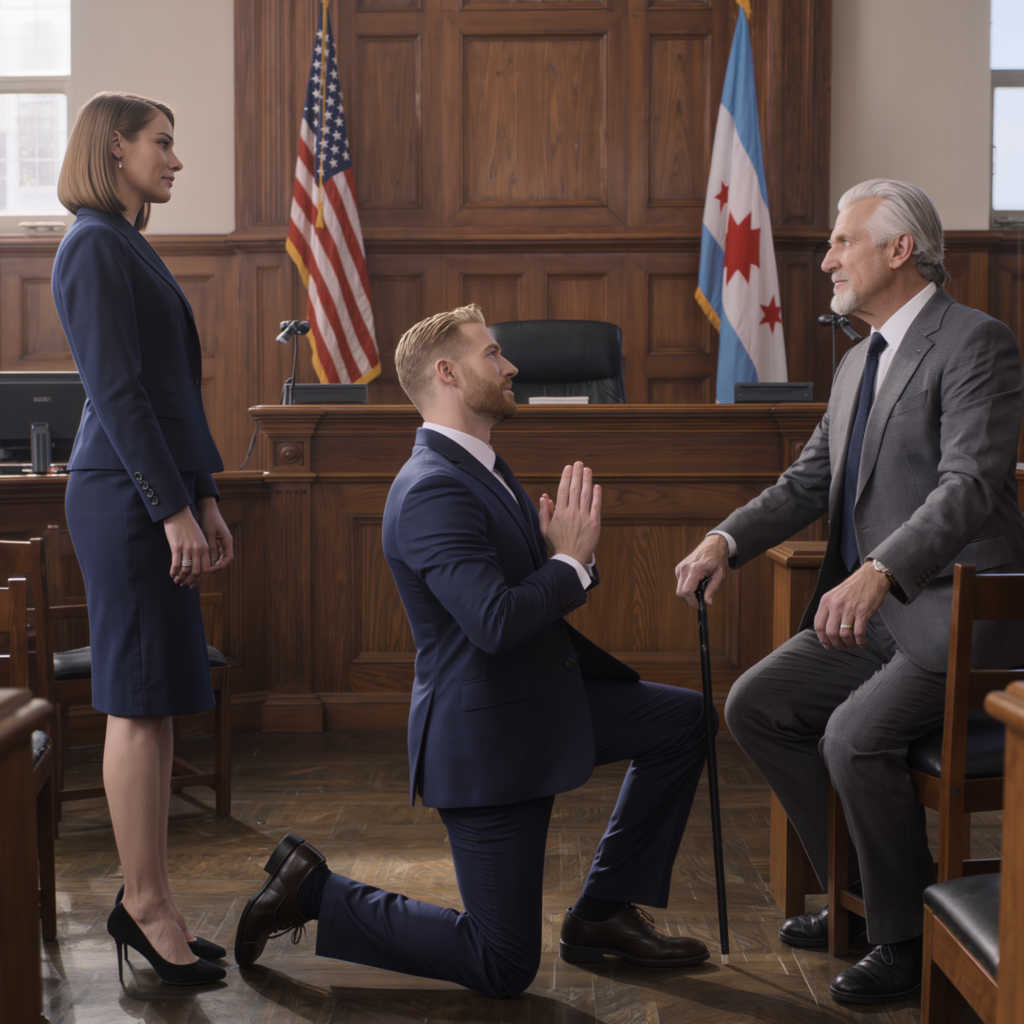
Then, pride destroyed, he dropped to his knees on the cold floor.
He hugged Mr. Kesler’s legs and sobbed uncontrollably.
“I’m begging you, Professor. My career, my future—please don’t destroy me. I’ll withdraw the petition. I’ll cancel the divorce. I’ll go back to Stella. Please, Professor.”
The sight was pathetic—and, to anyone watching, satisfying.
Gabe, who arrived like a king, now begged at the feet of the man he’d insulted.
Stella looked away, disgusted.
He wasn’t pleading out of love. He was pleading out of fear.
Mr. Kesler stared down at Gabe, unmoved.
He shifted his foot, breaking free of Gabe’s grasp.
“It’s too late for theatrics, Gabe,” Mr. Kesler said coldly. “You’re begging not because you regret hurting your wife, but because you’re afraid of losing your world.”
“Your wife deserves her freedom today. She deserves to be free from a leech like you.”
“Get up. Don’t humiliate yourself further. We’re going to finish this in front of the judge like a man—like someone responsible for his actions should.”
Then Mr. Kesler turned to Stella and extended his hand.
“Come on, Stella. Let’s go inside. Don’t be afraid. Justice is on your side.”
Stella took his hand, tears filling her eyes again—different tears now.
She walked toward the hearing room with her head held high, accompanied by the legal legend.
Behind them, Gabe dragged his feet, hollow, stumbling after them into the courtroom that was about to become the tomb of his arrogance.
Hearing Room Number Three felt colder than the lobby.
Faded white walls, rows of long wooden benches—silent witnesses to the tension hanging in the air.
At the petitioner’s table, Gabe sat slumped, his proud posture gone. His face was pale, his eyes fixed on the empty judge’s bench.
Cold sweat continued to bead on his temples, even as the air conditioning hummed.
Beside him, Leo—the smooth-talking colleague—sat stiff as wax.
He didn’t even dare open his briefcase.
Facing Stella alone might have been easy.
Facing the shadow behind her was suicide.
At the respondent’s table, Stella sat calmly, hands folded in her lap.
Next to her sat Mr. Kesler.
Though he wore a worn plaid shirt and faded dress pants, the dignity he radiated made the simple chair feel like a throne.
He sat upright, both hands resting on his cane, eyes closed for a moment as if meditating.
The bailiff called the court to order.
A side door opened.
Three judges in black robes entered.
Everyone stood.
The presiding judge—a middle-aged man with thick glasses and a stern face—walked to the center chair.
As his eyes scanned the room before sitting, he stopped.
His gaze locked onto the old man at the respondent’s table.
He squinted, making sure he wasn’t mistaken.
Then his stern face shifted into shock and extraordinary respect.
“Professor Kesler,” the presiding judge murmured, voice audible in the sudden hush.
The two associate judges also turned, surprised, and instinctively inclined their bodies toward the respondent’s table—a gesture of respect rarely seen in court.
Mr. Kesler opened his eyes, smiled faintly, and gave a calm nod.
“Please proceed with your noble duty, Your Honor,” he said. “Consider me not here. I’m just an old man accompanying an acquaintance in her search for justice.”
The phrase “consider me not here” had the opposite effect.
Mr. Kesler’s presence changed the entire atmosphere.
The presiding judge swallowed, aware this hearing was being directly supervised by the grandmaster himself.
There would be no room for foul play.
“Very well, Professor. Thank you for your presence. It is an honor for us,” the presiding judge replied, polite and slightly nervous.
Then he looked at Gabe as if to ask: Are you trying to get yourself killed?
The judge struck the gavel three times.
“The hearing is now in session.”
“Mr. Gabe Mendoza,” the judge said, voice grave and authoritative. “In the petition you filed, it states that you are seeking a divorce on the grounds of incompatibility. You are also claiming full control of all marital assets, alleging that your wife—Mrs. Stella—has no financial contribution.”
“Do you stand by this petition?”
Silence.
All eyes turned to Gabe.
Gabe tried to open his mouth, but his voice stuck. His throat felt tight, his tongue heavy.
He glanced sideways at Mr. Kesler.
The old man wasn’t looking at him, only staring forward, calm.
But Gabe knew—one wrong word, one more lie in front of that presence, and it would be over.
Leo nudged Gabe under the table, panic in the movement.
Withdraw, boss.
Withdraw the petition.
Don’t be crazy.
The judge’s patience tightened.
“Mr. Mendoza,” the presiding judge called more forcefully, “I repeat: do you stand by your claim to the marital assets?”
Gabe trembled.
He glanced at Stella.
She wasn’t looking at him with hatred.
She looked at him with pity.
That pity stung more than anger.
“No, Your Honor,” Gabe finally said, voice weak, deflated.
The judge raised his eyebrows.
“No? What do you mean?”
Gabe kept his head bowed.
“I… I withdraw my claim to the marital assets, Your Honor. I acknowledge that the house and its contents are community property.”
“I am even willing to surrender my share entirely to my wife as a form of my responsibility.”
Leo exhaled, nearly slumping in relief.
Stella’s eyes widened.
She glanced at Mr. Kesler.
The old man remained calm, only giving the slightest nod, as if this were expected.
“Let the record show,” the presiding judge said firmly. “Mr. Mendoza surrenders the assets in their entirety to Mrs. Stella.”
“Now,” the judge continued, “what about the grounds for divorce? Do you still insist that Mrs. Stella is not worthy of being with you?”
It was a trap.
If Gabe answered yes—if he cited social status like he had in the lobby—he would look petty and vile under Mr. Kesler’s gaze.
Gabe shook his head, tears slipping down.
“No, Your Honor. That reason is not relevant. I was the one who was wrong.”
“I was not able to be a good husband. I want a divorce because I am no longer worthy of her.”
A restrained wave of emotion moved through the room.
Gabe’s confession was born of fear, but to Stella it sounded like the first admission of fault she’d heard from him.
Mr. Kesler raised his right hand slightly.
“Your Honor, may I speak for a moment as the respondent’s companion?”
The presiding judge nodded immediately.
“Of course, Professor. The floor is yours.”
Mr. Kesler didn’t stand. He remained seated, but his voice filled the room.
He didn’t look at the judge.
He looked at the bowed profile of Gabe’s head.
“The law was created to humanize humans,” Mr. Kesler said.
Then, softer, cutting deeper:
“Son, your law degree and your expensive suit are worthless if you use them to oppress the person who once devoted her life to you.”
“Today, you lose your wife, but at least you saved what’s left of your conscience by telling the truth just now.”
“Do not repeat this mistake. Be a lawyer who defends the truth, not one who defends greed.”
Gabe sobbed quietly, shoulders shaking.
The words were both a slap and the last piece of advice from the idol he had disappointed.
The shame would etch itself into his memory like a scar.
“Thank you, Professor,” the presiding judge said, then reasserted authority.
“Very well. Since the petitioner has admitted his fault and surrendered his rights to the assets, and both parties agree to separate, the court will now proceed to read the judgment immediately.”
Stella listened to every word with mixed feelings—relief, sadness, and a strange sense of liberation.
She wouldn’t be left destitute. She wouldn’t be humiliated.
And she had watched her arrogant husband crumble.
When the gavel struck three times, finalizing the divorce decree, Stella felt as if a thousand-ton weight had been lifted from her shoulders.
She turned to Mr. Kesler.
“Thank you, sir,” she whispered, tears shining. “You didn’t just help me on the bus. You saved my life.”
Mr. Kesler smiled and patted the back of her hand.
“It wasn’t me, my dear. It was your own kindness that saved you. I was just an instrument.”
Across the table, Gabe stood slowly.
He didn’t dare look at Stella, let alone Mr. Kesler.
He nodded to the judge with a trembling hand, then hurried out without looking back, followed by a stumbling Leo.
Gabe left carrying crushing defeat and a shame that would haunt his career.
Stella remained seated, upright, ready to embrace a new chapter of her life.
The trial of conscience had been won by honesty.
Outside the hearing room, the air felt fresher—as if the oxygen that had been blocked in Stella’s chest finally flowed again.
She was no longer the unvalued wife of a successful lawyer.
She was a free woman who had defended her rights, her dignity, and her home—earned through her own sweat.
“Are you at peace now, my dear?” Mr. Kesler asked as they walked slowly toward the exit.
“Very much at peace,” Stella answered honestly. “I feel like a huge boulder has been lifted off my back.”
“I don’t know how to thank you enough. If you hadn’t been here, I might have walked out with nothing but the clothes on my back.”
“You don’t have to thank me, Stella,” Mr. Kesler said, looking out at the sunny courtyard. “Your victory today isn’t because of me, but because of the sincerity of your own heart.”
“God is the great director of everything. He arranged the script for you to take the same bus as me, for you to help me, and for me to return the favor.”
“That is God’s way of embracing you when you are in trouble.”
At the entrance lobby, a sleek black sedan—far more luxurious than Gabe’s—waited.
A chauffeur in an impeccable uniform stepped out and opened the rear door.
Mr. Kesler’s driver had come to pick him up.
Mr. Kesler paused before getting in.
He reached into the pocket of his plaid shirt and pulled out a simple ivory-colored business card with embossed gold lettering.
Only a name and a personal phone number—no long list of titles.
“Keep this,” Mr. Kesler said, placing the card in Stella’s hands. “Your house is secure now, but life must go on.”
“If you ever need a job or legal assistance in the future, don’t hesitate to call. The doors of my firm are always open to honest people like you.”
Stella accepted the card with trembling hands.
She bowed respectfully and kissed the back of Mr. Kesler’s hand like a daughter to her father.
“Thank you, sir. May you always be blessed with health and long life.”
“One more thing,” Mr. Kesler said, giving Stella’s shoulder a gentle pat. His gaze deepened.
“Never regret this separation. Don’t cry over losing that man. You didn’t lose anything, Stella.”
“He is the one who lost everything by chasing stones and throwing away a jewel. You have just reclaimed your dignity.”
“Go home with your head held high. Redecorate your house, cook your favorite meal, and start a new happy life.”
Stella nodded firmly, tears streaming—but not tears of sadness.
“Yes, sir. I will remember your words.”
Mr. Kesler smiled broadly, then got into the car.
The window rolled down, revealing a final wave from the legal legend before the sedan pulled away, leaving the courthouse and merging into the bustling city.
After Mr. Kesler left, Stella stood alone on the sidewalk.
Strangely, she didn’t feel lonely.
She felt whole.
She looked toward the street where the CTA bus she had taken that morning passed again, black smoke trailing behind.
That old bus—once a symbol of her poverty—had turned out to be the chariot that carried her to justice.
Stella lifted her eyes to the clear blue sky.
The sun was dazzling, but warm.
She touched the pocket of her dress, feeling the texture of Mr. Kesler’s business card, and the keys to the house that were now legally hers.
There was no more fear. No more low self-esteem.
Gabe might have status and money, but Stella had something money can’t buy.
Courage.
A clear conscience.
Stella smiled—the most sincere smile she had shown in the past year—and walked with light steps toward the bus stop, ready to return to her home, her castle, and begin a new chapter.
Life is full of surprises, and today Stella learned that kindness, no matter how small, is never in vain.
Justice found its way home just before sunset.
The moral is simple: kindness and good character are the best investments, the kind that never yield a loss.
Never look down on others based on outward appearance, and never be afraid to do good—even when you are facing hardship yourself.
In the end, integrity and a sincere heart will always triumph over arrogance and the highest positions.
God never sleeps when counting the deeds of His children.
And to you who have made it this far, I want to ask: what would you have done in Stella’s place?
Has anyone ever surprised you with kindness when you least expected it? Tell me in the comments—I love reading your stories.
If this story made you reflect on how we treat others, and how karma always comes around, don’t forget to leave a like, subscribe to the channel, and hit the notification bell so you don’t miss more stories like this one.
Share this video with someone who needs to hear this message.
News
My son looked me dead in the eye and said he’d sell the Connecticut house my late husband and I built, just to buy his wife a shiny new Mercedes—then gave me 24 hours to pack—because “she matters more.” I smiled, nodded, and started folding sweaters, while the truth sat in a folder he’d never thought to ask about.
My son said, “I decided to sell your house to buy a new car for my wife. She’s more important…
In a Chicago courtroom filled with reporters and family friends, my parents tried to bankrupt me in public—just to make sure the whole city believed I was broke. They wanted humiliation, headlines, and the end of my name. But when the judge asked one single question, their lawyer went pale—and my father’s empire began to crumble before everyone’s eyes…
I sat in a bankruptcy courtroom packed with strangers—not because I was out of money, but because my parents…
After my husband’s death, I decided to open his old safe. Inside was $500,000 in cash and some documents. But when I saw the third item, a cold wave of terror swept over me… and for the first time in fifty years of marriage, I realized how little I’d truly known the man I’d shared my life with.
After my husband’s death, I decided to open his old safe. Inside was $500,000 in cash and a stack…

For seven months, every single night at exactly 2:47 a.m., my husband would rise from our creaking bed, cross the dark room, and stand on my side just watching me breathe—until the night I pretended to sleep and finally heard what he was whispering, and the truth behind that 2:47 ritual shattered everything I thought I knew about my life.
For seven months, every single night at 2:47 in the morning, my husband would stand right next to my…
My son and his wife left me for a seven-day cruise with my “mute” 8-year-old grandson, but the second the lock clicked, he looked up and whispered, “Grandma, don’t drink the tea Mama made for you”—and that was the moment I realized this week wasn’t babysitting… it was a test I might not survive.
My son and his wife flew off on a cruise, leaving me alone for a week with my 8-year-old grandson,…

My name is Eleanor, I’m 70, and for years I let my own son believe I was the kind of fragile widow you could steer with pity and pressure. Three days ago, he tried to force my signature onto a $200,000 loan for a “dream house,” and when I refused, he hurt me badly enough that he thought I’d finally fold. The next morning, at a bank in our little American city, one screen proved how wrong he was.
My name is Eleanor. I am seventy years old. And until three days ago, my own son believed I…
End of content
No more pages to load