I’m glad to have you here. Follow my story until the end and comment the city you’re watching from.
The morning I found my son and his wife standing at my door with their suitcases, I knew exactly why they’d come. They thought I was rich. They thought I’d bought some luxury resort in the Rocky Mountains.
What they didn’t know was that the villa they’d heard about wasn’t mine at all. It belonged to twelve women who’d lost everything—women I’d chosen to build a real family with.
My name is Emma Carter. I’m 61 years old, and this is the story of how I learned that the people who share your blood aren’t always the ones who deserve your heart.
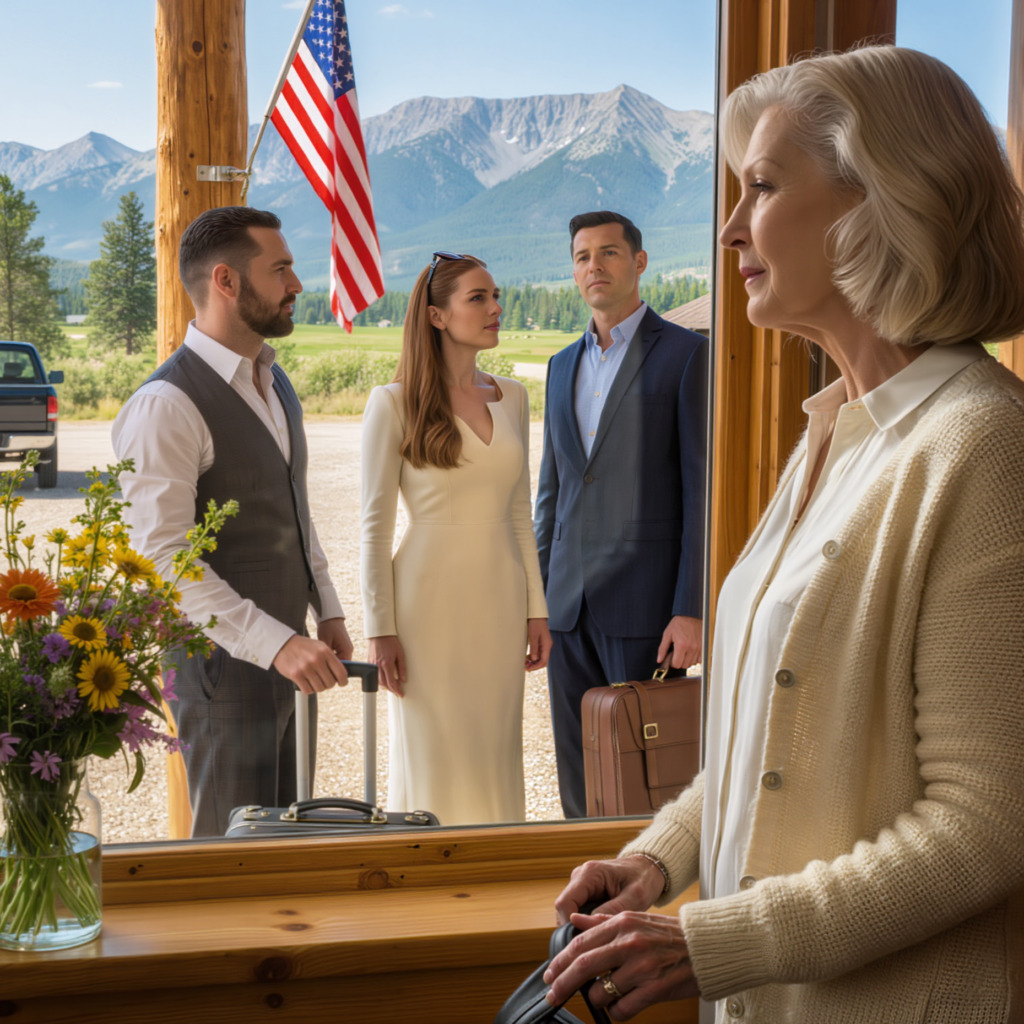
The wildflowers were purple and white that morning. I remember because I’d just finished arranging them in the tall glass vase by the window when I heard it—the low rumble of an engine climbing the narrow mountain road.
I froze, my fingers still wet from the flower stems. No one was supposed to visit that day. The women who lived here at Mountain Haven Retreat were all down in Pine Ridge for their weekly counseling sessions.
I’d been looking forward to the quiet. At 61, after a lifetime of chaos, I’d finally learned to treasure silence.
The engine grew louder. Through the tall windows of the main hall, I watched a black SUV appear around the bend, its paint so shiny it hurt to look at in the morning sun.
My chest tightened. Something in my body recognized that car before my mind did.
I set down the vase carefully. My hands had started to shake.
The SUV pulled up to the gravel drive near the front steps. The engine cut off. Car doors opened—one, two, three distinct slams that echoed off the mountain walls.
Three people.
I moved closer to the window, staying back just enough that they wouldn’t see me watching. The first person out was a man in his 30s, wearing a charcoal vest over a pressed white shirt.
Even from a distance, I could see the set of his jaw, the way he moved with that particular kind of confidence that comes from never being told no.
My son, Evan.
I hadn’t seen him in five years. Not since the morning after my cancer surgery when he’d shown up at the hospital, stayed two days, and asked to borrow $10,000 before he left.
The second person was a woman about his age—designer sunglasses, cream-colored dress that probably cost more than my monthly grocery budget back when I was working double shifts at Denver General.
Her heels clicked on the gravel as she walked around to the back of the SUV.
Sarah. Evan’s wife.
We’d met exactly four times. At their engagement party, I’d handed her an envelope with $5,000—money I didn’t have because Evan said they needed it for the wedding.
She’d thanked me without making eye contact.
The third person made my stomach drop.
He was older, maybe mid-40s, wearing a suit that looked expensive in that understated way wealthy people prefer. He pulled a leather briefcase from the trunk with practiced ease.
When he turned toward the house, I saw his face clearly—sharp features, calculating eyes, the kind of smile that never quite reaches the eyes.
I didn’t know him, but I knew the type.
The doorbell chimed. That soft, welcoming sound that usually announced frightened women looking for safety now felt like a warning bell.
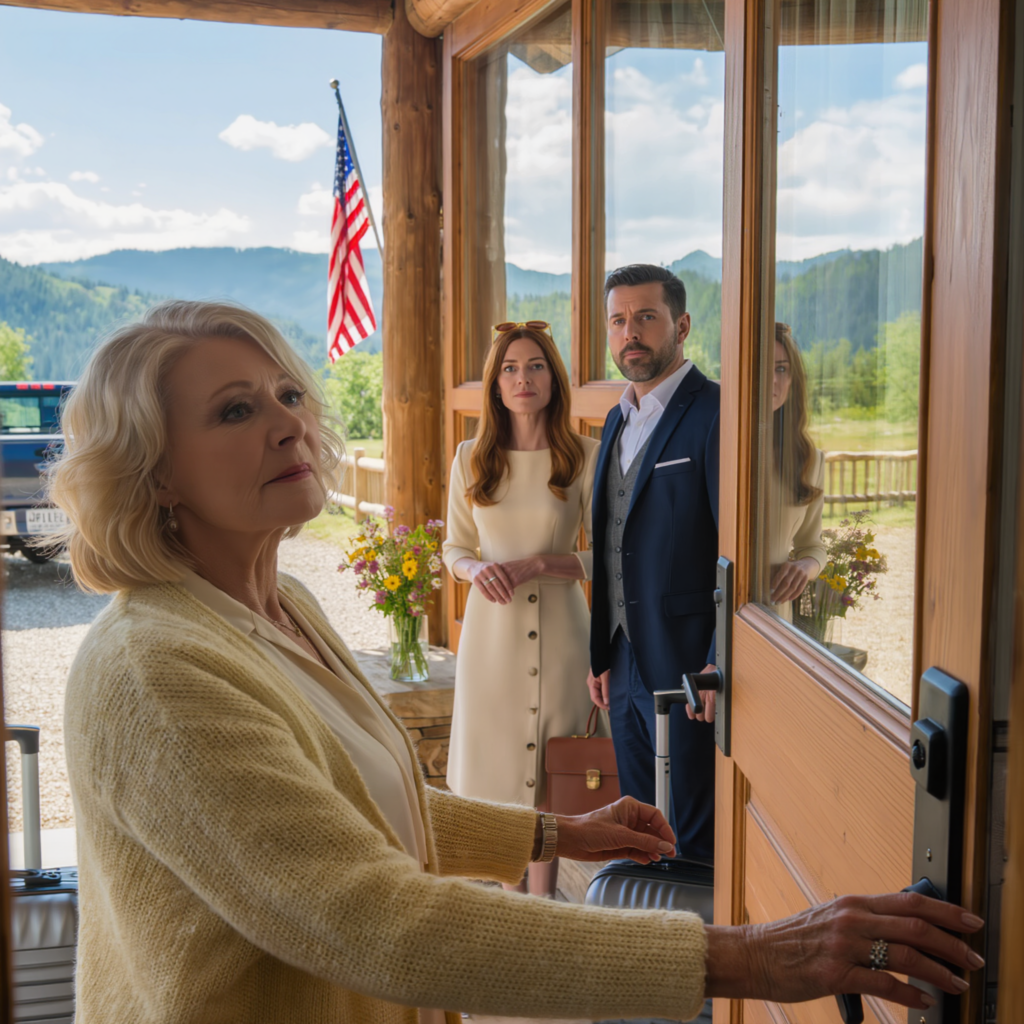
I took a slow breath. Then I walked to the door and opened it.
“Mom.”
Evan’s voice was carefully neutral. Not warm, but not hostile either—the voice of someone who’d rehearsed this moment.
“Evan.”
I kept my own voice steady.
“Sarah.”
“Hello, Emma.”
Sarah smiled. That thin smile. I remembered it—the one that never involved her eyes.
The man in the suit stepped forward, extending his hand.
“Mrs. Carter. Marcus Thornton. I’m Evan’s financial adviser.”
Financial adviser.
The words settled into my chest like stones.
I shook his hand because that’s what you do. His grip was firm. Professional.
“Mr. Thornton.”
“We heard you’d moved to the mountains,” Sarah said, already looking past me into the house. “To some kind of luxury property. We thought we’d come visit, maybe stay a few days, make up for lost time.”
She paused.
“Make peace.”
Make peace—as if the problem between us was a simple misunderstanding and not five years of phone calls that went to voicemail, birthdays acknowledged with generic cards signed only with his name, holidays spent alone while I recovered from surgery.
But I didn’t say any of that. Instead, I stepped back and opened the door wider.
“Come in.”
They didn’t wait for me to offer twice. Sarah walked in first, her heels loud on the wooden floor. Evan followed, rolling two large suitcases behind him.
Marcus came last, his eyes already scanning the space with that particular intensity people use when they’re appraising property value.
“It’s beautiful,” Sarah said, though her tone suggested she’d expected more. “Very rustic.”
The main hall did look beautiful that morning. Sunlight streamed through the tall windows, warming the honey-colored wood.
The furniture was simple but well-made, most of it built by Diana in our workshop. Fresh bread from Patricia’s kitchen sat cooling on the counter, filling the air with that yeast-and-warmth smell that makes any house feel like a home.
But Sarah wasn’t looking at any of that.
Her eyes had fixed on something else.
The wall.
The entire back wall of the main hall was covered in photographs—forty-seven frames of different sizes arranged in a pattern that had evolved organically over three years.
Not a professional gallery wall. Something more personal. More alive.
Every single photograph showed women, young and old, different races and backgrounds. Some smiling alone, others in groups.
Some were candid shots working in the garden, laughing over dinner, building furniture in the workshop. Others were more formal, like the portraits we did whenever someone completed our six-month program.
Not a single photo showed Evan.
I watched their faces as they stared at the wall.
Evan’s confusion was genuine. Sarah’s mouth formed a small, perfect O.
Marcus pulled out his phone and snapped a photo, trying to be subtle about it.
“Mom,” Evan said slowly. “Who are all these people?”
I walked past them to stand in front of the wall. My fingers touched one of the frames gently.
“This is Rebecca Torres,” I said. “She’s 28. She arrived here three years ago with a four-year-old daughter and nowhere to go. Her ex-husband put her in the hospital twice before she found the courage to leave.”
I moved to another photo.
“This is Patricia Reeves, 67 years old. Her three sons stole $80,000 from her retirement account and had her placed in a Medicaid nursing home. She came here thinking her life was over.”
“Mom—”
Evan tried to interrupt.
I kept going.
“This is Diana Foster, 45. Her husband spent fifteen years convincing her she was worthless, then took everything in the divorce. She showed up here with one suitcase and couldn’t even write a check in her own name.”
I turned to face them.
“This place isn’t what you think it is.”
Sarah’s laugh was sharp and nervous.
“What is it supposed to be, then? A hobby?”
“It’s a recovery retreat,” I said calmly. “Mountain Haven. A place where women who’ve been hurt, abandoned, and told they’re worthless can come to rebuild their lives.”
The silence that followed felt thick enough to touch.
Marcus recovered first, his business brain clearly working.
“A nonprofit. That’s admirable, Mrs. Carter. Tax benefits must be substantial.”
“It’s not a nonprofit,” I said. “It’s my home. And theirs.”
Evan stared at me like I’d started speaking a foreign language.
“You live here with strangers.”
“They’re not strangers,” I said quietly. “Not anymore.”
Sarah turned in a slow circle, reassessing everything with visible disappointment.
“So this isn’t a resort. Or an investment property.”
“No.”
“But the property value—” Marcus started.
“I don’t care about property value,” I interrupted. “I care about giving women a place to heal.”
Evan’s face went through several emotions in quick succession. Now it settled on something that looked like concern but felt more like calculation.
“Mom, we need to talk about your situation.”
“My situation?”
As if I were the one with problems.
“Let’s sit down,” I suggested. “I’ll make coffee.”
“Actually…” Sarah looked at the suitcases Evan had left by the door. “Where should we put our things? Which room is ours?”
The presumption in that question—which room is ours—took my breath away.
“There are no guest rooms,” I said. “Everyone here shares cabins. Six women to a cabin.”
Sarah blinked.
“You’re joking.”
“I have one small guest house for emergency situations. You can stay there tonight.”
“Tonight?”
Evan frowned.
“Mom, we were hoping to stay longer, to really reconnect.”
Something in my chest cracked.
For just a moment, I wanted to believe him. Wanted to believe my son had driven six hours into the mountains because he missed me, because he wanted to repair what we’d broken.
But then I saw Marcus checking his phone. I saw Sarah’s barely concealed disgust as she looked around the simple space. I saw the too-casual way Evan wouldn’t quite meet my eyes.
They hadn’t come here for me.
They’d come here for something else.
“We’ll talk in the morning,” I said. “The guest house is around back. It’s small but clean.”
“Perfect,” Marcus said smoothly. “We don’t want to impose.”
But they already had.
The moment they showed up without calling, without asking—with their suitcases and assumptions and that financial adviser with his leather briefcase full of whatever plan they’d cooked up—they’d already imposed.
I showed them to the guest house, a small structure about fifty yards behind the main building. It had one bedroom with a queen bed, a pullout couch in the living area, and a tiny bathroom.
Basic, but functional.
Sarah’s nose wrinkled as she walked inside.
“Cozy.”
The word meant small. Inadequate. Not what she’d expected.
“Dinner is at 6:00 in the main hall,” I said from the doorway. “If you want to join us.”
“Us?” Evan asked.
“The women,” I said. “We eat together every night.”
“Right.”
He set down his suitcase.
“We’ll be there.”
I didn’t go back to the main hall right away. Instead, I walked to my private quarters, a small suite of rooms on the second floor of the main building—my bedroom, a tiny office, and a bathroom that still felt luxurious after years of hospital housing with shared showers.
The office was where I kept the security system.
I’d installed cameras two years ago after an incident with one of our residents—abusive ex-partners who tracked her here. Nothing serious happened. Sheriff Morrison had handled it professionally, but it had scared me enough to take precautions.
Six cameras covered the property: main entrance, parking area, workshop, garden, and both sides of the main building. One camera pointed directly at the guest house.
I opened my laptop and pulled up the live feed. I felt guilty for about three seconds, then reminded myself that people who show up unannounced after five years of silence had forfeited certain privacy expectations.
The camera angle showed the guest house living room through the window. Evan and Sarah were visible unpacking. Marcus was on his phone, pacing.
I turned up the volume. The audio quality wasn’t perfect, but good enough.
“Exactly as you described it,” Marcus was saying into his phone. “Remote location, minimal security, elderly residents.”
A pause.
“Yes, the property is substantial. At least twenty acres, possibly more. Main building is newer construction, well-maintained.”
Elderly residents.
The phrase made my jaw clench.
Evan was rifling through his suitcase, not really listening. Sarah had disappeared into the bedroom.
Marcus ended his call and turned to Evan.
“Okay, so the good news is the property is definitely worth pursuing. Mountain real estate like this is premium, even with the inhabitants. We’re looking at high seven figures, maybe more.”
“Marcus.”
Evan’s voice carried a warning tone.
“She’s my mother.”
“I know that,” Marcus said smoothly. “Which is why this needs to be handled delicately. But Evan, you’re looking at $127,000 in debt—not the fifty-three you told Sarah about.”
My hand froze on the mouse.
$127,000.
“What?”
Sarah’s voice came from the bedroom doorway. She appeared in frame, her face pale.
“You said fifty-three. You promised me it was only fifty-three.”
Evan wouldn’t look at her.
“There were some additional complications.”
“Complications?”
Her voice rose.
“That’s almost three times what you told me. How could you—”
“Sarah, please.”
Evan held up his hands.
“Let’s not do this now.”
“When would you like to do it, Evan? After we’re homeless?”
Marcus stepped between them, ever the mediator.
“This is exactly why we’re here. Mrs. Carter has assets—significant assets—and no clear beneficiary.”
“She has me,” Evan said. “I’m her son.”
“Yes,” Marcus agreed. “But does she have a will? Is it updated? What happens if something were to happen to her, at her age? Health complications?”
“She’s sixty-one,” Evan interrupted. “Not ninety.”
“Old enough,” Marcus said, “especially if she’s showing signs.”
“Signs of what?”
Sarah had lowered her voice, but not her intensity.
Marcus pulled out a folder from his briefcase.
“Mental decline. Poor judgment. Giving away assets to strangers. The state of Colorado has very clear statutes about elder care and capacity.”
The words felt like ice water down my spine.
“You want to have her declared incompetent,” Sarah said slowly.
Not a question.
“I want to protect Evan’s inheritance,” Marcus corrected. “And frankly, Mrs. Carter’s welfare. Is it really healthy for a woman her age to be living in isolation with a dozen unstable women? What if there’s an incident? What if she gets hurt?”
Evan shook his head.
“That’s extreme. She seems fine.”
“Fine?”
Marcus gestured toward the window.
“Evan, your mother has given up a normal life to play house with charity cases. She’s isolated herself from family. She’s spending down assets on people who will never pay her back.”
In any court, that would raise serious questions about judgment.
“This is insane,” Evan said, but his voice lacked conviction.
“This is practical,” Marcus countered. “Look, I’m not suggesting anything permanent, just a temporary conservatorship while we sort out the financial situation. Get the property assessed. Maybe sell to a developer. Set up a proper trust fund for her care.”
“She could live very comfortably in a nice facility.”
“A facility?” Evan’s voice rose. “You want to put my mother in a nursing home?”
“A luxury retirement community,” Marcus amended smoothly. “Much more appropriate for someone her age than living in the wilderness with a bunch of broken women.”
Broken women.
The phrase made my hands curl into fists.
Sarah had gone very quiet. When she spoke again, her voice was thoughtful.
“How long would it take? The conservatorship—with the right evidence?”
“Two to three months. We’d need documentation of concerning behavior. Financial mismanagement. Maybe a sympathetic doctor’s evaluation.”
“I’m not drugging my mother,” Evan said flatly.
“No one’s suggesting that.”
Marcus’s patience was clearly wearing thin.
“But Evan, you need to focus. You’re $127,000 in debt. Your business failed. Your credit is destroyed. Your mother is sitting on a gold mine and giving it away to strangers.”
“At some point, you have to choose her feelings or your survival.”
The silence that followed was heavy.
Finally, Evan spoke.
“Let me talk to her tomorrow. Just let me try talking to her first.”
Marcus nodded slowly.
“Of course. Family first. But Evan…”
He paused.
“If she refuses to help, we’ll need to move to plan B.”
I closed the laptop.
My hands were shaking—not from shock. I’d suspected something like this the moment I saw Marcus step out of that SUV. But hearing it laid out so plainly, so clinically, made it real in a way that suspicion never could.
They wanted to take everything—not just the property, but my autonomy. My choices. My freedom.
I stood and walked to the window. From here, I could see the whole valley spreading out below—pine trees and aspens mixing in that particular way that only happens at this elevation.
Beyond that, the peaks of the Rockies touched a sky so blue it hurt.
This place had saved my life. Not dramatically, not all at once, but slowly, steadily—the way real healing always happens.
I thought about the woman I’d been five years ago. Emma Carter, 56 years old, divorced nurse at Denver General Hospital, working double shifts because the bills never stopped coming.
Living in a studio apartment that smelled like old carpet and resignation.
The day I got my cancer diagnosis, I was in the supply closet at the hospital counting inventory.
“Stage one,” the doctor had said later. “Very treatable. Good prognosis.”
I’d called Evan from the hospital parking lot, my hands shaking so badly I could barely hold the phone.
“Mom.”
His voice had been distracted.
“I’m in a meeting. Can I call you back?”
“I have breast cancer,” I’d said—just like that. No preamble.
A pause.
“Oh. Oh, Mom. I’m… God, I’m sorry. Are you okay?”
“I’m having surgery next week. Wednesday.”
“Wednesday.”
I could hear him typing.
“Next Wednesday the fourteenth. Yes. I’ll be there. I promise. As soon as the surgery’s done, I’ll drive up.”
He’d sounded sincere. Maybe he had been in that moment.
I had the surgery alone. I woke up alone in recovery with a nurse—someone I didn’t know, short-staffed that day—checking my vitals.
I went home to my studio apartment alone, with a drain tube and painkillers and instructions for wound care.
Evan called that evening.
“Traffic was bad,” he said. “I’ll come tomorrow.”
Tomorrow became the day after, then the day after that.
He showed up seventy-two hours post-op carrying takeout Chinese food and apologies. Stayed two days.
We didn’t talk about anything that mattered. He mostly worked on his laptop while I dozed on the couch, hooked up to my drain.
On the second day, while I was making tea, he brought it up.
“Mom, I know the timing is terrible, but I need to ask you something.”
I’d known from his tone what was coming.
“What is it, Evan?”
“I’m in a bit of a financial bind. The business needs a cash injection to get through the quarter. Just ten thousand. I’d pay you back with interest in three months.”
$10,000.
Three months of my salary after taxes.
“I don’t have that kind of money, Evan.”
“What about the house? You could take out a line of credit.”
“There is no house. I sold it to pay off your father’s debts. I have a studio apartment and a ten-year-old car.”
His face showed genuine surprise.
He really didn’t know.
Hadn’t asked.
“But Dad died six years ago.”
“Yes. And it took me five years to pay off everything he owed. The gambling debts, the credit cards, the second mortgage I didn’t know about.”
Evan looked away.
“I didn’t know it was that bad.”
“You didn’t ask.”
He left the next morning. No mention of the ten thousand. No offer to help with my recovery.
Just a hug and a promise to stay in touch.
I received a birthday card from him five months later. Generic. No personal message beyond his signature.
That was five years ago.
In the year after my surgery, something shifted in me.
I kept working at the hospital, but differently. I started volunteering at a women’s shelter on my days off.
I met women whose stories made my own struggles feel manageable by comparison.
Rebecca was the first one I really connected with. She was 25 then, with a three-year-old daughter and a broken arm that was healing wrong because she’d been too scared to go to the hospital.
Her husband had thrown her down the stairs.
I’d helped her navigate the restraining order process. Found her a pro bono lawyer. Helped her apply for emergency housing.
She cried in my arms one night after a court hearing.
“I don’t know how I’ll ever repay you.”
“You don’t repay kindness,” I told her. “You pay it forward.”
That phrase became my mantra.
I met Patricia at a community center. She’d been placed in a nursing home by her sons after they cleaned out her bank accounts.
The facility was understaffed, underfunded, and she’d lost forty pounds in three months.
When I met her, she was trying to do her own taxes at the library because she couldn’t afford help and wanted to report her sons for fraud.
Diana I found through the hospital. She’d come in for stitches after “walking into a door,” the same lie I’d heard a thousand times.
I sat with her in the examination room and told her the truth—that it wouldn’t get better, that she didn’t deserve it, that leaving was possible.
Six months later, she left with nothing.
Her husband had taken everything: the house, the bank accounts, even her jewelry. Everything in her name he’d convinced her to sign over, years ago, “for tax purposes.”
These women taught me something my own family never had.
That worth isn’t measured in what you have, but in who you are.
When my mother died—my last living parent—she left me $63,000. Not a fortune, but combined with my retirement savings and the money from selling my father’s coin collection, it was enough.
Enough to buy twenty-seven acres in the mountains outside Pine Ridge, Colorado.
Enough to build a small main hall and two cabins.
Enough to create something that mattered.
I invited Rebecca first, then Patricia, then Diana. Word spread quietly through networks of women who knew women who knew someone who needed help.
By the end of the first year, we had six residents.
By year two, we grew vegetables, built furniture, taught each other skills, healed.
I named it Mountain Haven Retreat, but we all just called it home.
And now Evan wanted to take it away.
Call me incompetent.
Put me in a luxury facility while he sold the land to developers.
Over my dead body.
The sound of vehicles on the gravel drive pulled me from my thoughts.
I checked my watch. 3:47 p.m.
The women were back early from town.
I went downstairs to meet them.
Rebecca came through the door first, her daughter Sophia’s hand firmly in hers. At seven now, Sophia had grown from that terrified toddler into a bright, curious child who loved books and bugs equally.
“Emma!”
Sophia broke away and ran to me.
I caught her in a hug that smelled like strawberry shampoo and sunshine.
“How was town, sweetheart?”
“We got ice cream, and Mama said I could get a library book about frogs.”
“A book about frogs sounds perfect.”
I looked over Sophia’s head at Rebecca.
“How was the session?”
Rebecca’s smile was genuine but tired. Therapy sessions always took a lot out of her.
“Good. Hard, but good.”
Her eyes found the guest house visible through the window.
“You have visitors.”
“My son and his wife.”
Understanding crossed Rebecca’s face. She knew enough about my history with Evan.
We’d had many late-night talks about complicated family relationships.
Patricia came in next, carrying two cloth grocery bags. At 67, she moved with the efficient energy of someone who’d spent decades as an accountant.
Her late husband’s watch—the only thing her sons hadn’t managed to steal—glinted on her wrist.
“Emma, I got the good flour. The whole wheat from that bakery you like.”
She set the bags on the counter, then noticed my expression.
“What’s wrong?”
“Nothing. I just have some unexpected guests.”
Diana appeared in the doorway, saw my face, and immediately went on alert. Three years of living with other trauma survivors had given all of us a sixth sense for when something was wrong.
“What happened?”
“My son is here.”
The temperature in the room shifted.
The women knew what Evan represented—all the years of being taken for granted, of giving and giving with nothing in return.
Grace Lou came in next, followed by Natalie Brooks. Grace was carrying bags from the art supply store.
Natalie, who rarely spoke but observed everything, took one look at my face and moved to stand beside me.
A silent show of support.
“How long are they staying?” Patricia asked, already unpacking groceries with practiced efficiency.
“I don’t know yet.”
“They know what this place is,” Diana’s voice carried an edge.
“They do now.”
The front door opened again.
Bella Rodriguez, our newest resident, stepped inside hesitantly. At 22 and five months pregnant, she still moved like someone expecting to be hit.
She’d been with us for less than a week.
“Is everything okay?”
Her voice was small.
“I heard voices.”
Rebecca immediately went to her.
“Everything’s fine, honey. Just some of Emma’s family visiting.”
But Bella’s eyes had found the window, found the guest house, found something that made her face go pale.
“That black SUV. Is that theirs?”
“Yes,” I said.
“Why?”
“My ex drove a black SUV.”
She wrapped her arms around herself.
“Same model. I just… Sorry. I’m being stupid.”
“You’re not being stupid,” Diana said, guiding her to a chair. “You’re being careful. That’s different.”
I knelt beside Bella’s chair.
“The people in that SUV are not going to hurt you,” I said. “I promise they’re not going to hurt anyone here.”
Bella nodded, but didn’t look convinced.
The sound of the guest house door opening made us all turn.
Through the window, I could see Evan, Sarah, and Marcus heading toward the main building.
“They’re coming,” Grace said quietly.
Patricia squared her shoulders.
“Good. Let them come.”
I stood up.
“I need to ask you all something, and I need you to be honest.”
Six pairs of eyes fixed on me.
“This could get complicated,” I said. “My son and his wife—they have expectations, and that man with them is some kind of financial adviser. They’re going to be asking questions, making judgments. It might get uncomfortable.”
“When hasn’t it been uncomfortable?” Diana said, with a slight smile. “We’re used to uncomfortable.”
“I know. But you don’t owe me anything. If you want to stay in your cabins until they leave—”
“Absolutely not,” Patricia interrupted. “This is our home, too. We’re not hiding.”
Rebecca nodded.
“Besides, I want to meet the famous Evan.”
There was no mistaking the irony in her voice.
The door opened.
Evan stepped in first, followed by Sarah and Marcus. They stopped just inside the threshold, clearly not expecting to find the hall full of people.
“Oh,” Evan said. “Sorry. We didn’t mean to interrupt.”
“You’re not interrupting,” I said. “We’re just back from town.”
“Everyone, this is my son Evan, his wife Sarah, and their associate Marcus.”
“Financial adviser,” Marcus corrected with a smooth smile.
There was a moment of awkward silence.
Then Patricia stepped forward, extending her hand.
“Patricia Reeves. I manage the household finances here.”
Marcus’s eyebrows rose slightly.
“A pleasure.”
“Diana Foster,” Diana said.
She didn’t offer her hand.
“I run our woodworking workshop.”
“Grace Lou,” Grace said. “I teach ESL and literacy classes.”
“Rebecca Torres,” Rebecca said, keeping Sophia close to her side. “I work at the Pine Ridge Clinic. This is my daughter, Sophia.”
“Natalie Brooks,” Natalie said quietly.
Just her name, nothing more.
Bella didn’t introduce herself. She moved to stand behind Diana, using her as a shield.
Sarah stared at all of them with barely concealed confusion.
“You all live here.”
“We all live here,” Patricia confirmed. “Have for three years, some of us longer, some shorter.”
“That’s quite a setup,” Marcus said.
His tone implied the opposite.
“It works for us,” Diana replied coolly.
Evan looked around the space, really seeing it for the first time: the long dining table that seated fourteen, the kitchen area where Patricia was already starting dinner prep, the bookshelf overflowing with donated books.
The children’s corner where Sophia’s toys lived alongside art supplies and board games.
“Mom,” he said slowly. “Can we talk privately?”
“Anything you need to say, you can say here,” I replied. “We don’t keep secrets in this house.”
Sarah made a small sound of disbelief.
“Surely there are some things that should stay between family.”
“These women are my family,” I said simply.
The words hung in the air.
Evan’s face went through several emotions: confusion, hurt, anger, and something that might have been shame.
“Your real family,” Sarah clarified, her voice sharp.
Rebecca stepped forward.
“Actually, family is who shows up, who cares, who stays.”
She looked directly at Evan.
“Emma talks about you sometimes. Says she hasn’t heard from you in five years.”
“That doesn’t sound like family to me.”
“That’s none of your business,” Evan said, color rising in his face.
“When you show up unannounced and start making demands, it becomes our business,” Patricia said. “This is our home. Emma is our family, and we protect each other here.”
Marcus held up his hands.
“I think everyone’s getting a bit defensive. We’re not here to cause problems.”
“Then why are you here?” Diana asked bluntly.
“To visit my mother,” Evan said. “Is that so wrong?”
“After five years?” Grace’s voice was gentle but pointed. “That’s a long time between visits.”
“You don’t know the whole story,” Sarah said.
“We know Emma’s story,” Rebecca replied. “That’s enough.”
I could feel the tension ratcheting up. This wasn’t how I wanted this to go—my son and the women I loved already at odds.
“Everyone take a breath,” I said quietly. “This doesn’t need to be a confrontation.”
“Doesn’t it?”
Patricia looked at me.
“Emma, why are they really here?”
It was the question I’d been avoiding. The one I couldn’t answer without exposing everything I’d heard on that security footage.
Evan must have sensed my hesitation because he jumped in.
“We came because we heard Mom was living alone in the mountains. We were worried. That’s all.”
“She’s not alone,” Diana said.
“With strangers,” Sarah amended. “Surely you can understand our concern. A woman her age, isolated.”
“I’m sixty-one,” I interrupted. “Not ninety. And I’m not isolated. I’m surrounded by people who actually care about me.”
The barb hit its mark. Evan flinched.
“Mom, that’s not fair.”
“Isn’t it?”
The words came out sharper than I intended.
“When’s my birthday, Evan?”
He blinked.
“What?”
“My birthday. What day is it?”
“April…”
“April 23rd.”
“May 16th,” I corrected. “It’s been May 16th for sixty-one years.”
The silence was deafening.
Even Sophia seemed to sense it, pressing closer to her mother’s leg.
“I…”
Evan looked genuinely stricken.
“I’m sorry. I should know that.”
“Yes,” I agreed. “You should.”
Marcus cleared his throat.
“Perhaps we should discuss this tomorrow when everyone’s had a chance to—”
“To what?” Patricia cut him off. “Prepare lies? We don’t work that way here.”
“I don’t think anyone’s lying,” Marcus said carefully. “Just misunderstanding.”
“There’s no misunderstanding,” my voice came out tired. “Evan, Sarah, Marcus—you’re welcome to stay tonight in the guest house. But tomorrow morning, we’re going to have a very honest conversation about why you’re really here.”
“We told you why,” Sarah started.
“You told me what you wanted me to believe,” I corrected. “Tomorrow I want the truth. All of it.”
I didn’t sleep that night.
At 2:47 a.m., I gave up pretending and went down to the kitchen. I made myself chamomile tea that I didn’t drink.
I sat at the long dining table in the dark, watching the moon paint silver lines across the wooden floor.
My laptop sat in front of me, still showing the paused security footage from earlier.
Marcus’s words frozen on the screen.
“She’s spending down assets on people who will never pay her back.”
People who will never pay her back.
As if love could be measured in transactions. As if the life I’d built here was just bad accounting.
I heard footsteps on the stairs—soft, careful, someone trying not to wake the others.
Rebecca appeared in the doorway wrapped in an oversized cardigan.
“Couldn’t sleep either.”
“Not really.”
She came and sat beside me, not asking permission, not waiting for an invitation.
That was one of the first things we taught women here—that they had a right to exist in space without apologizing for it.
“Sophia had a nightmare,” Rebecca said. “About her father. She hasn’t had one in months.”
“Was it the SUV? Seeing Bella’s reaction?”
“Maybe. Or maybe she just sensed the tension.”
Rebecca looked at the laptop screen.
“Are you watching the security footage?”
I should have lied. I should have closed the laptop and changed the subject.
Instead, I turned it so she could see.
“They’re planning to have me declared incompetent,” I said quietly. “Take the property. Put me in a facility.”
Rebecca didn’t look shocked.
“I know.”
“You know?”
“Diana heard them talking this afternoon through the window. She was going to tell you, but then you seemed like you already knew.”
Rebecca put her hand over mine.
“What are you going to do?”
“I don’t know yet.”
“Yes, you do.”
She smiled slightly.
“You’re going to fight. You’re going to make them see exactly who you are. And if they still choose to be blind, you’re going to show them the door.”
She made it sound so simple.
Maybe it was.
“I keep thinking about when Evan was little,” I said. “Before his father died. He was sweet. Thoughtful. He’d bring me dandelions from the yard like they were diamonds.”
“People change,” Rebecca said gently. “Sometimes they grow toward the light. Sometimes they don’t.”
“He’s my son.”
“I know. And you’ll always love him. But Emma—loving someone doesn’t mean letting them destroy you.”
She was right.
I knew she was right.
I’d told her the same thing three years ago when she was deciding whether to leave her husband.
“Come on,” Rebecca said, standing. “If we’re not sleeping, we might as well make breakfast.”
“The good breakfast?”
“The good breakfast,” she agreed. “The one that says, don’t mess with us.”
Despite everything, I smiled.
“The full spread.”
“The full spread.”
By 6:00 a.m., the kitchen was filled with the smell of Patricia’s fresh-baked biscuits, scrambled eggs with cheese and herbs from Grace’s garden, bacon that Diana had picked up from the farmers market, and the hash browns that Natalie made better than anyone.
Coffee percolated in the big urn we used for community meals.
The women gathered without being called.
They knew.
Somehow they always knew when one of us needed the others.
Sophia sat at the table coloring carefully in a book about marine animals. Bella was beside her, showing her how to blend colors.
The simple domesticity of it—the morning light, the warm food, the quiet companionship—made my chest ache.
This was what Evan wanted to take away.
Not just property. Not just money.
Home.
At 7:15, I saw movement through the window. The guest house door opening.
Evan emerged first, looking rumpled and tired. Sarah followed, already dressed perfectly despite the early hour.
Marcus came last—phone already pressed to his ear.
“They’re coming,” Diana said quietly.
“Let them come,” Patricia replied, pouring orange juice into glasses with steady hands. “Let them see what family actually looks like.”
The door opened.
All three of them stopped when they saw the table: twelve settings, food piled high, women gathered like a fortress around something precious.
“Good morning,” I said. “We eat breakfast together every morning. You’re welcome to join us.”
Sarah’s eyes scanned the spread.
“This is quite elaborate for a Tuesday.”
“We believe in taking care of each other,” Grace said simply. “Please, sit.”
For a moment, I thought they might refuse.
Then Evan’s stomach growled audibly, and he gave an embarrassed laugh.
“It smells amazing.”
They sat. Not together.
There wasn’t room.
Evan ended up between Diana and Patricia. Sarah between Grace and me.
Marcus took the end seat—still on his phone.
“We don’t use phones at the table,” Natalie said quietly.
It was the first time she’d spoken directly to any of them.
Marcus looked up, startled.
“I’m sorry. I’m in the middle of an important—”
“Then step outside,” Patricia said pleasantly. “But if you want to eat with us, the phone goes away.”
For a moment, Marcus looked like he might argue.
Then he seemed to realize he was outnumbered. He ended the call and pocketed his phone with visible reluctance.
“Thank you,” Natalie said.
We passed food family-style.
Evan took biscuits and eggs with visible appreciation. Sarah took small portions of everything, her movements precise and controlled.
Marcus ate mechanically, his mind clearly elsewhere.
Sophia broke the silence.
“Are you Emma’s son?”
She was looking at Evan with open curiosity.
“I am,” Evan said.
“Why don’t you visit more? Emma talks about you sometimes. She says she misses you.”
The entire table went still.
Rebecca put a hand on Sophia’s shoulder.
“Sweetie, that’s a grown-up question.”
“But I want to know,” Sophia insisted, with seven-year-old logic. “If my mama missed me, I would visit her every day.”
Evan’s face turned red.
“It’s complicated.”
“What’s complicated?” Sophia asked.
“Sophia,” Rebecca said gently, “eat your breakfast.”
But the damage was done.
Or maybe it was exactly what needed to happen.
Sometimes children ask the questions adults are too polite to voice.
“She’s right,” Evan said quietly. “If you missed someone, you’d visit them.”
He looked at me.
“I don’t have a good excuse, Mom. I just… I got busy. And then more time passed, and it felt harder to reach out.”
“You could have called,” I said.
“I know.”
“You could have written, texted, sent an email.”
“I know.”
“You could have come after my surgery. You promised you would come.”
His eyes filled with tears. Real ones, I thought.
“I know. I’m sorry. I’m so sorry.”
Sarah stared at her plate.
Marcus went very still, watching this exchange with the careful attention of someone calculating angles.
“Sorry isn’t enough,” Patricia said bluntly. “Not after five years.”
“Patricia,” I started, but she shook her head.
“No, Emma. Someone needs to say it.”
She looked at Evan.
“You don’t get to walk away from someone for five years and then show up expecting everything to be fine. That’s not how family works.”
“I made mistakes,” Evan said.
“You made choices,” Diana corrected. “There’s a difference.”
Evan set down his fork.
“You’re right. All of you. I made terrible choices. I was selfish and self-absorbed, and I took my mother for granted.”
He looked around the table.
“But I’m here now. Doesn’t that count for something?”
“Why are you here?” Rebecca asked. “Really? What made you decide to visit after all this time?”
The silence stretched out.
This was the moment—the question I’d been avoiding, that Evan had been avoiding, that hung over everything like a storm cloud.
“We heard she’d bought property,” Sarah said finally. “Expensive property in the mountains.”
“And you thought what?” Grace’s voice was soft but sharp. “That you’d come get your share?”
“No,” Evan said quickly. “No, that’s not—”
“That’s exactly it,” Marcus interrupted.
He’d been quiet this whole time, but now he leaned forward.
“Let’s stop dancing around it. Mrs. Carter, you’re sixty-one years old, living in an isolated location with a dozen women who have complicated histories. You’ve liquidated your retirement accounts and invested everything in property that generates no income.”
“From a financial planning perspective, that’s concerning.”
“Concerning to whom?” Patricia asked coldly.
“To anyone who cares about her future,” Marcus replied. “What happens in ten years? Twenty? Who’s going to take care of her when she needs help?”
“We will,” Diana said immediately.
Marcus smiled.
It wasn’t a kind smile.
“With what money? None of you have stable income.”
He looked around the table like he was evaluating inventory.
“You’re all living off Mrs. Carter’s generosity. What happens when that runs out?”
“We contribute,” Rebecca said. “We work. We—”
“You have jobs that barely cover personal expenses,” Marcus cut her off. “None of you could afford to maintain this property. Which means when Mrs. Carter can no longer manage it—and eventually, she won’t be able to—this whole operation collapses.”
“And then where will you all be?”
The cruelty of it took my breath away.
Not because it wasn’t logical. It was.
But because it reduced everything we’d built to a balance sheet—to numbers that didn’t account for worth that couldn’t be quantified.
“You want to know the real truth?”
Marcus continued.
“Evan is $127,000 in debt. His business failed. His credit is destroyed. And his mother is sitting on assets worth well over a million dollars that she’s giving away to strangers.”
“Marcus,” Evan said sharply. “That’s enough.”
“Is it?”
Marcus turned to him.
“You wanted to try talking first, so talk. Tell your mother what happens if you can’t pay your debts. Tell her about the people you borrowed from. Tell her what they’ve threatened to do.”
Sarah had gone pale.
“Marcus, stop.”
“Why?”
He looked at me.
“So we can keep pretending this is about family reconciliation? Mrs. Carter, your son is in serious trouble. The kind of trouble that doesn’t go away with apologies or good intentions.”
“He needs money. Significant money. And you have it.”
“So that’s why you came,” I said quietly.
Not a question.
Evan wouldn’t meet my eyes.
“I was going to explain. I was going to ask for help properly. I didn’t want it to come out like this.”
“How did you want it to come out?” Patricia demanded. “What was the plan? Butter her up for a few days and then hit her with the bill?”
“It wasn’t like that,” Evan insisted.
“Then what was it like?” Diana asked. “Because from where we’re sitting, it looks like you showed up after five years of silence because you need money. That’s not family. That’s opportunism.”
“You don’t understand,” Sarah said desperately. “We’re going to lose everything. Our house, our cars, everything we’ve worked for.”
“Good,” Natalie said quietly.
Everyone turned to stare at her.
She so rarely spoke that when she did, people listened.
“Maybe you need to lose everything,” Natalie continued, her voice still soft but steady. “Maybe that’s the only way you’ll learn what actually matters.”
Sarah’s face crumpled.
“That’s easy for you to say. You don’t have anything to lose.”
“I lost everything three years ago,” Natalie replied. “My freedom. My dignity. My sense of self.”
“I was trafficked for two years. Sold to men who saw me as property.”
“When I escaped, I had literally nothing. Not a dollar. Not a friend. Not even a name. So many fake ones, I’d almost forgotten my real one.”
The table had gone completely silent.
Even Sophia had stopped coloring.
“Emma found me in a shelter,” Natalie continued. “Brought me here. Gave me space to heal.”
“And you know what I learned? When you have nothing, you learn what everything actually means.”
“Everything is safety. Everything is kindness. Everything is people who see you as human.”
She looked at Sarah.
“So yes. Maybe you need to lose your house, lose your cars, lose everything that makes you feel superior to people like us.”
“Because until you do, you’ll never understand what your mother-in-law has built here.”
After breakfast, the women cleaned up in pointed silence.
Evan, Sarah, and Marcus stood awkwardly in the living area, clearly unsure what to do with themselves.
“We need to talk,” I told Evan. “Privately. Just you and me.”
Sarah started to object, but Evan held up a hand.
“Okay.”
We went to my office upstairs.
It was small: a desk, two chairs, and a window that looked out over the valley.
I closed the door and turned to face my son.
In the morning light, I could see how much he’d aged. Lines around his eyes that hadn’t been there five years ago. Gray threading through his dark hair.
He looked tired in a way that went deeper than sleep.
“Tell me everything,” I said. “The truth. All of it.”
He sank into one of the chairs and put his head in his hands.
When he looked up, his eyes were wet.
“I started a tech company three years ago. Consulting. Software development. I thought I knew what I was doing.”
He laughed bitterly.
“I was so confident.”
“Sarah’s father offered to invest, but I turned him down. Wanted to prove I could do it on my own.”
“What happened?”
“I made bad decisions. Hired the wrong people. Took on clients we couldn’t handle. Lost money on contracts I’d underpriced.”
He rubbed his face.
“By the end of year one, I was $50,000 in debt. I told myself I could fix it.”
“I took out business loans, maxed out credit cards, borrowed from friends. And Marcus…”
“Marcus was a friend of a friend. Said he could help restructure my debt, get me better terms.”
“What he actually did was consolidate everything into one loan with his associates.”
“Associates?” I repeated.
“You mean loan sharks?”
Evan nodded miserably.
“I didn’t know that’s what they were. Not at first. The interest rate seemed high but reasonable.”
“Then I missed a payment. And another. And suddenly the hundred thousand I owed became $127,000.”
“And they were calling every day with threats.”
“What kind of threats?”
“The kind that involves showing up at your house at 2 a.m. The kind that mentions Sarah by name. The kind that makes it very clear what happens to people who don’t pay.”
My stomach turned.
“Evan, why didn’t you tell me? Why didn’t you ask for help?”
“Because I was ashamed.”
The words burst out of him.
“Because I was thirty-three years old and I’d failed at everything. Because you’d already sacrificed so much for me and I couldn’t bear to ask for more.”
“Because…”
His voice broke.
“Because I’d been such a terrible son, and I didn’t think I deserved your help.”
“So instead you came here to take it?”
He flinched.
“No. Maybe. I don’t know.”
He looked at me.
“When Marcus found out you’d bought property in Colorado, he saw an opportunity. He said we could restructure everything if we could get access to your assets.”
“He talked about conservatorship. About having you declared incompetent if necessary. I told him no. I told him I’d never do that to you.”
“But you still came here.”
“I came here because I thought… I hoped that if I explained everything, if I was honest, you might help.”
“Not because you had to. Because you wanted to.”
Tears were streaming down his face now.
“I came here hoping that maybe, despite everything I’d done, you still loved me enough to help.”
The words hit me like a physical blow because of course I still loved him.
He was my son.
You don’t stop loving your children, no matter how much they hurt you.
But love and trust are different things.
And I didn’t trust Evan.
Not anymore.
“How much do you need?” I asked quietly.
His head snapped up.
“What?”
“To clear the debt. To get these people off your back. How much?”
“$150,000,” he whispered. “With penalties and interest.”
$150,000.
More than half of what I had left in liquid assets after building the retreat.
“And if I gave it to you,” I asked, “what would happen?”
“I’d pay off the debt. Start over. Maybe get a regular job instead of trying to run my own business.”
“Be normal.”
“And us?”
He looked confused.
“What do you mean?”
“Would you visit? Would you call? Would you be part of my life?”
“Or would you disappear for another five years until you needed something else?”
“Mom, that’s not fair.”
“Isn’t it?”
I leaned forward.
“Evan, you said you came here hoping I still loved you. But do you love me?”
“Really love me?”
“Or do you just love what I can do for you?”
“Of course I love you.”
“Then why didn’t you come when I had cancer?”
“Why didn’t you call on my birthday?”
“Why didn’t you check on me after your father died and I was left with all his debts?”
My voice was rising.
“Why has every interaction we’ve had in the past decade involved you needing something from me?”
“I don’t know.”
He was crying openly now.
“I don’t have a good answer.”
“I was selfish. I was blind. I took you for granted because you were always there—always reliable, always willing to help.”
“And by the time I realized what I’d lost, I didn’t know how to fix it.”
“So you showed up with your wife and a loan shark planning to take my home.”
“I didn’t plan that. Marcus did.”
He shook his head.
“I just… I was desperate. And I went along with it because I couldn’t see another way out.”
I stood up and walked to the window.
Below, I could see the women moving around the property: Patricia in the garden, Diana in the workshop, Rebecca walking with Sophia toward the trail that led to the creek.
My family.
The one I’d chosen.
The one that had chosen me back.
“I’m going to tell you something,” I said. “And I need you to really hear it.”
I turned to face him.
“I spent fifty-six years of my life being useful to people who didn’t value me. Your father used me as a bank account and emotional support while he gambled away our future.”
“You used me as a safety net and ATM while you pursued your dreams.”
“I gave and gave and gave until there was nothing left of me.”
“Mom, I’m not—”
“I’m not finished,” my voice was firm. “When I came here—when I built this retreat—I made a choice. I chose to give my time, my energy, and my resources to women who appreciated it, who worked for it, who treated me like a person, not a resource.”
I gestured out the window.
“Rebecca works forty hours a week at the clinic and still comes home to help with dinner.”
“Patricia manages our finances and teaches classes on budgeting. Diana builds furniture that we sell to support this place. Grace tutors and gardens.”
“Natalie creates art. Bella—who’s been here less than a week—has already offered to help however she can.”
“They’re not your family,” Evan said desperately.
“They’re…”
“They’re more family than you’ve been in years.”
The words came out sharper than I intended, but they were true.
“Family isn’t just blood, Evan. It’s showing up. It’s caring.”
“It’s being there when things are hard—not just when you need something.”
He stared at me like I’d struck him.
“I have $183,000 left in liquid assets,” I continued. “Everything else is tied up in this property and improvements in the program we’ve built.”
“If I gave you $150,000, I’d have $33,000 left. One emergency, one major repair, one unexpected crisis, and this whole place collapses.”
“Twelve women who’ve rebuilt their lives here would have nowhere to go.”
“So you’re choosing them over me?”
His voice was flat.
“I’m choosing sustainability over enabling,” I said. “There’s a difference.”
“That’s easy to say when you’re not the one about to lose everything.”
“I have lost everything,” I said.
The words exploded out of me.
“I lost your father to his addictions. I lost my health to cancer. I lost five years of my life to debt I didn’t create.”
“I lost my son to selfishness and neglect.”
“I’ve lost plenty, Evan.”
“The difference is, I use those losses to build something better.”
“So that’s it.”
He stood up.
“You won’t help me.”
“I didn’t say that.”
He stopped.
“What?”
“Sit down.”
He sat slowly, suspicion and hope warring on his face.
“I will help you,” I said, “but not by writing a check. That doesn’t help anyone. It just delays the inevitable.”
“If you want my help, you’ll earn it.”
“How?”
“You’ll stay here six months.”
“You’ll live in one of the cabins with the others. You’ll work in the garden, the workshop—wherever we need you.”
“You’ll attend counseling sessions. You’ll contribute to this community.”
“And at the end of six months, if you’ve proven that you’re serious about changing—if you’ve shown that you value people over money and family over convenience—I’ll give you $50,000.”
“Fifty thousand.”
His face fell.
“Mom, I need one-fifty.”
“Then you’ll get the rest the same way.”
“Six more months—another $50,000. And six months after that—the final $50,000.”
I crossed my arms.
“Three years total.”
“That’s how long you’ll work to earn what you need. Three years during which you’ll rebuild our relationship.”
“Three years during which you’ll become the man you should have been all along.”
“Three years during which you’ll learn what family actually means.”
“And if I say no?”
“Then you leave,” I said. “And you figure out your debts on your own.”
He stared at me for a long moment.
“What about Sarah? Marcus?”
“Sarah can stay if she agrees to the same terms.”
“Marcus leaves today.”
“Mom, he’s—”
“He tried to have me declared incompetent. Evan, he’s not staying in my home.”
Evan’s shoulders slumped.
“Can I think about it?”
“You have until this evening,” I said. “Dinner is at 6:00. If you’re at the table, I’ll know your answer.”
After Evan left my office, I sat in my chair for a long time, staring at nothing.
I’d done the right thing.
I knew I had.
Giving Evan money wouldn’t fix his problems. It would just postpone them.
He needed to learn accountability, self-sufficiency, the value of hard work.
But he was still my son, and part of me wanted to write that check—hand it over—and pretend money could fix what was broken between us.
A knock on the door pulled me from my thoughts.
“Come in.”
Patricia entered, carrying two mugs of tea. She handed me one and sat in the chair Evan had vacated.
“Diana told me the basics. Three years.”
“Three years,” I echoed.
“He’ll say no, probably.”
“And if he does,” I said, “then I’ll know for certain what I already suspect—that he loves the idea of having a mother more than he actually loves me.”
Patricia sipped her tea.
“You know what the hardest part of leaving my sons was?”
“What?”
“Accepting that I’d raised them wrong. That somewhere along the way, I taught them they could take without giving.”
“That I trained them to see me as a resource instead of a person.”
She looked at me.
“You’re not responsible for who Evan became, but you are responsible for what you allow him to continue being.”
“Is that from therapy?”
“No,” Patricia said. “That’s from three years of watching you teach the rest of us how to set boundaries.”
She smiled slightly.
“Figure I should return the favor.”
We sat in comfortable silence for a moment.
“What do you think he’ll choose?” I asked.
“I don’t know,” Patricia said. “But I know what Sarah will choose.”
“What—she’ll tell him to leave?”
“She married him for his success and potential, not for who he actually is.”
“When you stripped away the possibility of easy money, you showed her exactly what she’d be committing to—real work, real change, real humility.”
“Women like Sarah don’t do humility.”
Patricia was probably right.
I’d seen it in Sarah’s face during breakfast, the growing realization that this wasn’t going to be the windfall she’d expected.
“And Marcus?” I asked.
“Marcus will cause problems,” Patricia said. “Men like him don’t just walk away when they’ve identified an asset they want. He’ll try something.”
“Like what?”
“I don’t know. But we should be careful.”
The afternoon passed tensely.
I worked in the garden with Patricia, pulling weeds and harvesting vegetables. Physical labor helped clear my mind.
Around 3:00 p.m., I saw Marcus leave the guest house and walk to his car. He made several phone calls, pacing back and forth, his expression growing darker with each conversation.
Diana came out from the workshop.
“Emma, that man is taking pictures of everything. The cabins. The main building. The garden.”
“He’s documenting the property.”
“For what?”
“Nothing good,” I said.
She was right.
At 3:47, two vehicles I didn’t recognize pulled up the drive. A man and woman got out of the first car, both dressed in business casual.
The second car held three people in uniform—county building inspectors.
Marcus greeted them like old friends, shaking hands, gesturing toward the property with proprietary confidence.
Patricia appeared at my elbow.
“What’s happening?”
“Marcus called in a building inspection,” I said.
“Can he do that?”
“Anyone can file a complaint. They have to investigate.”
The inspectors spread out across the property with Marcus following, pointing things out. The woman was taking notes on a tablet.
The uniformed officers—I realized they were fire marshals—were checking the cabins one by one.
Diana came out of the workshop looking furious.
“They’re saying the electrical in cabin three isn’t up to code, which is— I had a licensed electrician do that work. I have permits.”
“Where are the permits?”
“In my cabin. In cabin three, which they’re currently inspecting and won’t let me enter.”
This was the plan Marcus had discussed on the security footage.
Create enough violations—real or manufactured—to condemn the property.
Force a sale.
Rebecca emerged from the main building with Sophia.
“Emma, they’re in the kitchen. They’re saying our commercial refrigerator doesn’t have proper ventilation clearance.”
“It’s been fine for three years.”
“They’re saying code changed last year. We’re not in compliance.”
I felt my hands start to shake—not from fear, but from rage.
I walked toward the group of inspectors.
Marcus saw me coming and smiled that smooth, professional smile.
“Mrs. Carter, I hope you don’t mind. I thought it would be prudent to have the property evaluated for everyone’s safety.”
“You filed false complaints,” I said.
“I filed legitimate safety concerns. If the property is up to code, you have nothing to worry about.”
The lead inspector, a tired-looking man in his 50s, approached with his tablet.
“Mrs. Carter, I’m Tom Bridger with the county. We’ve received complaints about multiple code violations.”
“I know what this is,” I interrupted. “And I have documentation for every structure on this property. Permits. Inspection certificates. Certificates of occupancy.”
“Everything is legal and up to code.”
“I’m sure it is,” Tom said diplomatically. “But we still need to complete our inspection.”
“It’s standard procedure when complaints are filed. And if the complaints are fabricated, then nothing will come of this.”
“But we have to check.”
I looked at Marcus.
He was still smiling.
That’s when Evan and Sarah emerged from the guest house.
Evan took one look at the scene, and his face went pale.
“What’s going on?”
“Marcus called in building inspectors,” I said flatly. “He’s trying to have the property condemned.”
“He what?”
Evan spun to face Marcus.
“You said you were making phone calls about restructuring the debt.”
“I’m protecting your interests,” Marcus replied calmly. “If the property can’t be used for its current purpose, it can be sold for development.”
“That’s worth significantly more than operating it as a charity.”
“I told you we weren’t doing that,” Evan’s voice rose. “I specifically told you.”
“You told me you wanted to try talking to her first,” Marcus said. “You did. She said no.”
“So now we move to plan B.”
“There is no plan B,” Evan snapped.
He looked at me.
“Mom, I didn’t know he was going to do this. I swear.”
“It doesn’t matter,” my voice came out tired. “He’s already done it.”
Tom cleared his throat.
“Mrs. Carter, I don’t mean to interrupt, but we need to continue our inspection.”
“Do you have your documentation available?”
“It’s in my office. I’ll get it.”
I walked back to the main building on legs that felt unsteady.
The women were gathered near the entrance, watching everything unfold.
“What do we do?” Rebecca asked quietly.
“We show them everything is legal,” I said. “We prove Marcus is lying.”
“And if they find something?” Grace’s voice was worried.
“Codes change.”
“What if there’s something we missed?”
“Then we fix it,” I said, trying to sound more confident than I felt. “We’ve done nothing wrong. This place is safe and legal.”
And then I stopped.
Through the window, I could see Marcus talking to the fire marshal, pointing at cabin five—the oldest cabin, the one that had been here when I bought the property.
I’d renovated it but not rebuilt it.
The fire marshal shook his head, making notes.
My stomach dropped.
Patricia followed my gaze.
“That’s the cabin I’m in.”
“I know.”
“They’re going to find something wrong with it, aren’t they?”
“Probably,” I admitted, because that was the strategy.
Find one violation. Use it to question everything. Create enough doubt in paperwork that operating the retreat became impossible.
I went to my office and gathered every piece of documentation I had: building permits, electrical certificates, plumbing inspections, fire safety approvals, three years of meticulous recordkeeping.
When I came back out, Tom was waiting with his team.
I handed him the folder.
“Everything’s here. Every structure, every system, every change we’ve made.”
He flipped through it, nodding.
“This all looks in order.”
“Because it is.”
“Except…”
The fire marshal approached—a younger man with a clipboard.
“Cabin five has knob-and-tube wiring in two rooms. That’s a code violation.”
My heart sank.
“The cabin came with the property. I was told existing wiring was grandfathered in.”
“It was until you did renovations,” he said. “The moment you pulled permits for other work on that structure, it triggered a requirement to bring everything up to current code.”
“I didn’t know that.”
“Ignorance of code doesn’t exempt you from it.”
He didn’t sound mean—just matter-of-fact.
“The cabin can’t be legally occupied until the wiring is replaced.”
Patricia stood beside me.
“That’s my cabin.”
“Then I’m afraid you’ll need to relocate until repairs are made.”
Marcus had moved closer, clearly enjoying this.
“It seems the property isn’t quite as well-maintained as Mrs. Carter claimed.”
“One grandfathered violation doesn’t condemn a property,” Tom said sharply.
He’d apparently picked up on what Marcus was doing.
“Mrs. Carter has sixty days to remediate. That’s standard procedure.”
“Sixty days?”
Patricia looked at me.
“Emma, where will I—”
“You’ll move into my suite,” I said immediately. “We’ll figure it out.”
“And if there are other violations we haven’t found yet?” Marcus pressed. “How many women will be displaced? How many safety issues are we overlooking?”
“That’s enough,” Evan said suddenly.
Everyone turned to look at him.
He stared at Marcus with something that looked like hatred.
“You’ve made your point. You found a violation. One violation in a three-year-old operation.”
“Congratulations.”
“I’m protecting your interests,” Marcus said again.
“No,” Evan said, his voice shaking. “You’re protecting yours.”
“You want this property condemned so you can force a sale and get your money.”
“You don’t care about my mother.”
“You don’t care about these women.”
“You don’t even care about me.”
“I’m just another debt to collect.”
“Evan, you’re being emotional.”
“I’m being clear for the first time in months.”
Evan turned to Tom.
“My mother’s property is legal. One code violation doesn’t change that. And the complaint that brought you here was filed in bad faith by a man who’s trying to profit from manufactured problems.”
Tom nodded slowly.
“I kind of figured that out.”
He looked at Marcus.
“Mr. Thornton, filing false complaints is a misdemeanor in Colorado. If I determine that’s what happened here, I’ll be forwarding this case to the district attorney.”
Marcus’s confident expression finally cracked.
“I filed legitimate safety concerns.”
“Based on what inspection?” Tom asked. “What expertise?”
“Or did you just walk around looking for things that might be wrong?”
Tom closed his tablet.
“Mrs. Carter, you have sixty days to remediate the electrical issue in cabin five. Everything else looks fine.”
“You’ll receive a formal report by mail.”
“Thank you.”
Tom and his team packed up and left. The fire marshals followed.
Within minutes, it was just us again.
Me. The women. Evan. Sarah. Marcus.
Marcus rounded on Evan.
“What were you thinking? You just cost yourself—”
“I cost myself nothing,” Evan interrupted. “You were never going to help me.”
“You were helping yourself.”
“Your debt doesn’t disappear just because you grew a conscience,” Marcus sneered.
“I know,” Evan said. “But I’d rather deal with it honestly than by destroying my mother.”
Marcus’s face went hard.
“Then you’re a fool, and you’re on your own.”
He grabbed his briefcase from the guest house and walked to his car without looking back.
The engine roared to life and he peeled out, sending gravel flying.
In the silence that followed, Sarah let out a bitter laugh.
“Well, that’s it then. We’re ruined.”
“No,” Evan said quietly. “We’re free.”
Sarah stared at Evan like he’d lost his mind.
“Free? We’re not free. We’re broke. We owe $127,000 to people who threaten to break kneecaps.”
“And your mother just made it clear she’s not writing us a check.”
“She offered to help,” Evan said.
“She offered to make you work like a servant for three years,” Sarah snapped.
“That’s not help. That’s punishment.”
“No,” Patricia said quietly. “That’s accountability.”
Sarah whirled on her.
“I wasn’t talking to you.”
“Maybe you should be,” Patricia replied, unflinching. “Because you’re standing in a place built by women who had nothing and rebuilt everything, and you’re calling honest work punishment.”
“Patricia,” I said gently. “Let them talk.”
“No,” Diana stepped forward. “She’s right to say it.”
“I’m tired of watching them treat what we’ve built like it’s beneath them.”
Rebecca joined them, Sophia holding tight to her hand.
“We work forty-hour weeks and still come home to cook and clean and contribute.”
“What makes you think you’re above that?”
“I’m not,” Sarah started.
“You are,” Grace said softly. “It’s in every look you’ve given us since you arrived.”
“Every time you wrinkled your nose at our food, our furniture, our lives.”
“You think we’re charity cases. Broken things Emma collected out of pity.”
Natalie moved to stand with the others.
Even Bella—who’d been so quiet and scared—straightened her spine.
They formed a line between Sarah and me. Not threatening—just present.
A wall of women who’d learned to take up space to defend what mattered.
“This is insane,” Sarah said. “Evan, tell them.”
But Evan wasn’t looking at her.
He was looking at the women—really seeing them for the first time.
“When’s the last time you worked a real job?” he asked Sarah suddenly.
She blinked.
“What?”
“When’s the last time you actually worked?”
“I managed our household,” Sarah said.
“With a housekeeper, a gardener, and a meal service,” Evan said quietly.
“When’s the last time you cooked a meal from scratch, cleaned a bathroom, planted something and watched it grow?”
“That’s not fair. We had the money for help.”
“Money we borrowed,” Evan said. “Money we didn’t have.”
He looked at me.
“Mom, I need to tell you something about why I really stayed away.”
Everyone went quiet.
After Dad died, Evan said, “I was angry. Angry at him for leaving. Angry at you for not somehow preventing it. Angry at myself for not being there.”
He swallowed hard.
“But mostly I was angry because I realized I was becoming him.”
I felt my chest tighten.
“Evan—”
“He was never satisfied,” Evan said, voice shaking. “Never present. Always chasing the next thing that would make him feel important.”
“And I looked at my life—the business I was building, the money I was spending, the way I treated people—and I saw him.”
“I saw all his worst traits in me.”
Tears streamed down his face.
“I stayed away because I was ashamed.”
“Because every time I talked to you, you were kind and loving and patient, and I knew I didn’t deserve it.”
“I knew I was using you the same way Dad did, and I couldn’t face that.”
“So instead you faced nothing,” Patricia said.
Not cruel. Just honest.
“Instead, I faced nothing,” Evan agreed. “I buried myself in work and debt and bad decisions because that was easier than admitting I needed to change.”
Sarah shook her head.
“This is ridiculous. We don’t have time for therapy confessions. We need to figure out what we’re going to do about the debt.”
“I know what I’m going to do,” Evan said.
“I’m staying.”
The words hung in the air like something solid.
“You’re what?”
Sarah’s voice went very quiet.
“I’m accepting Mom’s offer. Six months here—working, learning, changing.”
He looked at me.
“If you’ll still have me.”
I wanted to say yes immediately. Wanted to pull my son into my arms and tell him everything would be okay.
But I’d spent too many years being the person who fixed things, who made everything easy, who never let anyone face real consequences.
“On one condition,” I said.
“Anything.”
“You call your creditors today. You tell them the truth—that you’re working on a payment plan, but it will take time.”
“You don’t hide from them. You don’t pretend the problem doesn’t exist.”
“You face it honestly.”
He nodded.
“Okay.”
“And you attend counseling. Real counseling. With the therapist we use in town—twice a week minimum.”
“Okay.”
“And you work. Really work. Not symbolic work to make yourself feel better. Actual labor that contributes to this community.”
“I will,” he said. “I promise.”
Sarah backed toward the guest house.
“You’ve lost your mind. Both of you.”
“I’m not staying here like some… some refugee.”
“Then don’t,” Rebecca said simply. “Go home. Figure out your life.”
“But stop treating ours like it’s worthless just because we started from nothing.”
“I didn’t.”
“You did,” Diana said. “From the moment you walked in, you made it clear you think we’re beneath you.”
“That what we’ve built here is pathetic.”
“That Emma wasted her life on broken women who will never amount to anything.”
“That’s not—”
“I have a college degree,” Grace interrupted. “I taught high school English for twenty-three years. I’m not uneducated. I’m not stupid.”
“I just married a man who convinced me I was both, and it took me until I was forty-eight to realize he was wrong.”
“I was a corporate lawyer,” Diana said. “Made six figures. Had a corner office.”
“I lost it all because I believed my husband when he said I was lucky to have him, that no one else would want me.”
“I’m a licensed nurse,” Rebecca added. “I work in a clinic that serves people who can’t afford private doctors.”
“I’m raising a daughter who speaks two languages and reads at a fourth-grade level, even though she’s only seven.”
“I’m not broken. I’m surviving.”
Patricia smiled slightly.
“And I managed a fifty-million-dollar portfolio before my son stole my retirement.”
“I now manage a two-hundred-thousand-dollar annual budget for this retreat. I haven’t lost my skills.”
“I’ve just redirected them toward people who deserve them.”
Natalie, who almost never spoke, stepped forward.
“I was trafficked for two years. Sold to men who treated me like property.”
“I have scars on my body and in my mind that will never fully heal.”
“But I’m not broken.”
“I’m here. I’m alive. I create art that sells for real money.”
“I’m learning to be human again.”
She paused.
“What are you learning, Sarah?”
The silence that followed was profound.
Sarah’s face went through several emotions—anger, shame, defensiveness, and finally something that might have been recognition.
But she wasn’t ready to face it.
“I’m leaving,” she said finally. “Evan, if you come to your senses, you know my mother’s number.”
“Sarah,” Evan started.
“No. You want to play poor man’s retreat, fine. But I didn’t sign up for this.”
She went into the guest house and came out five minutes later with her suitcase.
She didn’t look at any of us.
She just walked to the car, got in, and drove away.
The dust from her departure settled slowly.
Evan stood there looking lost.
Not devastated—not the way you’d expect someone to look when their wife just left.
More like he’d been bracing for it and was surprised it didn’t hurt more.
“I’m sorry you had to see that,” he said to the room at large.
“We’ve all had moments like that,” Patricia said gently. “Moments where we realized the person we thought we needed wasn’t good for us.”
“It hurts, but it passes.”
“Where do I…?”
Evan gestured vaguely.
“Cabin four,” I said. “It has an empty bunk. You’ll share with three others.”
“James, who does maintenance. Carlos, who teaches music. And Ahmed, who’s studying to be a paramedic.”
“There are men here?” Evan looked surprised.
“Three,” I said. “We started accepting male residents last year. Turns out trauma and the need for community aren’t gender-specific.”
I pulled a key from my pocket.
“Same rules for everyone. Up at 6:00. Breakfast at 6:30. Work assignments from 8:00 to 4:00. Dinner at 6:00.”
“Community on Wednesday nights. Therapy twice a week. No exceptions.”
He took the key.
“Thank you, Mom.”
“Don’t thank me yet,” I said. “Wait until you’ve spent a week hauling firewood and cleaning communal bathrooms.”
“I will.”
He paused.
“And Mom… I’m sorry for all of it. I know sorry isn’t enough, but it’s a start.”
“It’s a start,” I agreed.
The first week nearly broke him.
Evan wasn’t used to physical labor. His hands blistered from working in the garden with Patricia.
His back ached from helping Diana move lumber in the workshop. He burned dinner when it was his turn to cook and had to start over while everyone waited—patient, but hungry.
On day three, I found him sitting outside cabin four at 2 a.m., head in his hands.
“Can’t sleep?” I asked.
He jumped.
“Mom. I didn’t hear you.”
“Old habit,” I said. “I used to do night rounds at the hospital.”
I sat beside him on the steps.
“What’s wrong?”
“Everything hurts,” he said. “My hands. My back. My legs.”
He laughed bitterly.
“I haven’t worked this hard in…”
He shook his head.
“Maybe ever.”
“You want to quit?”
“No. Yes. I don’t know.”
He showed me his blistered palms.
“I’m not good at this. Any of this. I burned dinner. I mixed up the laundry.”
“Yesterday, I accidentally dug up Grace’s medicinal herb section thinking it was weeds.”
Despite everything, I smiled.
“She was very patient about that.”
“She was,” he said.
“That’s the thing. Everyone’s so patient. Even after everything I’ve done, everything I’ve said, they treat me like… like I’m one of them.”
“You are one of them,” I said.
“But I’m not.”
He looked at me.
“They’re here because terrible things happened to them. I’m here because I made terrible choices.”
“It’s not the same, is it?”
I leaned back against the railing.
“Rebecca chose to marry her husband. Diana chose to stay for fifteen years. Patricia chose to trust her sons with her money.”
“We all make choices, Evan. Some turn out to be mistakes. The question is what you do after.”
“I don’t know what I’m doing,” he admitted. “I thought I’d come here and it would be hard but manageable. Like camping or something.”
“But this is…”
He gestured helplessly.
“This is real life.”
“People depending on each other. Contributing. Matter.”
“And I don’t know how to do that.”
“So learn,” I said.
“What if I can’t?”
“Then you’ll fail,” I said. “And that’s okay too.”
I stood up.
“Evan, you’ve spent your whole adult life afraid of failure. But failure is just information.”
“It tells you what doesn’t work, so you can try something else.”
“That’s very therapeutic of you.”
“I’ve been going to counseling too,” I said. “For three years. You think I built this place alone?”
“I had help. Lots of it.”
I put my hand on his shoulder.
“Go to bed. Tomorrow you’re helping Natalie in the art studio. She needs someone to prep canvases.”
“I don’t know how to prep canvases.”
“Then she’ll teach you,” I said. “That’s how this works.”
By week two, something started to shift.
Evan’s hands were still blistered, but he’d learned to wrap them properly. His back still ached, but he moved differently—more carefully, more intentionally.
He stopped burning dinner.
I watched him in the art studio with Natalie, carefully coating canvases with gesso while she painted.
They didn’t talk much. Natalie rarely did.
But there was something peaceful in their shared silence.
In the garden, Patricia put him on tomato duty.
“They need to be checked every day,” she explained. “Pruned. Staked. Watched for pests. It teaches patience.”
“I’m not patient,” Evan said.
“Then you’ll learn,” Patricia said, handing him pruning shears. “These are the suckers—the shoots between the main stem and branches.”
“They drain energy from fruit production. You have to remove them, but carefully. Too aggressive and you damage the plant.”
Evan spent an hour in the tomato section, carefully identifying and removing suckers.
When he finished, Patricia inspected his work.
“Good,” she said. “You only killed two plants.”
“I—what?”
“Relax. I’m joking. You did fine.”
She smiled.
“Tomorrow, peppers.”
In the workshop, Diana taught him basic carpentry.
“This is a miter saw. It will take your fingers off if you’re not careful, so pay attention.”
Evan paid attention.
By week three, he’d built a simple bookshelf. Nothing fancy—just a basic rectangle with four shelves.
But he’d measured, cut, sanded, and assembled it himself.
“It’s crooked,” he said, staring at it.
“It’s yours,” Diana replied. “And it holds books. That’s all a bookshelf needs to do.”
Sophia claimed it immediately for her room, filling it with her collection of ocean animal books.
Evan helped her arrange them, and I saw something on his face I hadn’t seen in years.
Pride.
Pride in something he’d created.
The counseling sessions were harder.
Dr. Morrison—a sharp, kind woman in her 50s who’d been working with trauma survivors for twenty years—didn’t let Evan hide behind explanations.
“You keep talking about your father,” she said during their third session.
I knew this because Evan told me later; part of his agreement was sharing his progress with me.
“But your father died years ago. What are you avoiding by focusing on him?”
“I’m not avoiding anything.”
“Yes, you are,” she said. “You’re avoiding the fact that you made your own choices. That you’re responsible for your own life.”
“I know I’m responsible.”
“Do you?”
“Because you talk about your business failing like it happened to you. Like you were a victim of circumstance.”
“But you chose to start a business without sufficient capital. You chose to borrow from predatory lenders.”
“You chose to avoid your mother after her cancer diagnosis.”
“Those were choices, Evan. Own them.”
He came back from that session quiet and shaken.
“She’s right,” he told me that evening. “I’ve been blaming Dad, blaming circumstances, blaming everything except myself.”
“And now… now I don’t know what to do with that information.”
“You keep going,” I said. “You keep working. You keep trying to be better.”
Week four brought a breakthrough I didn’t expect.
Bella went into early labor.
It happened at 3:00 a.m. Her water broke and she started having contractions forty minutes apart.
Rebecca—being the medical professional—immediately went into crisis mode.
“We need to get her to the hospital. It’s too early. She’s only thirty-two weeks.”
I was already calling 911.
The ambulance would take twenty minutes to reach us. We were remote enough that emergency response was slow.
Evan appeared in the doorway of the main hall, pulled on sweatpants, barefoot.
“What’s happening?”
“Bella’s in labor,” Rebecca said. “Too early.”
“What can I do?”
“Help Rebecca keep her calm. I’m calling the ambulance,” I said.
For the next twenty minutes, Evan sat with Bella, holding her hand, talking to her in a low, steady voice.
Not platitudes.
He told her about his first business meeting, about how terrified he’d been, about learning that being scared didn’t mean you couldn’t do hard things.
“You’re stronger than you think,” he said. “You left someone who hurt you. You came here alone and pregnant. You’re going to be okay.”
“Your baby’s going to be okay.”
Bella gripped his hand through a contraction.
“You promise?”
“I promise.”
The ambulance arrived.
They loaded Bella onto a stretcher. Rebecca went with her.
I followed in my car with Sophia.
Evan stayed behind with the others—keeping everyone calm, making coffee, fielding questions.
Bella’s baby—a girl, four pounds two ounces—was born at 6:47 a.m.
Premature, but healthy.
They named her Hope.
When I came back to the retreat twelve hours later, exhausted but relieved, I found Evan had organized everything.
Dinner was made. The garden was watered. The women were calm and cared for.
“You did good,” Patricia told him.
He shrugged, embarrassed.
“I just did what needed doing.”
“That’s the point,” Patricia replied.
Two months in, Sarah called.
Evan was in the garden when his phone rang. He looked at the screen, hesitated, then answered.
I tried not to eavesdrop.
Failed.
“Sarah. Hi.”
His voice was carefully neutral.
A pause while she spoke.
“I’m okay. Working hard. Learning a lot.”
Another pause.
“No, I’m not coming home. This is where I need to be right now.”
Her voice got louder. I could hear it from ten feet away, though not the words.
“Sarah, listen. I love you, but I’m not the same person I was two months ago. And I don’t think you want the person I’m becoming.”
More angry sounds.
“Because the person I’m becoming actually works for a living.”
“The person I’m becoming thinks material things matter less than real connections.”
“The person I’m becoming doesn’t need a luxury car and designer clothes to feel valuable.”
A long pause.
“I think we want different things, and that’s okay. But I can’t go back to who I was.”
“I won’t.”
When he hung up, he sat in the dirt for a long time, staring at nothing.
I went and sat beside him.
“She wants me to come home. Says she’ll forgive everything if I just stop this phase and be normal again.”
“What do you want?” I asked.
“I want to stay here. I want to finish what I started. I want…”
He picked up a handful of dirt, let it sift through his fingers.
“I want to be someone who knows how to grow things instead of just taking from them.”
“Then stay,” I said.
“She said she’ll file for divorce if I don’t come back, and…”
He exhaled.
“I think that might be for the best.”
He looked at me.
“Does that make me a bad person?”
“No,” I said. “It makes you someone who’s finally being honest about what he needs.”
Month three brought a surprise visitor.
Sheriff Morrison pulled up one Tuesday afternoon with a woman I didn’t recognize—forty-something, professional clothes, briefcase.
My stomach dropped.
“Is this about Evan?”
“In a manner of speaking,” Sheriff Morrison said.
The woman had kind eyes.
“Mrs. Carter, I’m Detective Lisa Reeves from the Denver Financial Crimes Unit.”
“What kind of complaint?” I asked.
“Predatory lending. Fraud. Extortion.”
“Mr. Thornton has been running a scheme for about five years—identifying people in financial trouble, offering consolidation loans with hidden terms, then using threats and intimidation to collect amounts far exceeding the original debt.”
I sat down heavily.
“How many people?”
“Forty-three that we’ve identified so far. Your son’s testimony was crucial.”
“He had documentation of everything: phone records, contracts, recordings of threats.”
She paused.
“We arrested Mr. Thornton yesterday. He’s being charged with seventeen felonies.”
“And Evan’s debt… the original debt was fifty thousand. Everything else—the penalties, the interest, the threats—was illegal.”
“A judge has voided the predatory portions.”
“Your son owes fifty thousand to the legitimate creditor, who’s agreed to a payment plan over five years with reasonable interest.”
“Fifty thousand?”
Still a lot.
But manageable.
Not life-destroying.
“Where’s Evan?” I asked.
“Workshop,” Sheriff Morrison said. “Want me to get him?”
“No,” I said. “I’ll tell him later.”
I looked at Detective Reeves.
“Thank you. For investigating. For believing him.”
“He made it easy,” she said. “The documentation he provided was thorough and organized.”
“He’s clearly learned attention to detail somewhere.”
I smiled.
“He’s learning a lot of things.”
That evening at dinner, I told Evan about the detective’s visit.
He set down his fork carefully.
“So I only owe fifty thousand now, plus reasonable interest.”
“Yes,” I said.
“That’s… that’s manageable.”
“I could pay that off in five years working a regular job.”
“You could,” I agreed.
“But I still want to stay the full six months,” Evan said. “If that’s okay.”
Patricia smiled.
“More than okay. We’re getting used to having you around.”
“Plus, you’re finally not terrible at cooking,” Rebecca added.
“Last night’s pasta was actually good.”
“It was edible,” Diana corrected.
But she was smiling.
Evan laughed.
Really laughed.
For the first time since he’d arrived.
High praise in this place.
Month four—Bella came back from the hospital with baby Hope.
Tiny. Pink. Perfect.
The women gathered around like aunts, cooing and offering advice.
Evan hung back, uncertain.
“You can hold her,” Bella said. “If you want.”
“I don’t know how.”
“Sit down,” Bella said. “I’ll show you.”
She placed the baby in his arms with careful instruction.
Hope was so small she fit in the crook of his elbow.
“She’s perfect,” Evan whispered.
“She is,” Bella said.
She looked at him.
“Thank you. For that night. For staying calm when I was terrified.”
“I didn’t do anything,” Evan said.
“You did,” Bella insisted. “You reminded me I could be brave.”
I watched my son holding that tiny baby—saw the wonder on his face—and realized he was learning something he’d never known before.
How to be gentle.
How to protect something vulnerable.
How to care for something without expecting anything in return.
Month five, Sarah’s divorce papers arrived.
Evan signed them without hesitation.
“You okay?” I asked.
“Yeah,” he said. “It feels right. Like closing a door that should have closed a long time ago.”
“Any regrets?”
“Only that I didn’t become this person sooner.”
He sealed the envelope.
“Maybe if I had, we could have built something real.”
“But you can’t build anything real on a foundation of lies and pretense.”
“I know that now.”
Month six arrived faster than I expected.
The morning of Evan’s last day, I woke to find him already in the kitchen making breakfast for everyone.
Pancakes. Bacon. Fresh fruit. Coffee.
“Couldn’t sleep?” I asked.
“Didn’t want to,” he said. “This is my last morning cooking for everyone. I wanted it to be good.”
The women gathered slowly, drawn by the smell of food and coffee.
When everyone was seated, Patricia stood up.
“Evan, we wanted to give you something.”
She handed him an envelope.
Inside was a card signed by everyone and a check for $5,000.
“What is this?” Evan asked.
“We all contributed,” Rebecca explained. “Money we’ve saved from our jobs.”
“It’s not much, but it’s a start on your debt.”
“I can’t take this,” Evan said.
“You can and you will,” Diana said firmly. “Because that’s what family does.”
“They help each other.”
Evan’s eyes filled with tears.
“Thank you. All of you. You’ve given me so much more than I deserved.”
“You’ve earned it,” Patricia said simply. “You showed up every day. You did the work. You changed.”
After breakfast, I took Evan to my office.
“I promised you $50,000 after six months,” I said. “I’m keeping that promise.”
I handed him a check.
He stared at it.
“Mom…”
“With what the women gave me, I only need forty-five thousand now.”
“Consider the extra five thousand a bonus,” I said. “For doing more than I expected.”
“I don’t know what to say.”
“Say you’ll keep going,” I told him. “Keep growing. Keep being the man you’ve become.”
He pulled me into a hug—a real one.
The kind we hadn’t shared in years.
“I will,” he whispered. “I promise.”
Two years later, I stood in the main hall of Mountain Haven Retreat, arranging wildflowers in a glass vase.
Purple and white petals caught the morning light.
The retreat had grown.
We now had eight cabins, twenty-two residents, and a waiting list.
Bella and Hope lived in cabin six. Hope was two years old, running through the garden, helping Patricia pull weeds.
The wall of photographs had expanded—new faces, new stories, new beginnings.
And right in the center, added just last month, a photo of Evan.
Not Evan from two years ago—slick, desperate, lost.
Evan now, building a cabin, smiling. Home.
He’d stayed six more months after that first period ended. Then six more.
Then he’d asked if he could stay permanently.
Not as a resident, he’d said.
“As staff.”
“I want to help run this place, if you’ll have me.”
I’d said yes.
He now managed our administrative work, handled legal issues, and taught financial literacy classes.
He’d paid off his entire debt eighteen months early through a combination of his work here, weekend consulting jobs, and careful budgeting.
The door opened.
Evan came in carrying his daughter.
Yes—daughter.
Six months after his divorce was final, he’d met Jennifer, a social worker in Pine Ridge who’d referred several women to our program.
They’d dated for a year before getting married in a simple ceremony in our garden.
Their daughter, Lily, was four months old.
“Morning, Mom,” Evan said, kissing my cheek.
“Morning, sweetheart.”
I took Lily from him, breathed in that baby smell that never gets old.
“How’s my granddaughter?”
“Perfect,” Evan said. “Like her grandmother.”
He grabbed a cup of coffee.
“Big day today. Three new residents arriving.”
“I know,” I said. “Are the cabins ready?”
“Patricia checked everything twice. Diana built new bed frames. Grace organized welcome baskets.”
“We’re ready.”
Through the window, I saw the women gathering for morning work assignments.
Rebecca was walking Sophia to the bus stop. She was nine now, in third grade, thriving.
Natalie was heading to the art studio with a new resident who wanted to learn painting.
Bella was in the garden with Hope, teaching her daughter the same things Patricia had taught her.
This place hummed with life.
Real life.
Hard and precious.
“Mom,” Evan said. “I have something to tell you.”
“What’s that?”
“Jennifer and I have been talking about buying property nearby,” he said, “starting a similar program for men.”
“We’d work closely with you. Same model. Same philosophy.”
“What do you think?”
I thought about the boy who’d shown up two years ago, desperate and broken, looking for easy money.
I thought about the man standing in front of me now, wanting to build something that mattered.
“I think your father would be proud,” I said. “And I know I am.”
His eyes filled with tears.
He cried easier now.
He’d learned it wasn’t weakness.
“Thank you for not giving up on me,” he said.
“Thank you for not giving up on yourself,” I said.
The sound of vehicles on the gravel drive announced the new residents.
Three women. Three different stories. Three new chances.
I handed Lily back to Evan and went to the door.
This was the moment I loved most—opening the door to someone who felt like they had nothing and showing them a place where they could become everything.
“Welcome to Mountain Haven,” I said to the first woman, who looked frightened and hopeful in equal measure.
“Come in. You’re home.”
That evening, after dinner, after the new residents had been settled, after Hope and Lily were asleep, and the mountain air had turned cool and pine-scented, I sat on the porch with a cup of tea.
Patricia joined me, then Diana, then Rebecca, Grace, Natalie, Bella, Evan, Jennifer.
My family.
Not the one I was born into, but the one I’d chosen—the one that had chosen me back.
“Emma,” Sophia appeared in the doorway holding a drawing. “I made this for you.”
It was a picture of the retreat: all the cabins, the garden, the mountains, and in the center, stick figures holding hands.
Dozens of them.
Family, Sophia had written across the top in careful letters.
I pulled her onto my lap.
“It’s perfect, sweetheart.”
“Are we really all family?” she asked. “Even though we don’t look the same?”
“Especially because we don’t look the same,” I said. “Family isn’t about looking alike. It’s about showing up, caring, staying.”
She thought about that—like Evan.
“Exactly like Evan.”
She smiled and snuggled closer.
Around me, my family—my chosen, hard, precious family—sat in comfortable silence as the sun set over the mountains.
People think revenge means watching someone else suffer.
But real revenge is building a life they can never touch.
A life so full of love and purpose that their absence doesn’t leave a hole.
I’d lost a lot in my 63 years: a husband to addiction, years to caregiving, health to cancer, money to other people’s debts.
But I’d gained more.
I’d gained women who fought beside me.
I’d gained a son who’d learned to be better.
I’d gained grandchildren who’d grow up knowing that family is something you build, not something you’re born into.
And I’d gained myself—the version of Emma Carter who knew her worth, who set boundaries, who chose love without losing herself in the process.
That was the real victory.
Not the property.
Not the program.
Not even the relationships.
The victory was knowing that at 63 years old, I was finally, completely, authentically free.
News
My son looked me dead in the eye and said he’d sell the Connecticut house my late husband and I built, just to buy his wife a shiny new Mercedes—then gave me 24 hours to pack—because “she matters more.” I smiled, nodded, and started folding sweaters, while the truth sat in a folder he’d never thought to ask about.
My son said, “I decided to sell your house to buy a new car for my wife. She’s more important…
In a Chicago courtroom filled with reporters and family friends, my parents tried to bankrupt me in public—just to make sure the whole city believed I was broke. They wanted humiliation, headlines, and the end of my name. But when the judge asked one single question, their lawyer went pale—and my father’s empire began to crumble before everyone’s eyes…
I sat in a bankruptcy courtroom packed with strangers—not because I was out of money, but because my parents…
After my husband’s death, I decided to open his old safe. Inside was $500,000 in cash and some documents. But when I saw the third item, a cold wave of terror swept over me… and for the first time in fifty years of marriage, I realized how little I’d truly known the man I’d shared my life with.
After my husband’s death, I decided to open his old safe. Inside was $500,000 in cash and a stack…

On the morning I boarded a packed CTA bus for my divorce hearing at the Cook County courthouse, I thought I was just a discarded wife trying to arrive with my head high—until a frail old man stumbled at the door, I caught him, and the quiet “thank you” he gave me became the first domino in a chain that would make my powerful attorney-husband lose his breath.
What if the path to a divorce hearing turned into the moment that would change your destiny forever? Today, I…
For seven months, every single night at exactly 2:47 a.m., my husband would rise from our creaking bed, cross the dark room, and stand on my side just watching me breathe—until the night I pretended to sleep and finally heard what he was whispering, and the truth behind that 2:47 ritual shattered everything I thought I knew about my life.
For seven months, every single night at 2:47 in the morning, my husband would stand right next to my…
My son and his wife left me for a seven-day cruise with my “mute” 8-year-old grandson, but the second the lock clicked, he looked up and whispered, “Grandma, don’t drink the tea Mama made for you”—and that was the moment I realized this week wasn’t babysitting… it was a test I might not survive.
My son and his wife flew off on a cruise, leaving me alone for a week with my 8-year-old grandson,…
End of content
No more pages to load